
Slate is natural stone and tile is a manufactured product, usually clay or concrete. Slate generally costs more, lasts longer and looks more refined. Tile is usually cheaper, comes in more shapes and colors, and still outlasts asphalt by decades. Both are heavy, both need a skilled installer, and both are far more expensive to fix badly than to install well. Below we compare the two on the points that decide the choice for a St. Louis homeowner: price, lifespan, weight, slope, Missouri code, storms, energy use and insurance.
TL;DR
- Cost: one 2025 guide puts natural slate at $15 to $30 per square foot installed and tile at $12 to $21. Slate sits at the top, but the ranges overlap.
- Lifespan: slate can reach 60 to 100+ years, while clay tile averages about 46.7 years.
- Weight: both are heavy. Have the framing checked before you commit, or look at lightweight slate systems.
- Missouri code: slate needs a 4:12 slope or steeper, tile 2.5:12 or steeper under the 2018 code. Your city may apply its own version.
- Best fit: slate for steep, historic or high-end homes you plan to keep. Tile for lower slopes, Mediterranean or Spanish styles, or a tighter budget.
Table of Contents
- What actually separates slate from tile
- Cost: what you will pay
- Lifespan and durability
- Weight and your roof structure
- Slope and Missouri code
- Looks and home style
- Maintenance and repairs
- Energy use and cool roofs
- Storms, hail and insurance
- Which should you choose?
- Our perspective
- Get a slate roof assessment in St. Louis
- FAQ
- Sources
What actually separates slate from tile
People use the words loosely, but the materials are different.
Slate is quarried rock split into thin, flat pieces. Its color, hardness and durability depend on where it was quarried. The National Park Service’s guidance on historic slate roofs calls it one of the most durable roofing materials there is, and says that how long a roof lasts depends on the stone and on how well it was laid.
Tile is fired clay or molded concrete. It comes in barrel (Spanish), flat, interlocking and scalloped profiles, in terracotta, earth tones, glazed colors and more. Because it is made in a factory, a tile roof offers more variety than slate.
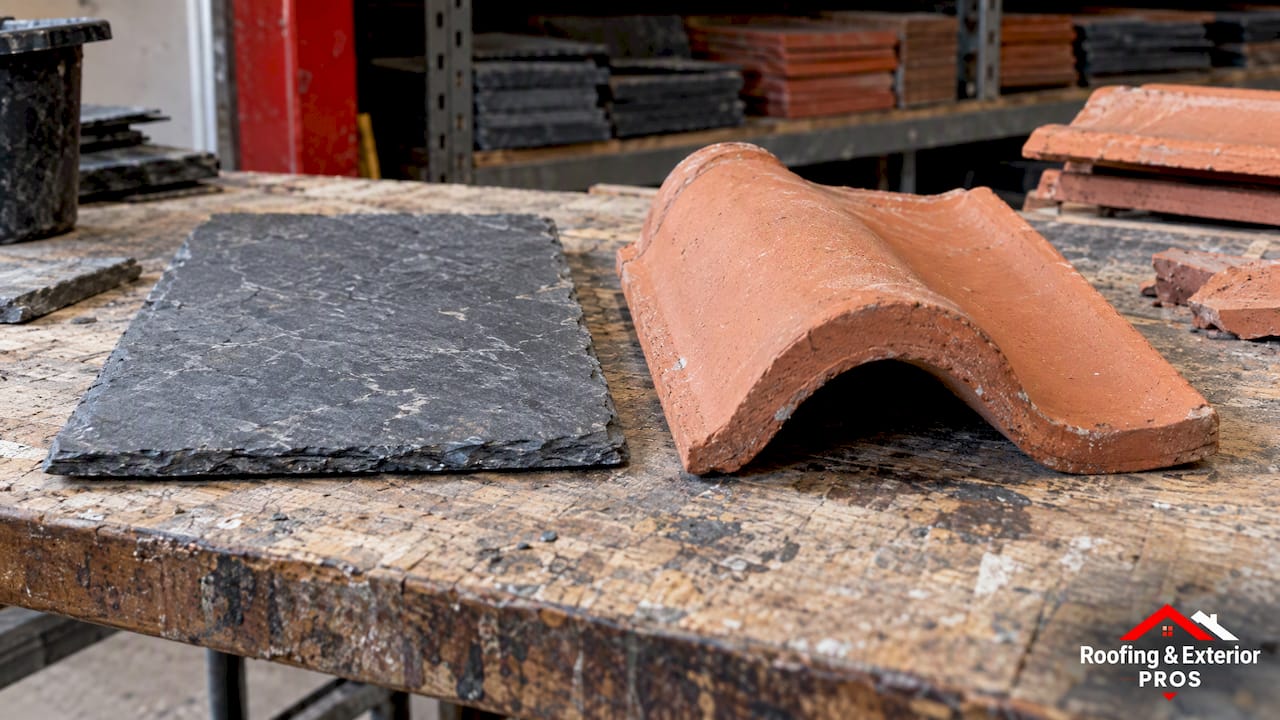
How to tell which you have. Slate is flat, thin and usually rectangular, with a slightly rough, stone-like surface and a muted gray, green, purple or black color. Tile is thicker, often curved or molded, and uniform in color. If your roof is old and you are not sure, a roofer can identify it in a few minutes from the ground and the attic.
Cost: what you will pay
Slate is the more expensive material in most comparisons. The 2025 cost guide above lists natural slate at $15 to $30 per square foot installed and tile at $12 to $21 per square foot. That guide was written for California, so treat the numbers as a national ballpark and not a St. Louis quote. Local labor, roof pitch, number of valleys, dormers and chimneys can move the total more than the material does.
Two things push either roof’s price up:
- Structural work. Heavy materials can mean reinforced framing, and that is billed on top of the roofing.
- Complexity. A simple gable is cheaper than a roof with hips, turrets and multiple penetrations, because every cut piece takes labor.
Both cost several times what asphalt shingles do, so the real question is how long you will own the house. For a deeper look at the cheaper end of the market, see our comparison of shingles vs metal roofing.
| Factor | Natural slate | Clay or concrete tile |
|---|---|---|
| Installed cost (one 2025 guide) | $15 to $30 per sq ft | $12 to $21 per sq ft |
| Typical lifespan | 60 to 100+ years | Clay averages about 46.7 years |
| Weight | Very heavy | Heavy |
| Minimum slope, Missouri 2018 code | 4:12 | 2.5:12 |
| Look | Refined, natural, muted colors | Wide range of colors and profiles |
| Repair | Individual slates can be replaced by a skilled slater | Individual tiles can be replaced, but broken tiles must be matched |
Lifespan and durability
On lifespan, slate generally wins. A roofing industry study on service life gives slate a mean service life that often reaches 60 to 100 years or more, against about 46.7 years for clay tile. Both far outlast asphalt shingles, which often last under 20 years.
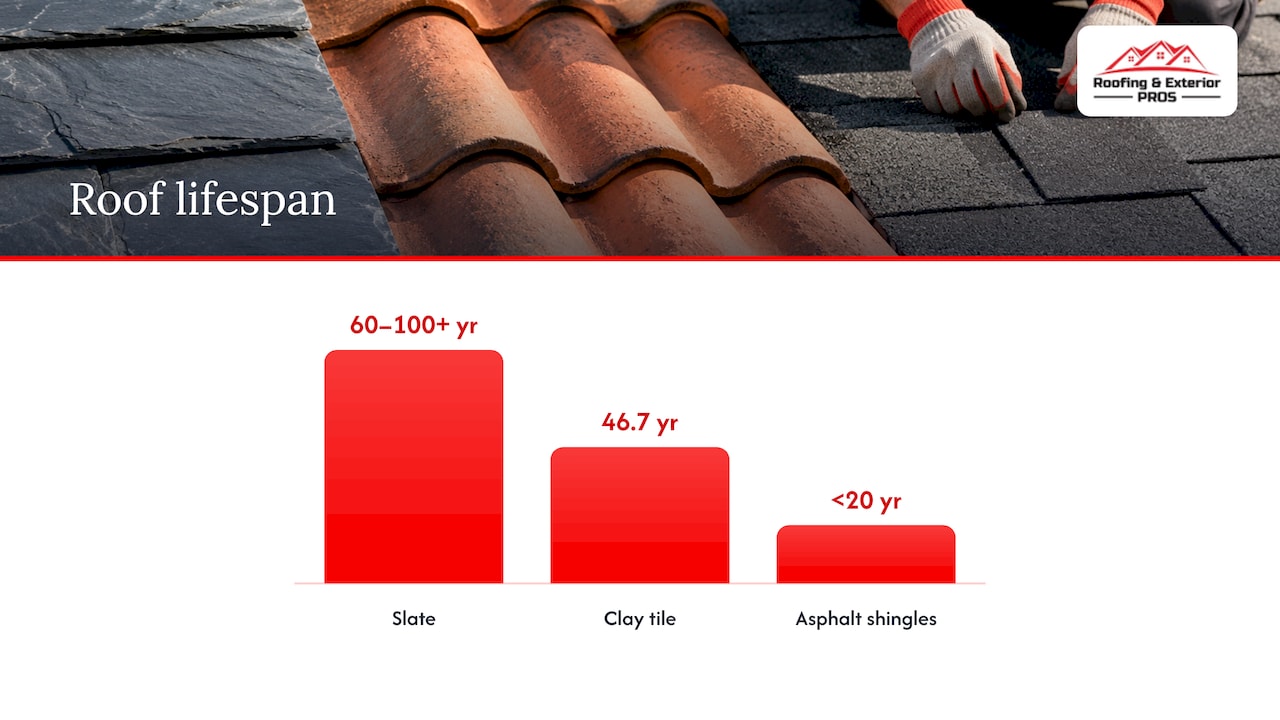
That figure comes with a caveat: slate durability depends heavily on the quarry and the installation. A cheap, soft slate with the wrong nails can fail early, while a good hard slate with copper or stainless fasteners can outlive the owner.
One point works in favor of slate owners. Slate roofs are often blamed for failure when the real culprit is the nails. The National Park Service describes this as nail sickness: the fasteners corrode while the slates themselves remain sound. Re-securing the existing slates with clips can cost far less than a full re-roof. If someone tells you your older slate roof is finished, get a second opinion from a roofer who works with slate before you sign for a tear-off. Our guide to repair or replacement walks through how to weigh that call.
Weight and your roof structure
Both materials are heavy, and that is the most common reason homeowners rule them out. The concern is real: a roof designed for asphalt shingles may not carry slate or tile without reinforcement, and a roofer or structural engineer should check the rafters and decking before anything is ordered.
Slate does have a workaround. North Country Slate markets a lightweight system that is real slate and up to 40% lighter than traditional slate, at under 6 pounds per square foot. For comparison, the same article notes that some architectural shingles weigh 4.5 pounds per square foot. Systems like this can bring slate within reach of roofs that could not take a traditional installation. It is one product from one manufacturer, so ask any installer for the actual installed weight of what they propose and have the framing checked against it.
Slope and Missouri code
The pitch of your roof limits your choices. Under the 2018 Missouri code provisions:
- Slate must go on solid sheathing, on slopes of 4:12 or greater, with at least two fasteners per slate.
- Clay and concrete tile need solid or spaced sheathing and generally a slope of 2.5:12 or greater. In high-wind conditions they may need special clips or head-fastening.
That gives tile the edge on lower-slope roofs, where slate is not permitted. Those provisions come from the International Building Code as published for Missouri. Residential work in St. Louis County, St. Charles County and individual cities such as Chesterfield, Ballwin or Wildwood is governed by locally adopted codes, so confirm requirements and permits with your municipality or have your contractor do it.
Looks and home style
Slate suits Tudor, Victorian, Gothic and Georgian homes, many of which you will see in neighborhoods like Ladue and across older parts of St. Louis. Its thin, flat profile and natural color variation give a roof a fine, layered texture that does not look like anything else.
Tile suits Mediterranean, Spanish Colonial and some Craftsman homes. Curves and terracotta tones give it a warm, bold look. On the wrong house, either one looks out of place, so match the material to the architecture. If you are still choosing between many materials, our residential roofing materials review and our 2026 guide to residential roofing material types compare the whole field.
Maintenance and repairs
Neither roof is maintenance-free. The National Park Service recommends treating slate as a long-term asset, with an annual visual inspection using binoculars or a drone rather than foot traffic. That catches slipped pieces and failed flashing before they cause rot or leaks inside the house. The same guidance says that if someone must walk on slate, they should hook a ladder over the ridge in preference to walking on the slates, because they crack easily.
The same logic applies to tile, which can crack underfoot. This is why a roofer who knows the material matters. A crew that routinely walks on an old slate roof to look at it can do more damage than the weather did. Flashing, valleys and chimney details usually fail before the slate or tile does, and those are repairs a good roofer can do without a re-roof.
Energy use and cool roofs
The Department of Energy’s cool roof guide says both slate and clay tile can be used in cool roof applications, with reflectivity depending on the mineral makeup or on glazes and surface treatments. It says that choosing a reflective material can reduce peak cooling demand by 10% to 15% compared with traditional dark, non-reflective roofing. In a St. Louis summer, that can matter, but the roof surface is only part of the picture. We have written about why attic ventilation and insulation often matter more than reflectance here.
Storms, hail and insurance
St. Louis gets hail and high winds, and heavy materials are not immune. Slate and tile can crack under large hail and when branches fall. Because individual pieces are expensive and sometimes hard to match, storm damage to a slate or tile roof can become a large claim.
The coverage on your policy matters a great deal here. According to the National Association of Insurance Commissioners, roof claims often distinguish between actual cash value (ACV) and replacement cost value (RCV). ACV deducts for the age and condition of the roof, which can leave a big gap for owners of older slate or tile roofs compared with RCV coverage. Read your policy before storm season, not after it. If you have a loss, our Missouri storm damage restoration guide explains what to document and what to expect, and your insurer or a licensed public adjuster can answer coverage questions specific to your policy.
Which should you choose?
Choose slate if:
- Your roof is steep (4:12 or more) and your home is traditional or historic.
- You plan to stay for decades and want the longest-lived roof available.
- You can afford the premium, or your home already has slate that should be repaired and not replaced.
Choose tile if:
- Your roof pitch is low, between 2.5:12 and 4:12.
- The home’s style is Mediterranean or Spanish, or you want a bolder color range.
- You want a long-lasting roof at a lower installed cost than slate.
Choose neither if you are likely to move within ten years, or if your framing cannot support the weight and reinforcement is not in the budget. Asphalt shingles or metal can be a better value, and our metal roof pros and cons guide covers that option honestly.
Our perspective
We are a local, family-owned company, and we see how these roofs hold up in our own service area. Our view is that the right roof starts with the house, not the brochure. Before we talk material, we want to know the pitch, the framing, the condition of the decking and how long you plan to live there.
Slate is a material we are glad to recommend where the house calls for it. It is on our roofing page alongside shingle, metal, wood shake and flat systems, and for the right steep-roof home it is hard to beat for longevity. But we also tell homeowners when a repair will do, when a lighter system makes more sense, and when an older slate roof only needs its fasteners and flashing addressed. A free inspection should give you information, not pressure.
Transparency matters most on the expensive jobs. Ask any contractor, us included, for the scope in writing, the material and its source, the plan for underlayment and flashing, and how the roof will be protected if rain comes mid-job.
— Jake Ehlinger
Get a slate roof assessment in St. Louis
If you are weighing slate for a new roof, or you have an older slate roof and want to know whether it needs repair or replacement, we can inspect it and give you a clear quote. See our roofing services for the materials we install, or visit our storm damage and emergency repair page if weather has already hit your roof. You can also start from our home page to request a free inspection and quote.
FAQ
Is slate roofing better than tile?
For lifespan and refinement, usually yes. Slate often reaches 60 to 100 years or more, while clay tile averages about 46.7 years. Tile can be the better choice on lower slopes, with more color options and a lower typical installed cost.
What is a drawback of a slate roof?
Cost and weight are the main drawbacks. Slate is among the most expensive residential roofing materials, and it may need structural reinforcement. It also cracks if walked on, and repairs require a roofer who knows how to work with it.
Is tile or slate more expensive?
Slate generally costs more. One 2025 guide lists slate at $15 to $30 per square foot installed and tile at $12 to $21, but the ranges overlap. Roof complexity and structural work can matter as much as the material.
How can I tell if my roof is tile or slate?
Slate is thin, flat and stone-like, in muted colors with natural variation. Tile is thicker, often curved or molded, and uniform in color. A roofer can confirm it quickly during an inspection.
Sources
- Cost guide: average cost to tear off and replace a roof (RoofingCalc)
- Service Life Predictability (Roofing Contractor)
- Missouri 2018 building code, Chapter 15 (UpCodes)
- Preservation Brief 29: Historic Slate Roofs (National Park Service)
- North Country Slate lightweight slate options (Roofing Contractor)
- Cool Roof Guide (U.S. Department of Energy)
- Replacement cost vs actual cash value (NAIC)