Cool roofs are worth considering for most St. Louis properties, but only as part of a bigger plan that includes attic insulation and proper ventilation. The single best next step is a roof and attic inspection paired with a local estimate, checked against Cool Roof Rating Council (CRRC) ratings and ENERGY STAR guidance before you commit to a product.
TL;DR:
- Cool roofs can reduce surface temperatures by up to 50°F compared to dark roofs, but their actual savings depend heavily on attic insulation and building type.
- Reflective coatings require recoating every 5 to 15 years, while long-lasting options like metal roofs can exceed 40 years with proper maintenance.
- The net annual cost savings from a cool roof are most significant for poorly insulated, hot-attic residential buildings or large commercial flat roofs needing cooling load reduction.
- Installing a cool roof without first improving insulation and ventilation often results in limited savings, making attic upgrades a critical first step.
- Cost varies depending on the roof type and scope; get a local estimate to compare coating and replacement options based on your property’s condition and intended lifespan.
Table of Contents
- What Is a Cool Roof St. Louis Homeowners Should Know About?
- Are Cool Roofs Worth It in St. Louis? Performance, Savings, and Neighborhood Benefits
- Cool Roof Options for St. Louis Homes and Businesses
- What Do Cool Roofs Cost, and How Long Do They Last?
- Incentives, Standards, and Local Programs for Cool Roofs in Missouri
- How to Decide if a Cool Roof Fits Your Property
- Local Perspective From Roofing & Exterior PROS
- How Roofing & Exterior PROS Helps You Evaluate a Cool Roof
- Sources
- FAQ
- A Local Take on the Cool Roof Hype
What Is a Cool Roof St. Louis Homeowners Should Know About?
A cool roof reflects more sunlight and releases absorbed heat faster than a standard roof. Two measurements define it: solar reflectance, which is how much sunlight bounces off the surface instead of soaking in, and thermal emittance, which is how quickly the roof releases the heat it absorbs. A dark asphalt shingle roof can hit 150°F or hotter on a July afternoon. A high-reflectance surface stays dramatically cooler, which means less heat radiates into your attic and, eventually, your living or working space.
St. Louis contractors typically work with four product families:
- Reflective coatings applied over existing flat or low-slope roofs
- Cool or reflective shingles engineered with light-colored or specialty granules
- Metal roofing with high-albedo factory finishes
- Single-ply membranes (TPO, PVC) manufactured with reflective surfaces
Each fits a different roof type and budget, which is why matching the product to the building matters more than chasing the highest reflectance number on a spec sheet.
Are Cool Roofs Worth It in St. Louis? Performance, Savings, and Neighborhood Benefits
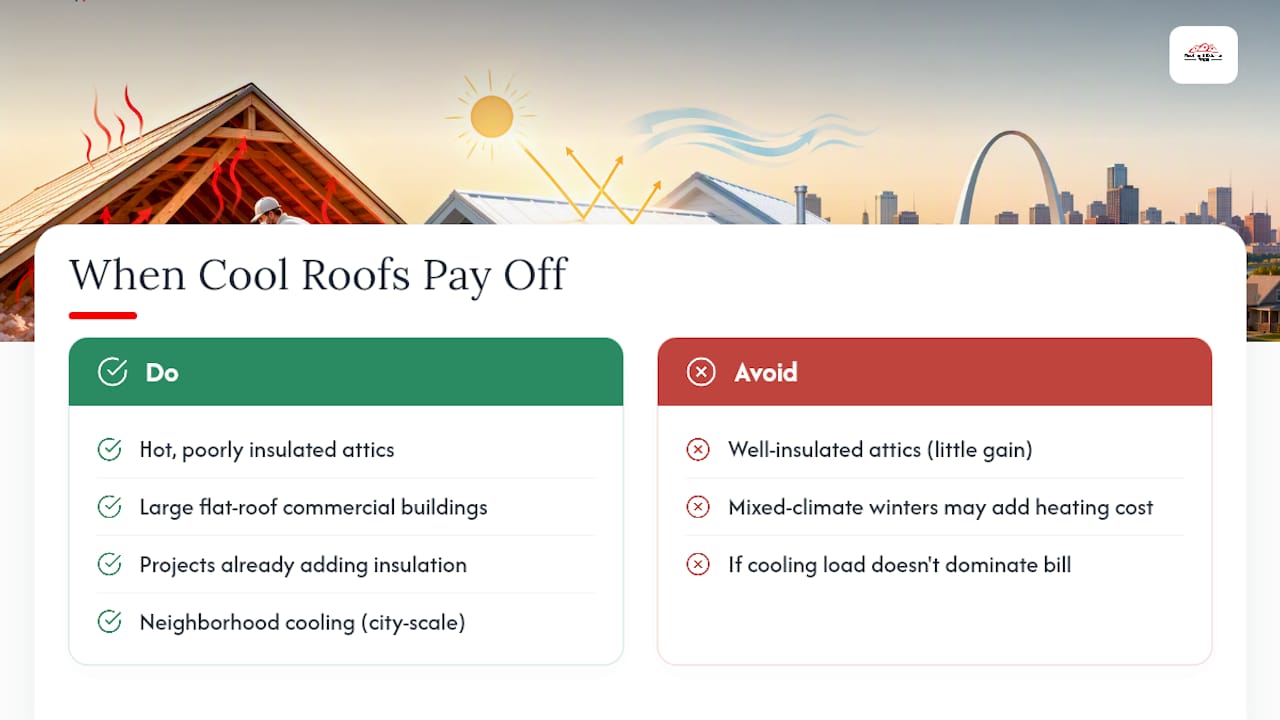
The honest answer depends on your building, not just your roof color. Local reporting on St. Louis’s urban heat has cited cool roof surfaces running as much as 50°F cooler than dark roofs on peak days, with cooling-cost reductions reported around 15% in some cases. That’s a meaningful cut to summer electric bills for a building with a hot, poorly insulated attic.
But St. Louis sits in a mixed climate, with cold, gray winters that complicate the math. A 2021 simulation study in the journal Energy modeled cool roof performance across U.S. climate zones and found that net annual savings depend heavily on insulation level, building type, and how the roof is attached. In a poorly insulated attic, a reflective roof can shave cooling costs in summer while adding slightly to heating costs in winter, sometimes leaving the net annual benefit small or inconsistent.
Insulation level changes the outcome more than roof color does. A well-insulated attic with a standard roof can outperform a poorly insulated attic with a premium reflective one.
That’s the nuance most marketing materials skip. Cool roofs make the most sense on hot-attic residential buildings with weak insulation, large flat-roof commercial buildings where cooling load dominates the energy bill, and any project already planning insulation upgrades. Beyond individual buildings, city-scale adoption also chips away at the urban heat island effect, which can lower ambient temperatures across a whole block, not just one rooftop.
Cool Roof Options for St. Louis Homes and Businesses
Picking the right product depends on your roof’s slope, current condition, and how long you plan to own the building.
- Reflective coatings work well as a retrofit on existing flat or low-slope roofs. They lower surface temperature at a fraction of replacement cost, but most acrylic and elastomeric coatings need recoating every several years and require careful surface prep to bond correctly.
- Cool or reflective shingles use specialty granules to boost solar reflectance while keeping the look of a standard shingle roof. They perform best on moderate slopes; very steep roofs see less benefit since sun exposure angles reduce the reflective advantage.
- Metal roofing with reflective finishes delivers the longest service life of any option here, often outlasting shingles by decades, though the upfront cost and the visual departure from traditional roofing styles give some homeowners pause.
- Single-ply membranes like TPO and PVC, along with coated commercial systems, remain the standard for low-slope commercial roofs and are usually installed with reflectance already built into the membrane, not added after the fact.
Homeowners weighing shingle types more broadly can compare residential roofing materials before narrowing down a cool roof option.
What Do Cool Roofs Cost, and How Long Do They Last?
Costs vary widely depending on whether you’re coating an existing roof or replacing it outright, so a local quote is the only way to get a real number for your building. That said, here’s what to expect in terms of lifespan and upkeep:
- Reflective coatings: often the lowest upfront cost, but expect to recoat every 5 to 15 years depending on the product and exposure.
- Cool shingles: comparable installed cost to standard architectural shingles, with a 20 to 30 year lifespan depending on the manufacturer and grade.
- Metal roofing with reflective finish: higher upfront investment, but a lifespan that regularly exceeds 40 years.
- Single-ply membranes: typically last 15 to 30 years depending on thickness and installation quality.
Maintenance for coated roofs means periodic inspection for cracking or wear at seams, with recoating scheduled before the surface degrades rather than after. Whatever the return on investment turns out to be, it hinges on your building type, existing insulation, and local energy rates, not the roof material alone.
Incentives, Standards, and Local Programs for Cool Roofs in Missouri
A handful of programs and standards are worth checking before you sign a contract:
- The IRS Residential Clean Energy Credit covers certain qualifying home energy improvements, and ENERGY STAR’s federal tax credit guidance explains which products and improvements typically qualify.
- Missouri’s Department of Natural Resources is administering IRA Home Energy Rebates funds, but the state has cautioned that rebates may not be publicly available until 2027 or 2028 at the earliest, so don’t count on this money for a near-term project.
- The City of St. Louis publishes a Cool or White Roof Program toolkit aimed at community and municipal building projects, useful background if you manage a nonprofit or public-facing property.
- Before buying any reflective product, verify its rating through the Cool Roof Rating Council, which maintains an independent product directory so you’re not relying on a manufacturer’s own claims.
How to Decide if a Cool Roof Fits Your Property
Work through these steps before signing anything:
- Check your attic insulation and air sealing first. If your attic’s R-value is below current recommendations, upgrade that before expecting big savings from a reflective roof alone.
- Inspect your existing roof’s condition and slope. A roof with years of life left might only need a reflective coating; a roof nearing replacement is a better candidate for cool shingles, metal, or a new membrane.
- Ask for a modeled savings estimate specific to your building. A contractor familiar with mixed-climate performance should be able to walk you through realistic expectations, not just a national average.
- Collect at least two local quotes that document CRRC and ENERGY STAR specs plus warranty terms, so you’re comparing apples to apples.
Pro Tip: Ask any contractor bidding your project how they handle ventilation fixes alongside the roofing work. A cool roof installed over a poorly ventilated attic leaves real savings on the table.
Also ask about warranty length, recoating schedules for coated systems, and whether they’ve handled insurance claims if your project follows storm damage.
Local Perspective From Roofing & Exterior PROS
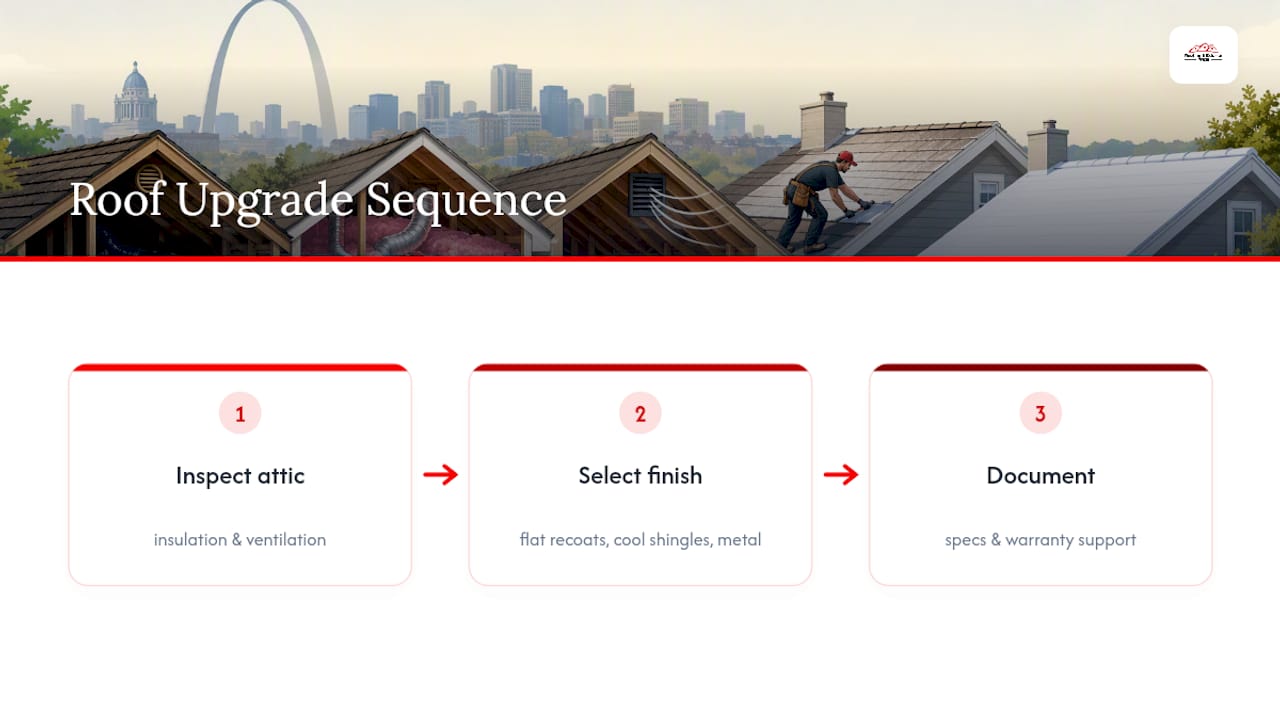
We evaluate attic insulation and ventilation before recommending any cool roof upgrade. We see the most requests for flat commercial recoats, residential cool shingles, and reflective metal finishes, always inspection first with documented specs and warranty support.
How Roofing & Exterior PROS Helps You Evaluate a Cool Roof
Roofing & Exterior PROS is the local alternative to guessing at national averages: we inspect your actual attic, roof, and building type before recommending a product, instead of quoting a one-size-fits-all reflective system.
A free inspection covers three things: attic insulation and air sealing, current roof condition and slope, and a realistic energy-saving estimate based on your building, not a national chart. Warranty terms for coatings, cool shingles, or reflective metal finishes are explained, and insurance claims paperwork can be handled if your project stems from storm damage. If you’re weighing a full replacement against a coating, our residential roofing services page covers material options in more depth. Ready to find out what a cool roof would actually save on your building? Request a free inspection and estimate from Roofing & Exterior PROS and get numbers specific to your roof, not a national average.
Sources
Check the CRRC product directory before buying, review ENERGY STAR’s federal tax credit guidance, confirm eligibility on the IRS Residential Clean Energy Credit page, and track Missouri’s rebate timeline through the DNR’s IRA Home Energy Rebates program. For deeper technical grounding, the MDPI mixed-climate simulation study is the most rigorous public research on this exact question.
- Cool Roofs in the US: The Impact of Roof Reflectivity, Insulation and Attachment Method on Annual Energy Cost (MDPI)
- Inflation Reduction Act (IRA) Home Energy Rebates Program | Missouri Department of Natural Resources
- Create A Cool Or White Roof Program
- Coolroofs
- Residential clean energy credit – IRS
FAQ
How Much Do Cool Roofs Cost?
Cost depends heavily on whether you’re coating an existing roof or installing new cool shingles, metal, or membrane. Coatings tend to run lower upfront but need recoating every 5 to 15 years, while shingle and metal replacements cost more initially but last decades longer. Get a local estimate from Roofing & Exterior PROS through our roofing services page for numbers specific to your building.
Are Cool Roof Shingles Worth It?
Cool shingles are worth it on hot-attic homes with moderate roof slopes and weak insulation, where summer cooling load dominates energy costs. In St. Louis’s mixed climate, the MDPI simulation study found that benefits shrink when insulation is already strong, so pair the shingle upgrade with an attic check first.
How Long Do Cool Roofs Last?
Lifespan varies by product: reflective coatings typically last 5 to 15 years between recoats, cool shingles run 20 to 30 years, single-ply membranes last 15 to 30 years, and metal roofing with reflective finishes often exceeds 40 years. Actual lifespan depends on installation quality and local weather exposure.
What Is the Average Cost to Replace a Roof in Missouri?
Replacement costs in Missouri vary by material, roof size, and whether the project includes upgrades like cool shingles or metal finishes. Free, no-obligation estimates are available to compare a standard replacement against cool roof options for your specific property.
A Local Take on the Cool Roof Hype
Most cool roof marketing treats reflectance like a magic number, the higher the better, and skips the part where insulation does more work than roof color in a climate like ours. St. Louis swings from humid, 95°F summers to icy winters, and that swing is exactly why the blanket advice you’ll find online doesn’t always hold up here. A reflective roof on a poorly insulated attic is still a poorly insulated attic with a lighter-colored lid.
The contrarian point worth making: chasing the highest CRRC rating before fixing insulation and ventilation is backwards. Fix the attic first, then let the roof material do the rest of the work. That order of operations is the difference between a roof upgrade that pays for itself and one that just looks good on a spec sheet. Building owners who skip straight to a premium reflective membrane without addressing airflow underneath it are paying for performance they may never fully collect.
— Jake Ehlinger