TL;DR:
- A roofing specification sheet is a detailed technical blueprint that defines all materials, methods, and standards for a roof project. It ensures consistent expectations among contractors, architects, and property owners, reducing costly mistakes and scope disputes. This document differentiates from product data sheets and quotes by coordinating material interactions and enforcing quality compliance through industry standards.
A roofing specification sheet is the definitive technical blueprint that outlines all materials, installation methods, and quality standards required before any roofing work begins. Known in the construction industry as a “roof spec,” this document governs every decision on a roofing project, from the grade of shingles to the fastening pattern for membrane attachment. Organizations like the Construction Specifications Institute (CSI) and testing bodies like ASTM International have built entire classification systems around these documents. Without a proper spec sheet, contractors, architects, and property owners are all working from different assumptions, and that gap is where costly mistakes happen.
What is a roofing specification sheet and what does it include?
A roofing specification sheet is the definitive technical blueprint that outlines all materials, installation methods, and quality standards before starting work. It typically covers roof covering types, flashing sequences, insulation R-values, and compliance with local building codes. Think of it as the contract between design intent and physical execution.
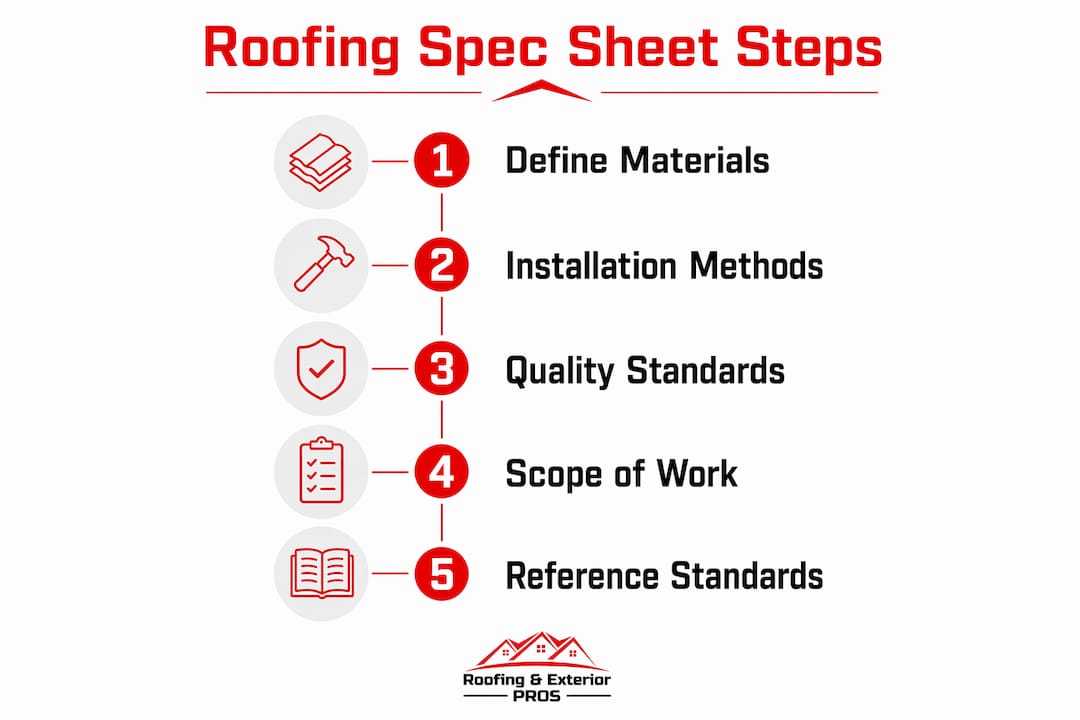
A complete roofing spec sheet addresses the following components:
- Roof covering type and grade: Specifies the exact product, manufacturer, and performance class. For example, a commercial project might call for a 60-mil TPO membrane from Carlisle SynTec, while a residential project might specify GAF Timberline HDZ architectural shingles.
- Underlayment and moisture barriers: Defines the type (felt, synthetic, or self-adhering), the application sequence, and overlap requirements to prevent water infiltration.
- Flashing materials and installation sequences: Covers metal type, gauge, and the order in which flashing is applied at valleys, penetrations, and wall intersections.
- Insulation R-values and ventilation design: States the required thermal resistance for the roof assembly and the ventilation ratio to prevent condensation and heat buildup.
- Fastening patterns and installation methods: Specifies nail type, spacing, and penetration depth. This detail directly affects wind uplift resistance.
- Warranty requirements: Documents both manufacturer product warranties and contractor workmanship warranties, including conditions that void coverage.
- Submittal requirements: Includes shop drawings, installer certifications, and mock-up review procedures to enforce quality control before full installation begins.
Pro Tip: Request the spec sheet before signing any roofing contract. If a contractor cannot produce one, that is a red flag. A legitimate roofing project specification protects you as much as it guides the crew.
The scope of work definition within the spec sheet is equally critical. It draws a clear boundary around what the contractor is responsible for, which prevents scope creep and mid-project disputes.

How does a spec sheet differ from product data sheets and quotes?
These three documents serve completely different purposes, and confusing them is one of the most common mistakes property owners make.
A Product Data Sheet (PDS) is a manufacturer-issued document focused on a single material’s performance metrics. It covers tensile strength, dry times, coverage rates, and compliance with standards like ASTM and ENERGY STAR. A PDS tells you what a product can do in isolation. It does not tell you how that product interacts with the other components on your specific roof.
A roofing quote is a pricing document. It lists labor and material costs but rarely specifies product grades, installation methods, or quality benchmarks. Two quotes can look identical in price while describing completely different levels of work.
A roofing project specification integrates everything. It defines how all materials work together, covering critical interfaces like flashing-to-membrane transitions, drain connections, and penetration seals that a PDS never addresses.
| Document | Primary focus | Covers installation method? | Covers material interactions? |
|---|---|---|---|
| Product Data Sheet (PDS) | Single material performance | No | No |
| Roofing quote | Pricing and scope summary | Rarely | No |
| Roofing spec sheet | Full project requirements | Yes | Yes |
The practical consequence of relying on a PDS alone is installation failure at critical interfaces. A project spec is the only document that coordinates all material interactions across the full roof assembly.
Pro Tip: When reviewing bids, ask each contractor to reference the same specification document. This is the only way to compare bids on equal terms. Without a shared spec, you are comparing apples to oranges.
What industry standards govern roofing specification sheets?
Roofing specifications do not exist in a vacuum. They reference established codes and testing standards that define minimum performance requirements.
CSI MasterFormat Division 07
CSI MasterFormat Division 07 covers thermal and moisture protection, which is the primary classification home for roofing work. Key sections include 07 50 00 for roofing membranes, 07 21 00 for insulation, and 07 62 00 for sheet metal flashing. Roofing is primarily codified under Division 07, but it connects to other divisions for plumbing and electrical components, which requires multi-disciplinary coordination across the project team.
ASTM, FM Global, and UL standards
Roofing specifications reference test standards from ASTM International, FM Global, and Underwriters Laboratories (UL) to define performance metrics. These include:
- Wind uplift ratings: FM Global approval ratings confirm a roof assembly can withstand specific wind pressures. This matters in St. Louis, where severe weather is a real risk.
- Fire resistance classifications: UL Class A, B, or C ratings define how well a roof resists fire spread. Most commercial projects require Class A.
- Solar reflectance: ENERGY STAR and the Cool Roof Rating Council (CRRC) provide metrics that affect energy code compliance.
Including these performance metrics in specs reduces long-term failures and confirms regulatory compliance. A spec that omits these references leaves the contractor free to substitute lower-performing materials without technically violating the contract.
Warranty language in the spec sheet also ties directly to these standards. A manufacturer warranty from GAF, Owens Corning, or Carlisle SynTec is only valid when installation follows the documented spec. Deviating from the spec voids coverage, which is a financial risk property owners often overlook.
Why is a roofing spec sheet critical for project planning?
A roof specification sheet acts as a risk-management tool by systematically evaluating substrate conditions, drainage, and thermal performance before material procurement. This front-loaded planning reduces moisture-related failures and costly mid-project corrections.
Here is where a solid spec sheet delivers the most value:
- Stakeholder alignment: Clear roofing specifications serve as communication tools aligning architects, owners, and contractors. Everyone references the same document, so there is no room for “I assumed” conversations during inspections.
- Dispute prevention at closeout: Transparent specs document performance requirements like wind uplift and fire resistance ratings upfront. When a dispute arises at project closeout, the spec sheet is the referee.
- Scope clarity and change order control: Ambiguities between supply and installation responsibilities commonly lead to mid-project change orders if not clarified in the spec. Materials like mechanical curbs, drainage components, and lightning protection must have clearly defined scopes to avoid cost overruns.
- Mock-up requirements: Specifications should require a job-site mock-up as standard practice. A mock-up confirms the finished roof meets aesthetic and functional expectations before full installation begins, reducing disagreements between architects, owners, and contractors.
- Code compliance documentation: A strong spec controls quality from start to finish and confirms compliance with local building codes and manufacturer warranty conditions.
Roof specs are integral to buildability, performance, and longevity, ensuring all construction partners work toward the same design intent. That alignment is not a luxury on large projects. It is the baseline for any project that needs to close on time and on budget.
For a deeper look at how these requirements translate to actual work on your home, the roofing scope of work guide from Roofing & Exterior PROS breaks down what homeowners should expect at each stage.
Key takeaways
A roofing specification sheet is the single most important document for aligning all project stakeholders, enforcing quality standards, and preventing costly disputes from bid through closeout.
| Point | Details |
|---|---|
| Core definition | A spec sheet defines materials, installation methods, and quality standards for the full roof assembly. |
| Not the same as a quote | Quotes cover pricing; spec sheets govern performance, materials, and installation requirements. |
| CSI Division 07 is the framework | Roofing specs follow CSI MasterFormat Division 07 for thermal and moisture protection classification. |
| Standards reduce risk | Referencing ASTM, FM Global, and UL ratings in the spec protects against material substitution and code violations. |
| Mock-ups prevent disputes | Requiring a job-site mock-up in the spec confirms quality expectations before full installation begins. |
Why I think most property owners underestimate the spec sheet
After working alongside roofing crews and project managers across dozens of residential and commercial jobs in the St. Louis area, I have seen the same pattern repeat itself. A property owner gets three bids, picks the middle price, and assumes the work will be comparable. It rarely is, because no one handed the contractors a shared specification document.
The spec sheet is not just a technical formality. It is the document that tells you whether the contractor bidding your job actually understands the scope. When I review a roofing project specification and see vague language around flashing sequences or missing references to ASTM standards, that tells me the spec was written to win a bid, not to build a roof.
The mock-up requirement is the piece I push hardest on. Most residential property owners have never heard of it, but on any project with a new material or a complex roof geometry, a mock-up saves real money. You find out before 10,000 square feet are installed whether the product looks and performs the way you expected.
The other thing I would tell any property owner: treat the spec as a living document. Products get discontinued. Lead times change. When a substitution is proposed, the spec should be the standard against which the substitute is evaluated, not a contractor’s verbal assurance that “it’s basically the same thing.”
If you are planning a roofing project and you do not have a spec sheet in hand, start there. Everything else, the bids, the timeline, the warranty, follows from that document.
— Jake
Get expert guidance on your next roofing project
Understanding a roofing specification sheet is the first step. Executing one correctly requires the right materials and an experienced crew who knows how to follow it.
At Roofing & Exterior PROS, we work closely with homeowners and commercial property owners across St. Louis, St. Charles, and O’Fallon to match the right materials to every project spec. Whether you are planning a full replacement or evaluating bids for a repair, our team brings the transparency and consistency you need to make confident decisions. Start with our residential roofing materials guide to understand your material options, or explore our roof installation process to see how specifications translate into real work. Contact us today for a free inspection and quote.
FAQ
What is a roofing specification sheet?
A roofing specification sheet is a technical document that defines all materials, installation methods, quality standards, and compliance requirements for a roofing project. It serves as the governing reference for contractors, architects, and property owners throughout the project.
What does a roofing spec sheet include?
A roofing spec sheet includes roof covering type and grade, underlayment requirements, flashing sequences, insulation R-values, fastening patterns, warranty conditions, and submittal requirements like installer certifications and mock-up reviews.
How does a roofing spec sheet differ from a product data sheet?
A product data sheet covers the performance metrics of a single material, such as tensile strength or coverage rate. A roofing spec sheet integrates all materials and defines how they work together across the full roof assembly.
What is CSI Division 07 in roofing?
CSI MasterFormat Division 07 covers thermal and moisture protection and is the primary classification for roofing work in construction documents. It includes sections for roofing membranes, insulation, and sheet metal flashing.
Why do roofing specifications reference ASTM standards?
ASTM standards define measurable performance benchmarks for wind uplift, fire resistance, and material durability. Including these references in a spec prevents material substitution and confirms the finished roof meets code and warranty requirements.