
TL;DR:
- A roofing square is a standard unit measuring 100 square feet of roof surface, crucial for estimating materials and costs. To calculate it, measure your home’s footprint, adjust for pitch and complexity, then add a waste factor before dividing by 100. Knowing your square count helps you compare contractor bids accurately and avoid budgeting surprises.
If you’ve ever gotten a roofing quote and seen the word “square” on the estimate, you may have wondered what it actually means. A roofing square is a standard unit of measurement used across the roofing industry, and understanding it can mean the difference between a well-planned project and a costly surprise. It has nothing to do with the shape of your roof. One roofing square equals 100 square feet of roof surface area, and that single definition drives how materials are ordered, how labor is priced, and how project budgets are built.
Table of Contents
- Key Takeaways
- What is a roofing square, exactly?
- How to calculate roofing squares
- Shingles, bundles, and how squares connect
- Roofing measurement terms you need to know
- Using roofing squares to budget and plan
- My honest take on roofing squares
- Let Roofing & Exterior PROS handle the numbers
- FAQ
Key Takeaways
| Point | Details |
|---|---|
| One square = 100 sq ft | A roofing square covers a 10-foot by 10-foot area, used industry-wide for pricing and materials. |
| Pitch changes your total | Roof slope increases actual surface area beyond your home’s footprint, affecting square count. |
| Bundles link to squares | Standard shingles need 3 bundles per square; architectural shingles may need 4 to 5. |
| Waste factor matters | Add 10 to 20% extra material depending on roof complexity to avoid shortages. |
| Squares drive contractor bids | Contractors price by squares, so knowing your count helps you compare quotes accurately. |
What is a roofing square, exactly?
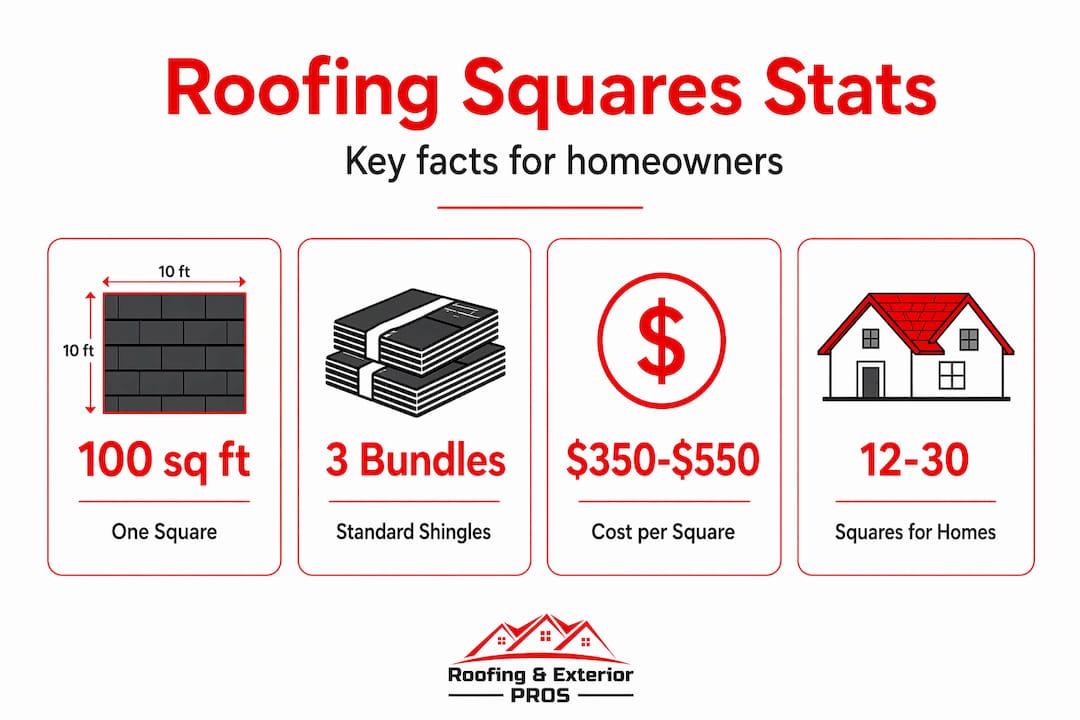
A roofing square is the roofing industry’s standard unit of measurement. One square equals 100 square feet, which you can picture as a 10-foot by 10-foot section of roof surface. Roofers, suppliers, and manufacturers all work in this unit because it simplifies pricing, material ordering, and project planning across every job size.
Here is where many homeowners get tripped up. Your roof’s square footage is not the same as your home’s floor plan footage. A 2,000 square foot house does not automatically have a 2,000 square foot roof. The actual roof surface area depends on your roof’s pitch (its slope) and its complexity. A steeply pitched or multi-faceted roof has significantly more surface area than a flat-looking footprint suggests.
The term “roofing square” is the recognized industry standard. You will sometimes hear it called simply a “square,” and that shorthand is used universally by contractors and suppliers. Here is a quick summary of how roofing squares show up in real projects:
- A 1,500 sq ft roof surface equals 15 squares
- A 2,000 sq ft roof surface equals 20 squares
- A 2,500 sq ft roof equals 25 squares, and all contractor pricing reflects that unit
- Roofing materials, from shingles to underlayment, are packaged and priced per square
- Labor charges are almost always quoted per square as well
Understanding the roofing square definition puts you on equal footing with any contractor walking through your job. You stop being a passive recipient of numbers and start being an informed decision-maker.
How to calculate roofing squares
Calculating your own roofing squares is not complicated, and doing it before you talk to a contractor gives you a solid baseline. Here is a practical, step-by-step method most homeowners can follow safely.
- Measure your home’s footprint. Standing on the ground, measure the length and width of your house, including any overhangs. Multiply those numbers to get the base square footage. For a house that is 40 feet wide and 50 feet long, that is 2,000 square feet.
- Account for roof pitch. Your roof’s actual surface area is larger than its footprint because of slope. A low-pitch roof (4:12 pitch) adds roughly 7% more area. A steeper pitch (8:12) adds about 20% more. A very steep roof (12:12) can add 40% or more.
- Calculate total roof surface area. Multiply your base footprint by the pitch factor. For a 2,000 sq ft footprint with a moderate 6:12 pitch (factor of 1.12), your roof surface is approximately 2,240 square feet.
- Divide by 100. That 2,240 sq ft roof equals 22.4 squares. Always round up to the nearest full square when ordering materials.
- Add a waste factor. Simple gable roofs need about 10% extra, hip roofs around 15%, and complex roofs with multiple valleys or dormers require 20% or more. Tack that percentage onto your square count before ordering.
- Verify with a roofing square calculator. Several online tools let you plug in dimensions and pitch to cross-check your math. Accurate calculations reduce waste and keep your project on schedule.
Pro Tip: Never measure your roof from the rooftop unless you have proper safety equipment and experience. Ground measurements combined with a pitch factor give you a reliable estimate without the risk.
Roof pitch and complexity are consistently underestimated by homeowners. Adjusting your calculations for pitch prevents the uncomfortable surprise of running short on materials mid-installation. If you are unsure about your pitch, a roofing contractor can measure it quickly with an inclinometer or pitch gauge.
Shingles, bundles, and how squares connect
Once you know your square count, you can figure out exactly how much material to buy. Shingles are sold in bundles, and the number of bundles per square depends on the shingle type.
| Shingle Type | Bundles per Square | Coverage per Bundle |
|---|---|---|
| Standard 3-tab asphalt | 3 bundles | ~33.3 sq ft |
| Architectural (dimensional) | 4 to 5 bundles | ~25 to 33 sq ft |
| Heavier premium shingles | 5+ bundles | Varies by product |
Standard 3-tab shingles need 3 bundles per square, with each bundle covering approximately 33.3 square feet. Architectural shingles, which are thicker and more durable, typically require 4 to 5 bundles per square depending on the manufacturer’s specifications.
This distinction matters for your budget. If you price a job based on 3-tab bundle counts and then switch to architectural shingles, your material cost goes up noticeably. Always confirm bundle coverage with your supplier before finalizing your order.
The consequences of getting this wrong run in both directions. Ordering without correct square calculations leads to either costly overages (leftover materials you paid for) or shortages that stall your project and often cost more to resolve in a rush. Matching your order precisely to your square count, plus the appropriate waste factor, keeps both outcomes off the table.
Pro Tip: Buy your materials from a single production run when possible. Shingles from different batches can vary slightly in color, and that variation becomes visible once they are installed.
For projects involving commercial roofing, square counts get larger and material planning becomes even more critical. A 10,000 square foot commercial roof is 100 squares, and even a 5% ordering error means five full squares of wasted material or missing coverage.
Roofing measurement terms you need to know
When you review a contractor’s quote or plan a roofing project, you will encounter several terms that all relate back to roofing squares. Knowing these terms helps you read estimates accurately and ask the right questions.
- Square footage vs. roof area. Square footage usually refers to your home’s floor plan. Roof area is the actual surface your contractor will cover, accounting for pitch and overhangs. These numbers are rarely the same.
- Roof pitch. Pitch describes the slope of your roof as a ratio of vertical rise to horizontal run, such as 6:12. Higher pitch means more surface area and more material per square foot of floor plan.
- Waste factor. This is the percentage of extra material you add to account for cuts, overlaps, and irregular shapes. As noted, waste factor ranges from 10 to 20% depending on roof complexity.
- Roof footprint. The top-down view of your home’s outline. Contractors start here and apply pitch multipliers to arrive at true roof area.
- Bundle. The retail unit for shingles, with multiple bundles making up one square.
Roofing terms like these are critical for understanding how your project will be scoped and priced. When you know what a contractor means by “waste factor” or “pitch adjustment,” you can evaluate whether their estimate is realistic or inflated.
Contractors price jobs by squares rather than raw square footage specifically to standardize costs across different roof shapes and complexities. A quote given in squares is easier to compare between multiple bids because it already accounts for slope and material needs. If a contractor quotes only in square feet without noting pitch or waste, that is a red flag worth asking about.
Using roofing squares to budget and plan
Knowing your square count transforms an abstract roofing project into a concrete budget. Here is what typical residential roofs look like when translated into squares, along with general cost ranges using asphalt shingles.
| Roof Size (sq ft) | Squares | Est. Material + Labor Cost |
|---|---|---|
| 1,200 sq ft | 12 squares | $4,200 to $6,600 |
| 1,800 sq ft | 18 squares | $6,300 to $9,900 |
| 2,500 sq ft | 25 squares | $8,750 to $13,750 |
| 3,200 sq ft | 32 squares | $11,200 to $17,600 |
These figures are based on asphalt shingle costs ranging from $350 to $550 per square including labor, which is the industry standard range for most residential projects in 2026. Metal roofing costs more per square, but the unit of measurement stays the same.
When you compare contractor bids, ask each one to break down the quote by square. A contractor who quotes $14,000 on a 25-square roof is charging $560 per square. That number is easy to compare against a competing bid of $13,500 ($540 per square) or $15,000 ($600 per square). Without the square breakdown, you are comparing lump sums that could reflect very different scopes of work.
Understanding squares improves your ability to spot both low-ball bids (which may cut corners on waste factor or underlayment) and inflated ones. Before you prepare for a roof replacement, having your own square count done gives you a number to verify against every quote you receive.
My honest take on roofing squares
I have worked on roofing projects of every size, and I can tell you that the single most common source of budget problems is not material costs or labor rates. It is a misunderstood square count. I have seen homeowners hand a contractor the deed to their house (practically speaking) because they had no idea how many squares their roof was. They had no way to know whether the bid was fair.
What I’ve learned is this: the roofing square is a simple concept, but its implications run deep. A miscalculation of just three squares on a 25-square roof means you are either short roughly 300 square feet of shingles or you’ve ordered $1,000 to $1,650 worth of excess material. Neither outcome is acceptable when it’s preventable.
My honest advice is to do your own ground-level calculation before the first contractor arrives. It takes 20 minutes and a tape measure. When the contractor presents their square count, you now have a basis for conversation rather than blind acceptance. If your numbers differ significantly, ask why. A good contractor will explain exactly where the difference comes from, whether it is pitch, waste factor, or additional layers of underlayment.
The homeowners who have the smoothest roofing projects are almost always the ones who showed up prepared. Knowing what a roofing square means and how many squares your roof has is the foundation of that preparation.
— Jake
Let Roofing & Exterior PROS handle the numbers
At Roofing & Exterior PROS, we measure every roof with precision before we give you a single number. Our team has served homeowners and business owners across the St. Louis metropolitan area for years, and accurate square calculations are where every project starts.

Whether you need a full residential or commercial roof installation, a repair, or a storm damage assessment, we walk you through the measurement process with full transparency. You will know exactly how many squares your roof is, what materials we recommend, and why the estimate is what it is. No surprises. We also offer free roof inspections so you can get a professional square count without any obligation. Contact Roofing & Exterior PROS today to schedule yours and start your project with confidence.
FAQ
What does a roofing square mean in simple terms?
A roofing square equals 100 square feet of roof surface area, equivalent to a 10-foot by 10-foot section. It is the standard unit contractors and manufacturers use for pricing and material estimation.
How many bundles of shingles do I need per square?
Standard 3-tab asphalt shingles require 3 bundles per square, with each bundle covering about 33.3 square feet. Architectural shingles typically need 4 to 5 bundles per square depending on the product.
Why do roofers price jobs by squares instead of square feet?
Contractors use squares to standardize costs and material quantities across roofs with different pitches and shapes. Pricing per square makes bids easier to compare and ensures pitch adjustments are already factored in.
How do I calculate roofing squares for my home?
Measure your home’s footprint, multiply by a pitch factor to get total roof surface area, then divide by 100. Add a waste factor of 10 to 20% depending on roof complexity before ordering materials.
What is a typical waste factor when calculating roofing squares?
Simple gable roofs need about 10% extra material, hip roofs around 15%, and complex roofs with dormers or multiple valleys require 20% or more to account for cuts and overlaps.