
TL;DR:
- A roofing cost estimate is an itemized document detailing materials, labor, permits, warranties, and contingencies to ensure transparency. Homeowners should compare detailed line items across bids, verifying scope, warranty, and hidden costs to avoid surprises. A thorough estimate fosters accountability and helps identify contractors who provide honest, comprehensive proposals.
A roofing cost estimate is a detailed financial document that itemizes every material, labor charge, permit fee, and warranty detail involved in your roofing project. Most homeowners receive a number and assume that is the full picture. It is not. Understanding how roofing cost estimates are structured gives you the power to compare bids fairly, spot contractors cutting corners, and avoid surprise charges once work begins. At Roofing & Exterior PROS, we believe a transparent estimate is the foundation of every successful project.
How roofing cost estimates are structured: the standard sections
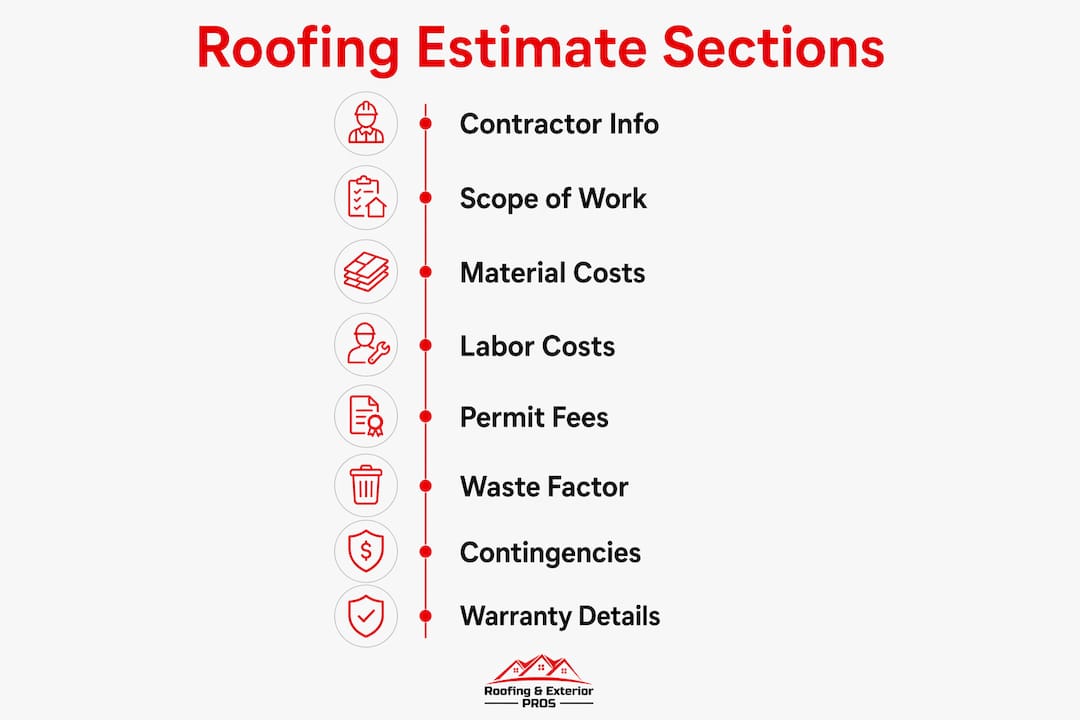
A legitimate roofing estimate is not a single number on a page. Professional estimates contain 8 to 10 distinct sections and typically run 4 to 8 pages. A one-line lump sum total is one of the clearest red flags in the industry. Each section serves a specific purpose, and knowing what belongs in each one lets you hold any contractor accountable.
Here are the sections you should expect to see in every professional roofing estimate:
- Contractor information. Full legal business name, physical address, license number, and proof of liability and workers’ compensation insurance. If this section is missing, stop reading and call the next contractor.
- Scope of work. A detailed description of every task: tear-off of existing layers, decking inspection, underlayment installation, flashing replacement, ridge cap, ventilation, and final cleanup. Vague language like “install new roof” is not acceptable.
- Material specifications. Manufacturer name, product line, color, and quantity for every material. For asphalt shingles, this means the brand (such as GAF, Owens Corning, or CertainTeed), the shingle series, and the exact square footage ordered.
- Warranty details. Both the manufacturer’s material warranty and the contractor’s workmanship warranty, with specific durations. A GAF Timberline HDZ shingle carries a lifetime limited warranty, but only when installed by a certified contractor.
- Payment schedule. A breakdown of when payments are due and in what amounts. Legitimate contractors do not require full payment upfront.
- Project timeline. Start date, estimated completion, and any conditions that could affect scheduling such as weather or material lead times.
- Permit fees. Listed as a separate line item, not buried in overhead costs.
- Dumpster and disposal fees. Separate from labor, covering debris removal and haul-away.
- Decking replacement allowance. A pre-defined per-sheet rate for replacing damaged decking discovered after tear-off.
- Price validity period and signatures. The date the estimate expires and signatures from both parties.
Pro Tip: Ask every contractor to walk you through their estimate section by section before you sign. Any contractor who resists that conversation is telling you something important.
How contractors calculate labor and material costs
The roofing estimate breakdown for labor and materials follows a consistent formula, though regional pricing and roof complexity create real variation. Understanding the math helps you recognize when a number is reasonable and when it is not.

Roofing contractors price work in roofing squares, where one square equals 100 square feet of roof surface. A standard 2,200 square foot home typically has a roof surface of 22 to 28 squares depending on pitch and overhang. For a standard asphalt shingle replacement, material costs run $120 to $175 per square and labor runs $150 to $500 per square, with materials accounting for 30 to 50 percent of the total budget and labor representing 35 to 45 percent.
One cost element that surprises many homeowners is the waste factor. Waste factors of 10 to 20 percent are standard practice, added to the raw square footage to account for cuts at hips, valleys, and starter rows. This is not padding. It reflects real material consumption on any roof with angles, dormers, or complex geometry.
Tear-off labor typically adds $1 to $2 per square foot as a separate line item from installation labor. Contractors who embed tear-off costs into a single labor total make it harder for you to compare bids accurately. Roof pitch also affects labor pricing. A steep 10/12 pitch roof requires safety equipment, slower work pace, and more physical effort than a low-slope 4/12 pitch, and that difference should appear explicitly in the estimate.
| Cost component | Typical range per square | Notes |
|---|---|---|
| Asphalt shingle materials | $120 to $175 | Varies by brand and shingle grade |
| Labor (installation) | $150 to $500 | Higher for steep or complex roofs |
| Tear-off labor | $100 to $200 | Should be a separate line item |
| Waste factor addition | 10 to 20% of material cost | Standard industry practice |
| Underlayment and accessories | $30 to $60 | Felt, ice and water shield, ridge vent |
Pro Tip: Ask your contractor to show you the square footage calculation and the waste percentage they applied. Any reputable contractor will have this documented and will explain it without hesitation.
What additional costs and contingencies belong in estimates
Beyond materials and labor, a thorough roofing project cost analysis includes several line items that less experienced contractors routinely omit. These omissions are not minor. They often account for hundreds or even thousands of dollars that appear as surprise charges after work begins.
Here is what every estimate should include as separate, clearly labeled line items:
- Permit fees. Permit fees range from $100 to $500 depending on your municipality. In the St. Louis area, permit requirements vary by county and city. A contractor who skips the permit to save you money is exposing you to code violations, failed inspections, and potential insurance claim denials.
- Dumpster and disposal fees. Debris removal typically adds $400 to $600 to the total. Some contractors include this in overhead, which hides the true cost and makes comparison harder.
- Decking replacement allowance. Decking is priced per sheet, often around $75 per sheet, as an allowance in the estimate. The actual condition of your decking is only visible after tear-off, so this allowance sets a transparent rate before work begins rather than negotiating mid-project.
- Flashing replacement. Chimney, pipe boot, and valley flashing are frequently omitted from low-bid estimates. Replacing flashing is not optional on a full roof replacement.
- Ventilation upgrades. If your attic ventilation does not meet current building codes, the contractor is required to bring it into compliance. This cost belongs in the estimate, not as a change order.
A roofing estimate is a project baseline, not a fixed-price contract. Hidden damage can alter final pricing, which is exactly why the decking allowance and contingency language matter. A well-written estimate defines the rate for contingency work upfront, so you are never negotiating from a position of surprise. You can also review roof decking water damage signs before your project starts to get a realistic sense of what your contractor may find.
How should homeowners compare roofing estimates side by side?
Comparing roofing bids line by line rather than by total price is the only reliable method for an apples-to-apples evaluation. The lowest total price almost always reflects an incomplete scope, not a better deal. Understanding roofing quotes means reading every line, not just the bottom number.
Use this comparison framework when evaluating bids:
| Evaluation point | What to look for | Red flag |
|---|---|---|
| Scope of work detail | Every task listed explicitly | Vague phrases like “install roof” |
| Material specifications | Brand, product line, and quantity | Generic terms like “3-tab shingles” |
| Permit fees | Listed as a separate line item | Absent or bundled into overhead |
| Warranty terms | Manufacturer and workmanship durations | No workmanship warranty offered |
| Payment schedule | Staged payments tied to milestones | Large deposit required upfront |
| Price validity | 30 to 90 days minimum | “Today only” pricing |
Price validity periods should be at least 30 to 90 days on any legitimate estimate. A contractor who tells you the price is only good today is using a pressure tactic, not reflecting real material cost volatility. Walk away from that conversation.
When one estimate includes flashing replacement and another does not, add the cost of flashing to the lower bid before comparing totals. The same applies to missing permit fees or disposal costs. Adjusting for missing line items gives you the true cost of each proposal. Our roof estimate comparison checklist walks you through this process step by step so nothing gets overlooked.
Obtain at least three bids for any roof replacement. Verify that each contractor carries current liability insurance and a valid state roofing license. Check their workmanship warranty length. A contractor offering a two-year workmanship warranty versus one offering ten years is not equivalent, even if their material specs match.
Pro Tip: If a bid arrives as a single-page document with one total price and no line items, do not negotiate. Request a fully itemized estimate or move to the next contractor. A detailed estimate protects you as much as it protects the contractor.
Key takeaways
A roofing estimate’s value lies entirely in its detail. Itemized line items, transparent contingency pricing, and verified contractor credentials separate a trustworthy bid from a liability.
| Point | Details |
|---|---|
| Estimates have 8 to 10 sections | Expect contractor info, scope, materials, warranty, payment, permits, and decking allowance. |
| Materials and labor split the budget | Materials run 30 to 50% of total cost; labor accounts for 35 to 45%. |
| Waste factor is legitimate | A 10 to 20% waste addition covers real material use on cuts and overlaps. |
| Compare line items, not totals | Adjust for missing items before comparing bids to get a true cost picture. |
| Contingency pricing prevents disputes | A pre-defined decking rate protects both parties from mid-project surprises. |
What I’ve learned from years of roofing estimates
After working with homeowners across the St. Louis area on hundreds of roofing projects, the pattern I see most often is this: homeowners focus on the total price and skip the details. That single habit costs people money every time.
The most expensive roofing projects I have seen were not the ones with the highest initial bids. They were the ones where a low-bid contractor omitted permit fees, skipped flashing replacement, and had no decking allowance in the contract. When the decking turned out to be water damaged, the homeowner had no agreed rate to reference. The contractor named a number, and the homeowner had no leverage.
Transparency in estimates is not a courtesy. It is a professional obligation. When a contractor hands you a detailed, itemized document, they are telling you they have nothing to hide. When they hand you a one-page total, they are telling you the opposite.
I also want to address the “today-only” pricing tactic directly. Rejecting estimates that demand large upfront deposits or use pressure pricing is not being difficult. It is being smart. Legitimate contractors give you time to review, compare, and ask questions. That is what we do at Roofing & Exterior PROS, and it is what every reputable contractor should do.
Ask tough questions. Ask why a line item is missing. Ask what the workmanship warranty covers specifically. Ask what happens if more decking damage is found. The answers tell you everything you need to know about who you are hiring.
— Jake
Get a transparent, itemized estimate from Roofing & Exterior PROS
At Roofing & Exterior PROS, we provide fully itemized estimates that cover every section described in this article, from material specifications to decking allowances and permit fees. We work closely with homeowners throughout the St. Louis metropolitan area to make sure you understand every line before you sign anything.

If you are preparing for a roof replacement, our guide on preparing for roof replacement walks you through exactly what to expect from the first inspection through project completion. When you are ready to evaluate bids, our roofing estimate comparison guide gives you a structured method to review every proposal you receive. Contact Roofing & Exterior PROS today for a free inspection and a detailed, no-pressure estimate on your roofing project.
FAQ
What should a roofing estimate include?
A professional roofing estimate should include contractor licensing and insurance information, a detailed scope of work, material specifications by brand and quantity, warranty terms, a payment schedule, permit fees, disposal costs, and a decking replacement allowance. Estimates typically run 4 to 8 pages and contain 8 to 10 distinct sections.
What is a roofing square and why does it matter?
A roofing square equals 100 square feet of roof surface and is the standard unit contractors use to calculate both material quantities and labor costs. All pricing in a roofing estimate, from shingle costs to tear-off labor, is based on this measurement.
Why do roofing estimates include a waste factor?
Waste factors of 10 to 20 percent are added to the measured square footage to account for material cuts at hips, valleys, ridges, and starter rows. This is standard industry practice, not overcharging.
How many roofing bids should I get?
Obtain at least three bids and compare them line by line rather than by total price. The lowest bid frequently omits critical work such as flashing replacement, permit fees, or disposal costs, which appear as additional charges once the project starts.
What is a decking replacement allowance?
A decking replacement allowance is a pre-agreed per-sheet rate, often around $75 per sheet, included in the estimate to cover damaged decking discovered after tear-off. It prevents surprise change orders by setting a transparent rate before work begins.