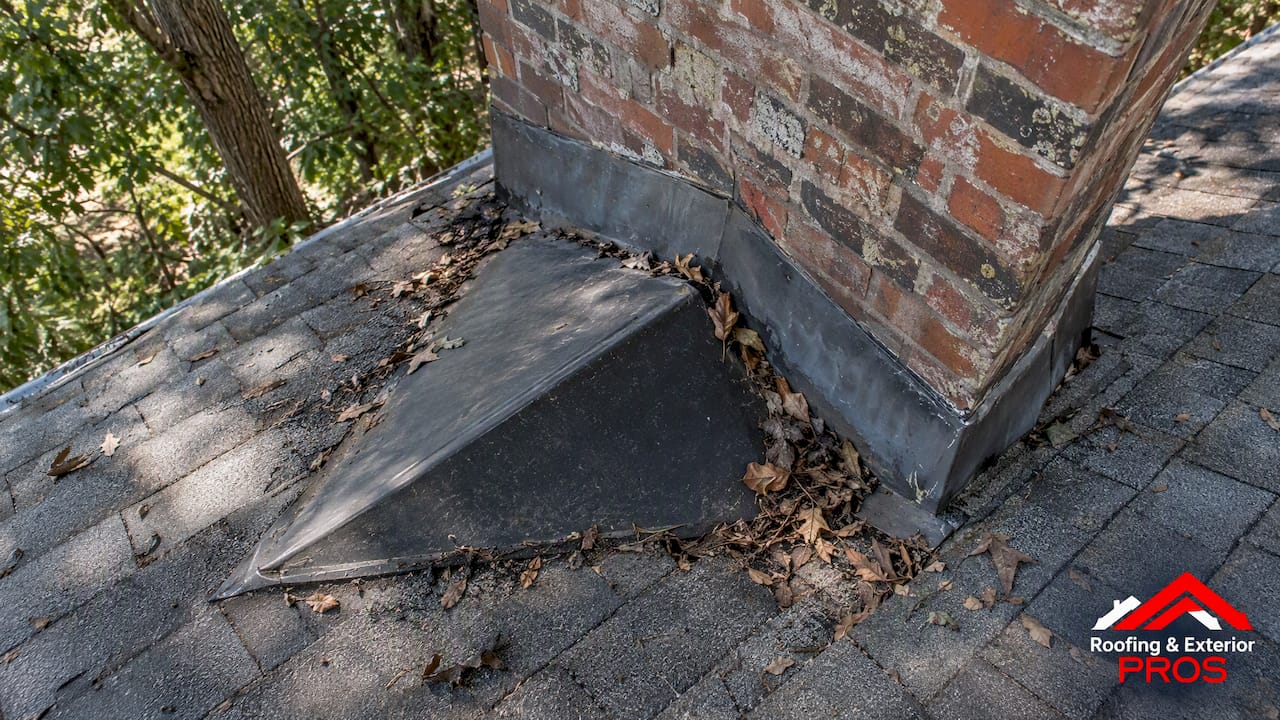
If your chimney is wider than 30 inches measured parallel to the ridge, and it does not sit on the ridge, the model building code calls for a cricket on its uphill side. A cricket (also called a saddle) is a small peaked section of roof that sheds water and debris around the chimney instead of letting it pile up behind it. Below, we explain the rule, how big the cricket has to be, what the local St. Louis-area codes say, and how to handle a cricket during a re-roof or an insurance claim.
TL;DR
- The International Residential Code (IRC) requires a cricket when the chimney’s width parallel to the ridge is greater than 30 inches and the chimney does not intersect the ridgeline.
- Cricket size depends on roof pitch. On a 12:12 roof the cricket height is half the chimney width. On a 3:12 roof it is one-eighth.
- St. Louis City, St. Louis County and St. Charles County each adopt and amend their own code editions, so confirm the rules with your local building office before work starts.
- Adding a cricket during a full roof replacement costs far less than retrofitting one later. Ask every contractor for a cricket plan in writing.
Table of Contents
- What the code actually says
- How big does the cricket have to be?
- What local codes say in the St. Louis area
- Do you need a permit to add a cricket?
- Why a cricket matters beyond the code
- Adding a cricket during a re-roof vs. retrofitting later
- Chimney crickets and storm damage insurance claims
- Our perspective on chimney crickets
- Get your chimney checked before you replace the roof
- FAQ
- Sources
What the code actually says
The language most building departments rely on is IRC section R1003.20. It states that chimneys must have crickets where the dimension parallel to the ridgeline is greater than 30 inches (762 mm) and the chimney does not intersect the ridgeline. Two conditions have to be true at once:
- The chimney is wider than 30 inches on the side that faces up the slope.
- The chimney does not straddle the ridge.
A chimney that rises right through the ridge sheds water to both sides on its own, so it does not need a cricket. A chimney on the slope, a foot or more below the ridge, is the typical case that does. The water running down the roof hits the wide uphill face of the masonry and has nowhere to go but sideways, slowly, if at all.
The code also says how the cricket meets the roof. The cricket and the chimney get flashed so that water leaves the intersection, and the cricket covering has to be a material that suits the roof. Roofing manufacturers publish their own guidance too. GAF’s guide to chimney crickets notes minimum dimensions for the cricket and flashing, and it is worth reading alongside the code before you meet a roofer.
What about chimneys under 30 inches?
Below the threshold, the code does not require a cricket. Many roofers still like one on a chimney that is close to 30 inches, or on any roof with heavy tree cover, because leaves and debris collect behind the chimney quickly. Some local officials and contractors use slightly different cutoffs. Treat the 30-inch figure as the model code’s line, then check what your own jurisdiction enforces.
How big does the cricket have to be?
Cricket size is not one fixed number. It is a ratio between the cricket height (H) and the chimney width (W), and it changes with roof pitch. The steeper the roof, the taller the cricket needs to be. The IRC table, as published by UpCodes, reads like this:
| Roof slope | Cricket height (H) as a share of chimney width (W) |
|---|---|
| 12:12 | 1/2 of W |
| 8:12 | 1/3 of W |
| 6:12 | 1/4 of W |
| 4:12 | 1/6 of W |
| 3:12 | 1/8 of W |
Here is a worked example. Say your chimney is 36 inches wide on the uphill side and your roof is a 6:12 pitch, which is common on older St. Louis brick homes. The cricket height is one-quarter of 36 inches, so 9 inches. On a steeper 12:12 roof, the same chimney would need an 18-inch-high cricket. That is why a detailed roof plan matters: the roofer cannot guess the cricket size without measuring both the chimney and the pitch.
The model code also says the cricket and chimney intersection must be flashed and counterflashed, and that the cricket valleys need metal or an approved underlayment. In practice, that usually means step flashing on the sides, a saddle flashing at the peak of the cricket, and counterflashing set into the masonry mortar joints. Sealant alone is not flashing.

What local codes say in the St. Louis area
The St. Louis region does not run on a single code. Each jurisdiction adopts a building code edition and amends it. That affects what an inspector will look for.
- City of St. Louis: the city adopted the 2018 International Residential Code through Ordinance 70795, with amendments.
- St. Louis County: the county publishes plan checklists. One of its residential guides, for room additions, tells applicants to show and label cricket construction where the chimney side parallel to the roof ridge is more than 30 inches. That checklist cites the 2015 IRC as amended by county ordinance, so check the county’s current edition.
- St. Charles County: the county adopted the 2021 St. Charles County Building Code with local amendments, most recently updated by ordinance in December 2025.
- Municipalities: cities such as Florissant, Chesterfield, Wildwood, Ballwin and others can have their own permit processes. Florissant’s residential roofing guide says a building permit is required for all residential and commercial roofing and re-roofing there.
The 30-inch trigger has been in the model code for several editions, so you can expect it across the region. What changes is how the building office reviews and enforces it, and the exact edition. Call the building division in your city before you sign a contract. If you want more background on how this plays out in practice, we wrote about how building codes affect roof repairs in St. Louis.
Do you need a permit to add a cricket?
A cricket changes the roof framing, so it is not the same as patching a few shingles. In the City of St. Louis, normal building maintenance does not require a permit in most instances, but a permit is needed for structural change or major alteration. The city’s guidance for roofs says a permit applies when you are installing an entire new roof that is not a like-for-like replacement, or when more than 25% of the roof sheathing is removed and replaced.
On a typical re-roof with a cricket, the cricket is part of the permitted scope. We recommend the cricket appear on the plans or scope of work submitted with the permit application. In the county and in the suburbs the thresholds can differ, and some towns require a permit for every re-roof. Our guide to which St. Louis roofs need permits goes through the 25% sheathing and 4:12 slope questions in more detail.
If you are replacing an entire roof, St. Louis County also publishes a re-roofing checklist that is useful to read before you collect bids.
Why a cricket matters beyond the code
The code sets a floor. The real reason to build a cricket is that the chimney is one of the most common leak points on a roof. Water runs down the slope, stops at the wide wall of the chimney, and collects. Leaves, pine needles and ice add to the problem. Flashing alone on a wide chimney is under constant pressure from standing water, and the sealant and the metal eventually give way.
The usual results are:
- Rotted decking behind the chimney
- Stained ceilings and walls near the fireplace
- Wet insulation and attic framing
- Repeated repairs at the same spot, because the cause (the pooling) was never fixed
Manufacturers say the same. IKO’s explanation of roof crickets points out that not every building code in North America requires one, but most specify a saddle on wider chimneys. Whether or not your inspector asks for it, a wide chimney with no cricket is a leak waiting to happen.
Adding a cricket during a re-roof vs. retrofitting later
Timing makes a big difference in cost. When the old shingles are already off, the crew can frame the cricket, sheathe it, and flash it as part of the roof system. After a new roof is finished, a cricket means removing good roofing around the chimney, framing the cricket, and re-flashing. Labor goes up, and you are paying for roofing material twice in that area.
If you are planning a replacement, take these steps:
- Measure the chimney. Check the width on the side that faces up the roof. Anything over 30 inches, not at the ridge, needs a cricket under the model code.
- Know your roof pitch. A roofer measures this in seconds. It decides the cricket height.
- Ask for a written cricket plan. The estimate should show the cricket’s dimensions, materials and flashing method, not just a line that says “flash chimney.”
- Check the permit scope. Ask who pulls the permit and whether the cricket is listed on the application.
- Plan the chimney masonry. If the mortar joints are crumbling, counterflashing will not hold. Masonry repair may need to happen first.
Our residential roof replacement guide and roof installation process page show where the cricket fits in the overall job.
Chimney crickets and storm damage insurance claims
Many cricket conversations start after a hailstorm or windstorm. If your roof is being replaced under a claim and the chimney is over 30 inches wide with no cricket, the cricket becomes a code question as well as a roofing one. Whether your carrier pays for code-required work depends on your policy, so ask your agent whether it includes coverage for code upgrades, and ask in writing.
What we suggest to homeowners:
- Photograph the chimney, the roof around it, and any staining or rot in the attic before work begins.
- Measure the uphill width of the chimney and note it in the estimate.
- Have your roofer list the cricket as its own line item, with measurements, so the adjuster can see exactly what is being requested and why.
- Keep the correspondence about code requirements together with the claim file.
For a look at how another contractor group frames documenting and preparing for storm damage, see this storm preparation guide for Morris and Somerset County, New Jersey homes. It is written for New Jersey, so use it for the general approach to documentation, and follow Missouri and St. Louis-area rules for your own claim. We also cover the steps in our guides to what homeowners should do with a roof insurance claim and how to file a roof claim after storm damage.
Our perspective on chimney crickets
We are a family-owned roofing company, and chimney leaks are among the calls we hear most. Our view is simple: a cricket is not an upsell. On a wide chimney it is part of building the roof correctly.
We tell homeowners to treat it as a required repair component in a storm restoration, not an optional extra. If the chimney is over the 30-inch threshold, we want it written into the scope from day one, so the roof you get is built to current code and the cricket is not a surprise on the invoice.
We also encourage you to ask every roofer, us included, to show you the cricket plan during the estimate. A contractor who understands water management can tell you the cricket height, the flashing sequence and the materials without hesitating. One who says flashing and sealant will be enough on a wide chimney is a reason to keep shopping. If you are comparing bids, our guides on choosing a St. Louis roof replacement contractor and selecting a reputable local roofer list what to ask.
And please do not wait. Adding a cricket while the roof is open is far cheaper than cutting into a finished roof later.
— Jake Ehlinger
Get your chimney checked before you replace the roof
If you are in the St. Louis area and are not sure whether your chimney needs a cricket, we will measure it, check the pitch and put the details in a written estimate. We handle residential and commercial roofing, and when storms are involved we also provide storm damage restoration and 24/7 emergency repairs, including tarping and help with insurance claims. Reach out through roofingandexteriorpros.com to schedule a free inspection and quote.
FAQ
What size chimney requires a cricket?
Under the model IRC, any chimney wider than 30 inches measured parallel to the ridge that does not intersect the ridgeline needs one. If your chimney sits right at the ridge, it does not. Measure the face that points up the slope, since that is the side where water collects.
Is a chimney cricket required by code in St. Louis?
The City of St. Louis follows the 2018 IRC with amendments, and St. Louis County’s published plan checklist calls for cricket construction on chimneys more than 30 inches wide. St. Charles County uses its own 2021 building code. Because each jurisdiction amends its code, call your local building division to confirm what applies to your address.
Can I add a cricket to an existing roof without replacing it?
Yes, but it is more expensive. The roofer has to remove shingles and underlayment around the chimney, frame and sheathe the cricket, then re-flash and re-shingle. Doing it as part of a replacement avoids tearing out good material.
Does the cricket need a permit?
It depends on the job and the municipality. In the City of St. Louis, a permit applies to a full new roof that is not like-for-like or where more than 25% of the sheathing is replaced, and the cricket should be on the submitted scope. Many suburbs require a permit for every re-roof, so ask your building office before work starts.
Will insurance pay for a cricket after storm damage?
It depends on your policy and the adjuster’s review. If the chimney needs a cricket to meet current code, list it as a separate, measured line item and ask your carrier in writing whether code-upgrade work is covered.
Sources
- IRC R1003.20 Chimney Crickets, ICC
- R1003.20 Chimney Crickets, UpCodes
- City of St. Louis Ordinance 70795, 2018 IRC
- When a Residential Building Permit is Needed, City of St. Louis
- Residential Room Additions Building Permit Requirements, St. Louis County
- Re-Roofing Checklist, St. Louis County
- Article II Building Code, St. Charles County
- Florissant Residential Roofing Guide
- How Chimney Crickets Support a Healthy Roof, GAF
- Why is a Roof Cricket Recommended for Chimneys?, IKO