TL;DR:
- Verifying local licensing, active insurance, and obtaining consistent, detailed references is crucial when selecting a reputable roofer in Missouri. Homeowners should request three comprehensive quotes, check credentials directly with local authorities, and avoid signing contracts with storm-chaser contractors who pressure for quick decisions. Building a trusted relationship relies on thorough vetting, direct reference checks, and confirming active coverage before project commencement.
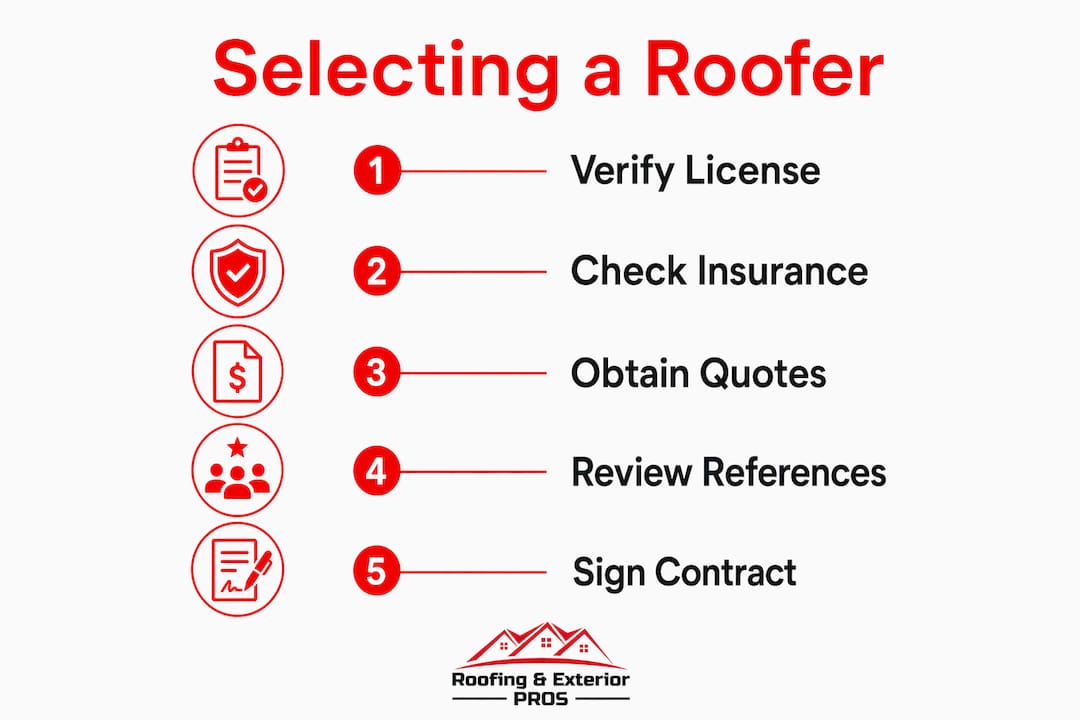
Selecting a reputable local roofer means verifying active licensing, current insurance, documented references, and written warranty terms before any contract is signed. In St. Louis and across Missouri, the roofing contractor market includes both highly qualified professionals and unvetted operators, so the difference between a sound roof and a costly mistake often comes down to how thoroughly you screen your contractor. This guide gives you a practical, St. Louis-specific framework for finding trusted roofing professionals, covering local licensing rules, quote comparison, reputation checks, and the pitfalls that catch homeowners off guard.
How to select a reputable local roofer: licensing and insurance in Missouri
Missouri does not issue a statewide general contractor license. Licensing is managed locally, at the city and county level, which means a roofer working in St. Louis City must be registered there, while a contractor operating in St. Charles County needs separate verification in that jurisdiction. This is the single most misunderstood aspect of hiring a roofer in this region, and it catches homeowners off guard more often than any other issue.
To verify a contractor’s registration in St. Louis, contact the city’s Building Division or your county’s building department directly. Ask whether the contractor holds an active roofing or home improvement registration and whether any complaints or violations are on file. This call takes five minutes and eliminates a significant category of risk.
On the insurance side, two policies are non-negotiable. Workers’ compensation covers any laborer injured on your property, and liability insurance protects your home if the crew causes structural or property damage. Without both, you as the homeowner can be held financially responsible for accidents that occur on your roof.
Pro Tip: Request a Certificate of Insurance before any work begins, then call the insurance provider directly to confirm the policy is active and covers roofing operations. A certificate alone is not enough. Active policy verification during the project lifecycle is the only reliable protection against expired or mismatched coverage.
| Credential | What to verify | How to check |
|---|---|---|
| Local registration | Active city or county roofing license | Contact local building department |
| Workers’ compensation | Active policy covering roofing labor | Call insurer directly |
| Liability insurance | Minimum $1M coverage for property damage | Request certificate and verify with insurer |
| Bonding | Surety bond protecting against incomplete work | Ask contractor for bond documentation |
What should a roofing quote include?
Getting at least three written estimates is the baseline standard for any roofing project, whether you need a full replacement or targeted storm damage repairs. A single quote gives you no context for pricing, scope, or quality. Three quotes reveal the range and help you identify outliers in either direction.
A quality roofing estimate covers more than a price. Before signing anything, confirm that each quote includes the following:
- Scope of work: A specific description of what will be removed, replaced, or repaired, including the roofing material type, brand, and product line.
- Project timeline: Start and estimated completion dates, with a note on how weather delays are handled.
- Workmanship warranty: The contractor’s own guarantee on labor, typically ranging from one to ten years.
- Manufacturer warranty: The material warranty from the shingle or roofing product manufacturer, which can range from 20 years to limited lifetime coverage depending on the product tier.
- Payment schedule: A clear breakdown of deposit, progress payments, and final payment tied to project milestones, not arbitrary dates.
- Permit responsibility: Confirmation of which party pulls the required building permits.
- Cleanup and disposal: Written confirmation that the contractor handles debris removal and site cleanup.
Homeowners frequently confuse workmanship warranties with manufacturer warranties, treating them as interchangeable. They are not. Workmanship and manufacturer warranties cover entirely different failure modes. A manufacturer warranty covers defective shingles. A workmanship warranty covers installation errors. If a contractor installs premium shingles incorrectly and your roof leaks, the manufacturer warranty will not apply. Only the contractor’s workmanship warranty does, and only if it is documented in writing.
Pro Tip: When comparing quotes, create a side-by-side table with each contractor’s name, total price, workmanship warranty length, manufacturer warranty tier, and permit responsibility. This format makes it immediately clear which proposals are genuinely comparable and which are cutting corners on coverage. You can also review roofing estimate components to understand what each line item should include.
| Quote element | What to look for | Red flag |
|---|---|---|
| Workmanship warranty | 5 years or more in writing | Verbal only or less than 1 year |
| Manufacturer warranty | 30-year or lifetime shingle tier | No mention of product brand or tier |
| Payment terms | Milestone-based schedule | Large upfront deposit over 30% |
| Permit responsibility | Contractor pulls permits | Homeowner asked to pull permits |
How do you verify a roofer’s reputation?
References provide stronger assurance than online reviews because they give you direct access to a homeowner who experienced the full project cycle. Ask every contractor you are seriously considering for at least three references from projects completed in the past 12 months. Then call those references and ask specific questions: Did the crew finish on time? Did the final cost match the estimate? Were there any issues, and how did the contractor handle them?
Online reviews on platforms like Google, Houzz, and the Better Business Bureau are useful for initial screening, but they require critical reading. Look for patterns across multiple reviews rather than reacting to individual five-star or one-star outliers. A contractor with 80 reviews averaging 4.6 stars tells you more than one with 6 reviews averaging 5.0. Pay attention to how the company responds to negative reviews. A professional, solution-oriented response signals accountability.
The Better Business Bureau is particularly useful for uncovering complaint history. Search the contractor’s business name and check both the rating and the complaint detail section. A low rating or unresolved complaints about incomplete work, billing disputes, or warranty denials are concrete warning signs.
Here is a checklist of trusted verification sources and what to look for with each:
- Local building department: Confirm active registration and check for permit violations or stop-work orders.
- Better Business Bureau (BBB): Review complaint history, resolution records, and accreditation status.
- Google Reviews: Look for volume, recency, and response patterns from the contractor.
- Houzz or Angi: Cross-reference ratings and read project-specific feedback.
- Direct references: Contact past customers and ask targeted questions about budget, timeline, and satisfaction.
- Vetted-match services: Platforms that validate contractors via license, insurance, and BBB history before referral add a pre-screening layer.
Reputability is not just about positive reviews. It is about verifiable, documented proof of consistent performance across multiple projects and customers.
Common mistakes homeowners make when hiring roofers
The most expensive roofing mistake St. Louis homeowners make is hiring based on price alone. A low bid often signals reduced material quality, an unlicensed crew, or missing insurance coverage. Hiring uninsured or unlicensed contractors exposes you to direct financial liability if a worker is injured on your property or if the work fails and you have no warranty recourse.
Storm-chaser contractors are a specific risk in the St. Louis area, where severe weather events regularly bring out-of-state crews looking for quick insurance claim work. These contractors often pressure homeowners to sign contracts on the spot, before a proper inspection or estimate comparison is possible. A reputable contractor will never require a same-day signature.
“The biggest failure mode we see is homeowners who accepted a Certificate of Insurance at face value without confirming the policy was active and matched roofing operations. By the time a claim arises, the coverage has lapsed or excludes the work performed.”
Verifying insurance at the moment of contract signing, not just at the initial meeting, is critical. Policies can lapse between your first conversation and the project start date. Confirm active coverage with the insurer directly, every time.
Pro Tip: Keep a project file with copies of the signed contract, Certificate of Insurance, permit documentation, and all written communications. If a dispute arises months after project completion, this documentation is your only leverage. Also review how local building codes affect your project before work begins, since permit requirements vary by municipality in the St. Louis metro area.
Key takeaways
Selecting a reputable roofing contractor in St. Louis requires verifying local licensing, active insurance, written warranties, and direct references before signing any contract.
| Point | Details |
|---|---|
| Verify local licensing | Missouri has no statewide license; check city or county registration directly with the building department. |
| Confirm active insurance | Request a Certificate of Insurance and call the insurer to confirm workers’ comp and liability are current. |
| Get three written quotes | Compare scope, warranty terms, payment schedules, and permit responsibility across all proposals. |
| Check references directly | Call at least three past customers and ask specific questions about budget, timeline, and issue resolution. |
| Avoid storm-chaser pressure | Never sign a contract on the spot; reputable contractors allow time for proper review and comparison. |
Why I trust references over reviews every time
I have spent years watching homeowners make the same avoidable mistake: they read a handful of five-star Google reviews, feel reassured, and skip the reference call. Online reviews are useful for filtering out obvious problems, but they are a starting point, not a conclusion. A contractor can accumulate strong reviews on straightforward jobs and still mishandle a complex storm damage restoration or a full replacement with multiple penetrations.
When I talk to homeowners who had bad experiences, the pattern is almost always the same. They did not call references. They did not verify insurance beyond accepting a certificate. And they did not read the warranty language carefully enough to understand what was actually covered.
Missouri’s local licensing structure makes this even more consequential. Because there is no single statewide database to check, verifying contractor credentials requires real effort. You have to make phone calls. You have to ask direct questions. That extra step is exactly what separates homeowners who get a quality roof from those who spend years dealing with leaks and warranty disputes.
My honest recommendation: treat the reference call as non-negotiable. Ask the past customer whether they would hire the contractor again without hesitation. That single question tells you more than any star rating.
— Jake
How Roofing & Exterior PROS makes the process easier for St. Louis homeowners

At Roofing & Exterior PROS, we are a local, family-owned team serving St. Louis, St. Charles, and O’Fallon with residential and commercial roofing services built on transparency and documented quality. Every project starts with a free inspection and a detailed written estimate that covers scope, materials, warranty terms, and payment schedule. We carry active workers’ compensation and liability insurance, and we are registered with local building departments across the St. Louis metro area. If you are ready to work with a contractor who meets every standard covered in this guide, visit Roofing & Exterior PROS to schedule your free estimate today.
FAQ
Does Missouri require a statewide roofing license?
Missouri does not have a statewide general contractor license. Licensing is handled at the city and county level, so you must verify registration with your local building department before hiring any roofing contractor.
What insurance should a roofer carry?
Every roofing contractor should carry active workers’ compensation and liability insurance. Workers’ comp protects laborers injured on your property, and liability insurance covers damage the crew causes to your home.
How many quotes should I get for a roofing project?
Get at least three written quotes from separate contractors. Multiple estimates give you a realistic price range and allow you to compare scope, warranty terms, and payment structures side by side.
What is the difference between a workmanship warranty and a manufacturer warranty?
A workmanship warranty covers installation errors by the contractor and typically ranges from one to ten years. A manufacturer warranty covers defective roofing materials and can range from 20 years to a limited lifetime, depending on the product.
How do I spot a storm-chaser contractor in St. Louis?
Storm-chaser contractors typically arrive unsolicited after severe weather, pressure you to sign a contract immediately, and may lack local registration. A reputable contractor will always allow time for you to verify credentials and compare estimates before committing.