
TL;DR:
- Understanding and complying with building codes for roof repairs in St. Louis are crucial to avoid costly surprises and ensure project success.
- Permits are often required for significant work, and code compliance can expand the scope of repairs beyond initial estimates, affecting costs and timelines.
- Working with a knowledgeable contractor who manages permit processes and understands local regulations provides protection and peace of mind.
Most St. Louis homeowners assume a roof repair is just a contractor, some shingles, and a few hours of work. The reality is that understanding how building codes affect roof repairs can mean the difference between a smooth project and a costly compliance surprise. Local building code regulations determine what permits you need, which materials are acceptable, how the work gets inspected, and sometimes how much more work actually needs to be done. This article walks you through exactly what to expect, from permit fees to inspection stages, so you can plan your project with confidence.
Table of Contents
- Key takeaways
- St. Louis permitting basics for roof work
- How codes change the scope of your repair
- How permit rules differ across the St. Louis metro
- Real costs and timelines tied to code compliance
- My take on navigating codes for roof repairs
- How Roofing & Exterior PROS handles code compliance for you
- FAQ
Key takeaways
| Point | Details |
|---|---|
| Permits are often required | Roof replacements and many repairs in St. Louis require a permit before work begins. |
| Codes expand repair scope | When a permit is triggered, current building codes apply and may require material or structural upgrades. |
| Jurisdiction rules vary | Permit triggers and enforcement differ across St. Louis city and surrounding municipalities. |
| Compliance adds real costs | Permit fees, inspection stages, and code-required upgrades all affect your final project budget. |
| Insurance gaps are common | Standard homeowner policies rarely cover code upgrade costs, so plan for that expense separately. |
St. Louis permitting basics for roof work
When you schedule a roof repair or replacement in St. Louis, the first question to answer is whether your project requires a permit. The short answer for most significant work: yes. St. Louis roof replacements are subject to strict plan review and high inspection standards under the city’s adopted building code framework. The city enforces the 2015 International Building Code with state amendments, which means inspectors take compliance seriously and plan reviews are thorough.
The cost to get started is relatively straightforward. A typical reroof permit fee runs about $145, and that covers the permit itself. Inspections are separate steps in the process, and you should expect multiple site visits before your project is officially closed out.
Here is what typically triggers a permit requirement for roofing work in St. Louis:
- Full roof replacements, including tear-offs and recovers
- Any work that involves replacing or repairing the roof deck or sheathing
- Structural repairs to rafters or framing members underneath the roof surface
- Re-roofing projects where new material is layered over existing shingles
- Significant repairs that go beyond patching a few isolated shingles
Cosmetic repairs, like replacing a handful of damaged shingles after a hailstorm without touching the deck, may not require a permit. But the line between “minor repair” and “permit-required work” is not always obvious. Permit requirements apply not only when structural members are involved but also when roof deck replacement or re-sheathing is needed.
Pro Tip: Before any contractor starts work on your roof, call your local building department or have your contractor confirm whether a permit is required. Starting without one can result in stop-work orders, fines, and difficulty selling your home later.
How codes change the scope of your repair
This is where many homeowners get caught off guard. When a permit is required, the work must comply with the building codes that are current at the time of the permit, not the codes that were in effect when your home was originally built. Code compliance applies when permits are needed, and that can meaningfully expand what your contractor is required to do.
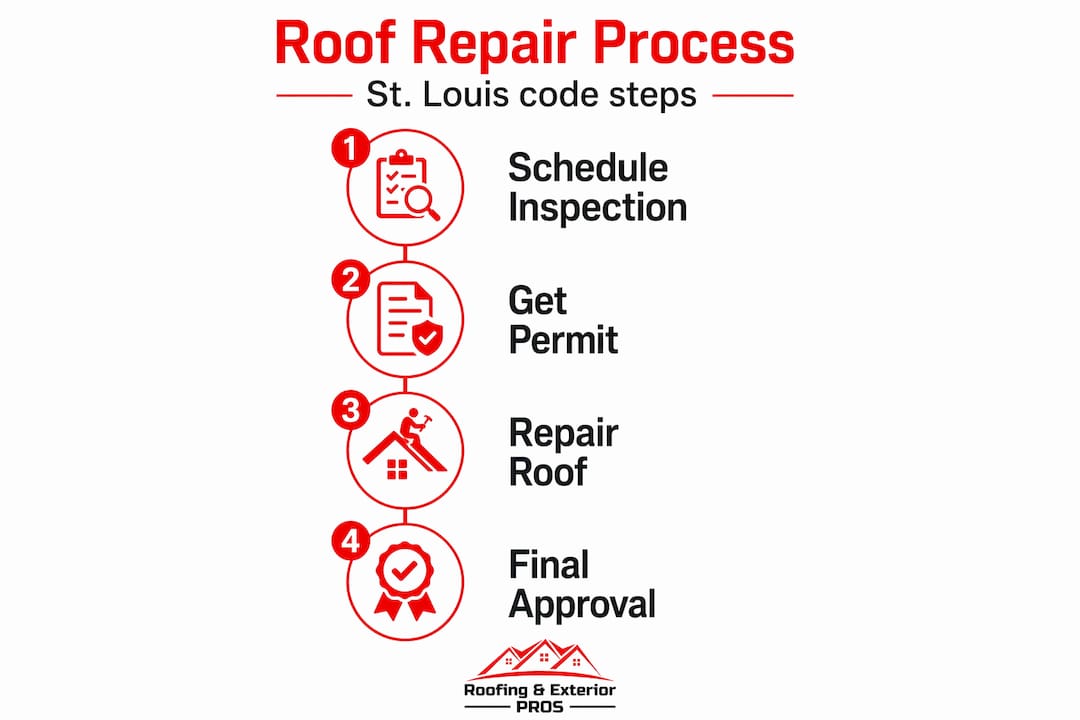
Here is a practical sequence of how this plays out on a typical St. Louis roof project:
- You schedule a full roof replacement. Your contractor pulls a permit, which triggers current code compliance requirements.
- The deck gets inspected. If sections of the roof deck are deteriorated, they must be replaced to current standards before new material goes on top.
- Underlayment and ice and water shield requirements apply. IRC code sections R905.2, R908, and R803 regulate underlayment and layering rules, including where ice and water shield is required along eaves and in valleys.
- Fastening patterns are checked. Current codes specify nail type, spacing, and penetration depth. If your contractor uses the wrong fastening pattern, the inspector will catch it.
- Structural elements get reviewed. If the inspector or contractor discovers damaged rafters or framing, structural changes require permits and current-code compliant repairs before the project can proceed.
- Final inspection closes the permit. Only after all stages pass does the project officially meet roof repair compliance standards.
The two-layer rule is worth understanding specifically. Many older St. Louis homes have one layer of shingles already on the roof. Some jurisdictions allow a second layer to go on top as a recover, but current codes cap the number of layers, and if you are already at the limit, a full tear-off is required. That decision alone can add significant cost to what started as a straightforward repair.
Pro Tip: Ask your contractor to walk you through which specific code sections apply to your project before signing a contract. A contractor who can answer that question clearly is one who will not surprise you with scope changes mid-project.
How permit rules differ across the St. Louis metro
St. Louis is not a single jurisdiction when it comes to roofing permits. The city itself operates under its own rules, and each surrounding municipality, from Chesterfield to Webster Groves to St. Charles County, may have different triggers, fees, and inspection requirements. Building codes vary locally, and St. Louis area homeowners should confirm their exact municipal requirements rather than assuming uniformity.
To illustrate how much variation exists, here is a comparison of permit requirements across a few Missouri jurisdictions:
| Jurisdiction | Permit required for full replacement | Permit required for minor repairs | Notable requirements |
|---|---|---|---|
| St. Louis, MO | Yes | Depends on scope | 2015 IBC with state amendments; strict plan review |
| Columbia, MO | Yes | No for minor patching | IRC compliance; deck and underlayment inspections |
| Kansas City, MO | Yes | Depends on scope | Local permit rules include specific triggers for structural work |
The practical takeaway is that what is exempt in one city may require a permit two miles away. If your home sits near a municipal boundary or in an unincorporated area of St. Louis County, the rules governing your project may be different from what your neighbor experienced. This affects not just whether you need a permit, but also the timeline for inspections, the specific materials that are acceptable, and what happens if the work does not pass inspection on the first visit.
Roofing contractors who work across the St. Louis metro regularly should know these distinctions. If your contractor seems unfamiliar with the local permit office or cannot tell you which jurisdiction governs your property, that is a red flag worth taking seriously.
Real costs and timelines tied to code compliance
Understanding the financial side of roof repair compliance helps you budget accurately and avoid surprises. The permit fee itself is relatively modest, around $145 for a standard reroof in St. Louis city. The bigger cost drivers are the code-required upgrades that come with it.
Here is a breakdown of the cost and timeline factors homeowners commonly underestimate:
- Inspection staging adds time. Typical inspections include a tear-off or deck inspection, an underlayment inspection, and a final inspection. Each stage requires the inspector to visit the site, and scheduling gaps can add days to your project.
- Failed inspections cost money. If work does not meet code, your contractor must redo it before the next inspection. Contractors who plan for inspection timing and weather avoid costly rework, but not all do.
- Code upgrades are rarely covered by insurance. Many homeowners assume their policy will pay for whatever the code requires. Most standard policies do not include ordinance or law coverage by default. Insurance and contractors cannot bypass current code requirements, so if upgrades are needed, you may be paying for them out of pocket unless you have a specific endorsement on your policy. Reviewing your insurance deductible rules before starting a project can save you a real headache.
- Material upgrades add to the total. If current codes require a specific underlayment grade, a thicker deck, or a particular shingle class for your wind zone, those materials cost more than the minimum-grade options.
- Weather delays compound inspection delays. In St. Louis, spring and fall storm seasons can back up both contractor schedules and inspection queues. Planning your project outside peak storm season, when possible, reduces the risk of extended delays.
Understanding the full cost picture before work begins is one of the most practical things you can do as a homeowner. Get the permit cost confirmed, ask your contractor which code upgrades are likely, and check your insurance policy for ordinance or law coverage before signing anything.
My take on navigating codes for roof repairs
I have seen a consistent pattern over the years: homeowners who skip the permit step because they want to save time almost always end up spending more time and money fixing the problem later. A contractor who offers to “skip the permit” is not doing you a favor. They are transferring the legal and financial risk directly onto you.
What I have found actually works is defining the project scope in writing before work begins. Clear scope definition before starting, whether it is deck repair versus shingle replacement only, avoids mid-project permit issues that can stall a job for days. When the scope is vague, permit triggers get missed, and then everyone scrambles.
The other thing I want homeowners to understand is that building codes are not bureaucratic obstacles. They exist because roofs protect everything below them. A roof installed to current code is more resistant to wind uplift, better sealed against water intrusion, and structurally more reliable than one installed to standards from 20 years ago. When you look at it that way, compliance is not a cost. It is protection for your home and your family.
My honest advice: work with a contractor who pulls permits as standard practice, communicates clearly about what the code requires for your specific project, and has a working relationship with your local building department. That combination eliminates most of the surprises.
— Jake
How Roofing & Exterior PROS handles code compliance for you
Navigating permits, inspections, and code requirements on your own is genuinely complicated, especially when rules vary across St. Louis municipalities. At Roofing & Exterior PROS, we handle the permit process as part of every qualifying roofing project. Our team knows the local code nuances across the St. Louis metro, and we communicate clearly about what your specific project requires before work ever starts.

We offer free roof inspections and project estimates so you know exactly what you are dealing with before committing to anything. Whether you need a straightforward roof repair or replacement or a full code-compliant re-roof with structural upgrades, our team walks you through every step. We also work alongside your insurance company when storm damage is involved, helping you understand what your policy covers and where code upgrade costs may fall. Visit our St. Louis roofing services page to learn more or schedule your free inspection today.
FAQ
Do all roof repairs in St. Louis require a permit?
Not all repairs require a permit. Minor patching of a few shingles typically does not, but full replacements, deck repairs, and any work involving structural members do require a permit under St. Louis building code regulations.
How much does a roofing permit cost in St. Louis?
A standard reroof permit in St. Louis city costs approximately $145, with additional inspection visits required at multiple stages of the project.
Can my insurance cover code upgrade costs during a roof repair?
Most standard homeowner policies do not cover code-required upgrades unless you have an ordinance or law coverage endorsement. Review your policy carefully before starting any permitted roofing work.
Why does getting a permit sometimes expand the scope of my roof repair?
When a permit is required, the work must comply with current building codes, not the codes from when your home was built. This can trigger requirements for upgraded materials, specific fastening patterns, or structural repairs that were not part of the original plan.
Do permit rules differ between St. Louis city and surrounding suburbs?
Yes. Each municipality in the St. Louis metro area sets its own permit triggers and inspection requirements. A project that needs a permit in one city may be exempt in another, so confirming local rules before starting is always the right move.