For most asphalt shingle roofs, an open valley with metal flashing is the better choice. A woven valley interlaces shingles from both roof planes across the valley, which looks seamless but is more prone to trapping debris, snow and ice, and it is hard to do well with today’s thicker laminated shingles. The right answer still depends on your shingle type, your roof slope and what the shingle manufacturer allows. This guide walks through each style, the closed-cut option people often confuse with woven, and what to ask your roofer before a St. Louis roof replacement.
TL;DR
- A valley is where two roof planes meet. It carries more water than any other part of the roof, so how it is built matters.
- Open valleys use a metal liner and hold the shingles back from the centerline. Woven valleys interlace shingles from both sides. Closed-cut valleys run shingles from one side across and trim the other.
- The National Roofing Contractors Association (NRCA) does not recommend woven valleys and recommends open valleys for high-profile architectural shingles.
- Your shingle manufacturer’s installation instructions decide which valley styles keep your warranty intact. Check them before you sign.
Table of Contents
- What a roof valley does
- The three valley types
- Woven valley vs open valley, side by side
- How to choose for your roof
- Rolled roofing vs shingles in a valley
- What good valley construction includes
- What to check in St. Louis after a storm or before a replacement
- Our perspective on valleys
- Get your valleys inspected
- FAQ
- Sources
What a roof valley does
A valley is the inside angle where two sloping roof planes meet. Water from both planes runs down into it, so it carries a heavier flow than the rest of the roof. It is also where leaves, pine needles and ice tend to collect.
NRCA calls the valley underlayment, flashing and construction one of the most critical details of an asphalt shingle roof system, because they direct runoff off the roof planes. If you have ever tracked a ceiling stain back to its source, a valley is a common place to find it. Our guide on why a roof leaks covers the other usual suspects, and our explainer on what roof flashing does shows why the metal in a valley carries so much weight.
The three valley types
The roofing industry describes three basic approaches: woven, open and closed-cut. People searching for “open vs closed valley” are usually comparing open with either woven or closed-cut, so it helps to separate all three.
Open valley
An open valley has a metal liner running down the valley. The shingles stop short of the centerline on both sides, so the metal stays exposed as a clear channel for runoff. NRCA describes this as a clear, unobstructed runoff channel.
The metal is the visible trade-off. Some homeowners dislike the stripe of metal against the shingles. Others like the crisp line it makes, especially when the metal is painted to match the roof.
Woven valley
In a woven valley, shingles from both planes are laid across the valley and overlapped in alternating courses, so no metal is visible. The result is a continuous shingle surface. It is the most seamless look of the three.
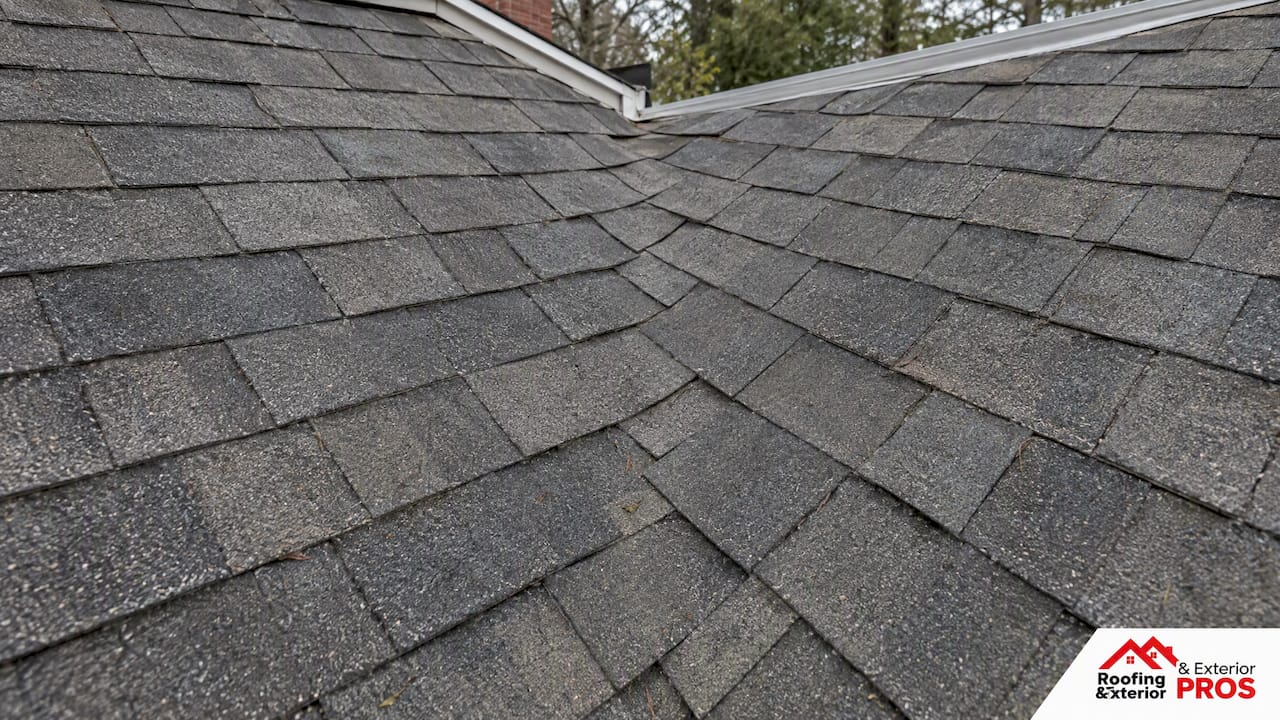
The weak point is performance. NRCA says woven valleys are more likely to collect debris, hold snow and ice, and bridge, meaning the shingle bends across the valley instead of lying flat against the underlayment. Shingle maker IKO notes that woven valleys are now rarely seen and hard to install with laminate shingles, which are stiffer and thicker than the older 3-tab style.
Closed-cut valley
A closed-cut valley is the middle path. Shingles from one plane run across the valley and extend at least 12 inches up the other plane. Shingles from the second plane are then cut about 2 inches back from the centerline, per NRCA’s description. The finished valley is covered in shingles and has a clean, straight line, with no metal showing and no weaving.
On many roofs, “closed valley” in a quote means closed-cut. Ask your contractor which they mean, because the two are built differently.
Woven valley vs open valley, side by side
| Factor | Open valley | Woven valley |
|---|---|---|
| Look | Metal channel visible between shingle edges | Continuous shingle surface, no metal visible |
| Water flow | Clear, unobstructed channel | Water crosses shingle surfaces, more chance of bridging |
| Debris, snow and ice | Sheds more easily | More likely to catch and hold |
| Laminated shingles | Recommended by NRCA for high-profile architectural shingles | Hard to install well because of stiffness and thickness |
| NRCA position | Recommended in the cases above | Not recommended |
| Installation | Metal liner, careful shingle trimming | Skilled hand-weaving, course by course |
The table matches what practitioners describe as the core trade-off: performance on water drainage, appearance, and installation effort, as one roofing contractor summarizes it.
How to choose for your roof
No single style wins on every roof. These are the factors that should drive the decision.
Shingle type
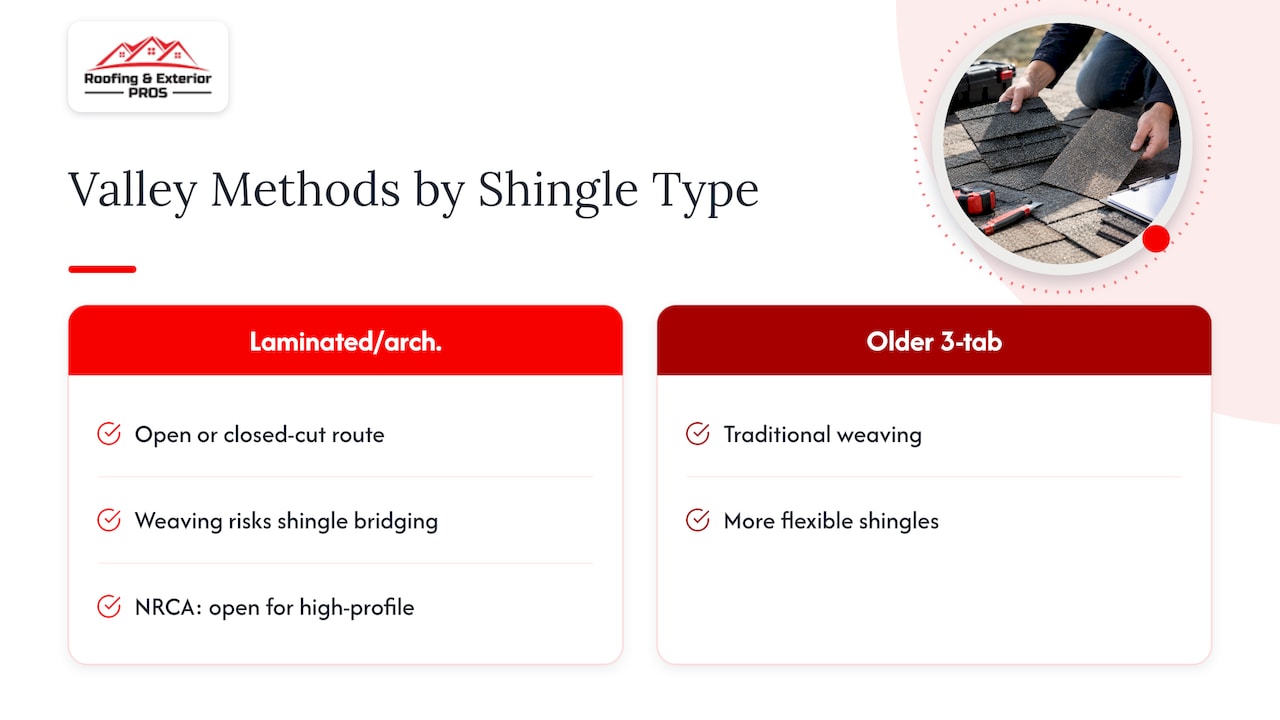
If your roof uses thick laminated or architectural shingles, an open or closed-cut valley is the practical route. Weaving stiff shingles risks bridging, where the shingle does not seat against the underlayment. NRCA recommends open valleys for high-profile architectural shingles. Older 3-tab roofs are more flexible and were the ones traditionally woven.
Roof slope
NRCA also recommends open valleys where the valley is at a 4:12 slope or less. A 4:12 slope rises 4 inches for every 12 inches of run, which is fairly gentle. On low slopes, water moves more slowly and is more likely to back up under shingles, so a clear metal channel is the safer detail.
Climate
St. Louis gets heavy summer thunderstorms, hail, and winters with freeze-thaw cycles. Those conditions put stress on valleys. NRCA notes that for valleys under 4:12 in freeze-thaw or heavy-rainfall regions, fasteners may need to be held back more than 8 inches or nail heads covered with roof cement or self-adhering patches. Ice that sits in a valley can push water under shingles, which is another point in favor of a smooth metal channel. If you want to see how climate and material choices affect longevity, read our piece on asphalt shingle lifespan factors.
Appearance
Looks are a fair thing to weigh. If you want no metal visible, closed-cut gives you a clean shingled valley without weaving, and a painted metal liner can soften an open valley. Just make sure appearance does not override the manufacturer’s requirements.
Manufacturer instructions and code
The model residential code allows several valley lining options, and installation has to follow the manufacturer’s instructions. Permitted linings include two-ply mineral-surfaced roll roofing for open valleys and one-ply smooth roll roofing for closed valleys, under IRC Section R905.2.8.2. Local building departments adopt and amend the code, so confirm requirements for your municipality.
If your shingle maker does not approve of woven or closed valleys for your product, an open valley or the approved alternative is the one that protects your warranty. Ask for the instruction sheet in writing.
For a deeper look at how an open versus closed valley comparison plays out for asphalt shingles, this open versus closed valley comparison covers drainage, appearance and installation difficulty.
Rolled roofing vs shingles in a valley
People searching for roll roofing vs shingles are often really asking about valleys, because roll roofing shows up as a valley liner. They are two different products with different jobs.
Shingles are individual pieces layered to shed water on a pitched roof. Roll roofing is a continuous asphalt-based sheet, sold in rolls and typically used on low-slope structures like sheds and garages, or as a liner. In valleys, the code lets roofers use it as the lining: two plies of mineral-surfaced roll for an open valley, or one ply of smooth roll for a closed valley, as the IRC handout lists.
That does not make roll roofing a good substitute for shingles across a main roof on a house. Metal valley flashing is the more common liner for open valleys on residential reroofs. For help comparing what goes on the main field of the roof, see our residential roofing materials review and the guide to types of residential roofing materials.
What good valley construction includes
Regardless of the style, the pieces underneath decide whether a valley lasts. NRCA’s guidance points to these details:
- Underlayment. Use a full-width sheet of polymer-modified bitumen underlayment, base sheet or self-adhering sheet centered in the valley and secured with minimal fasteners.
- Overlap. Adjacent underlayment should overlap the valley base ply by at least 6 inches.
- No bridging. Shingles and underlayment should follow the valley contour without spanning a gap.
- Fastener distance. Fasteners should stay at least 8 inches from the valley centerline.
Those are the same points to check on a photographed inspection report or during a walk-around after a storm. For a look at what sits under your shingles, our article on the best roof underlayment options is a good companion.
What to check in St. Louis after a storm or before a replacement
- Look at the valleys from the ground. Granule loss, dark streaks, lifted shingle edges or visible rust on a metal liner are signs the valley needs a closer look.
- Check for debris. Leaves and twigs collect where trees overhang the roof. Open valleys shed them more easily, but they still need clearing.
- Ask what style is on the roof now. If a contractor proposes switching from woven to open, ask why, and what the shingle manufacturer requires.
- Get the valley detail in writing. Your estimate should state the valley style, liner material and underlayment. Our roofing specification sheet guide shows what a complete scope looks like.
- Document storm damage promptly. If hail or wind damaged shingles near a valley, photos and a written inspection help with an insurance claim. See what to check first after storm damage.
Valley problems sometimes show up inside the house first. If a ceiling stain appears after heavy rain, a temporary tarp can limit damage until the repair is done. That is part of our emergency and storm damage services.
Our perspective on valleys
We see valleys as a place where a few extra minutes of care save a lot of trouble later. Our approach comes down to being plain about the trade-offs. A woven valley can look beautiful, and we understand why some homeowners ask for one. But on the laminated shingles most homes in the St. Louis area carry today, we would rather talk you through an open or closed-cut valley that follows the manufacturer’s instructions and what NRCA recommends.
We also think the valley should be written into your estimate, not left to assumption. Tell us which style you are being quoted, what liner goes under it, and how the underlayment overlaps. When you can read those details on paper, you can compare bids fairly, and you know what to hold your roofer to. As a local, family-owned company, we would rather you understand your roof than simply sign.
— Jake Ehlinger
Get your valleys inspected
If you are planning a replacement or have noticed leaks near a roof valley, we can inspect the roof, explain what style is in place and quote the right fix. We work with residential and commercial roofs across the St. Louis area, and we can help with storm damage insurance claims.

Ready for a free inspection and quote? Visit our roofing page to see what we install and repair, or start with our residential roof replacement guide to know what to expect.
FAQ
Is a woven valley or an open valley better?
For most modern asphalt shingle roofs, an open valley is the better pick. NRCA does not recommend woven valleys because they are more prone to debris, snow and ice buildup, and bridging. An open valley gives water a clear metal channel and is recommended for architectural shingles.
What is the difference between an open and a closed valley?
An open valley leaves a metal liner exposed between the shingle edges. A closed valley covers the valley with shingles, either woven or closed-cut. In a closed-cut valley, shingles from one side run across and the other side is trimmed near the centerline.
Can I use roll roofing in a roof valley?
Yes, in some cases. The model residential code permits two-ply mineral-surfaced roll roofing for open valleys and one-ply smooth roll roofing for closed valleys, installed per the manufacturer’s instructions. Metal is also a permitted lining. Check your local building department and shingle maker for what applies to your roof.
Do woven valleys work with laminated shingles?
They are difficult. Laminated shingles are stiffer and thicker than 3-tab shingles, which makes weaving harder and raises the chance of bridging. Most roofers now use open or closed-cut valleys on laminates.
How do I know if my roof valley is failing?
Look for leaks or stains on the ceiling beneath a valley, rusted or lifted metal, missing granules and shingle edges that have curled. If you see any of these, have a roofer inspect it before the next heavy storm.
Sources
- NRCA, In the Valley (valley types and recommendations)
- NRCA, In the Valley (closed-cut construction and fastener guidance)
- IKO, open roof valley vs closed valley
- Fraser Roofing, roof valley types
- IRC roofing handout, valley linings
- Open vs closed valley for homeowners