
TL;DR:
- A roofing scope of work is a detailed written document that defines tasks, materials, timelines, and responsibilities for a project, serving as the legal and operational foundation of the contract. It protects homeowners by specifying warranty types, change procedures, and acceptance criteria, ensuring clarity and accountability. Comparing bids requires matching scope details; vague language and scope omissions often cause cost disputes and warranty issues.
A scope of work in roofing is a written document that defines every task, material, timeline, and responsibility involved in a roofing project. In the industry, professionals refer to it as a “roofing scope of work” or simply the “project scope,” and it serves as the legal and operational foundation of your roofing contract. Without it, you have no reliable way to compare bids, enforce warranties, or hold a contractor accountable. Whether you are replacing a residential roof in St. Louis or managing a commercial property, understanding what a roofing scope of work includes is the single most important step before signing anything.
What key elements are included in a roofing scope of work?
A roofing project scope covers far more than just “replace the roof.” Typical roofing scopes specify tear-off extent, roof area measured in squares, detailed material brands and warranty classes, flashing and ventilation details, and cleanup procedures. Each of those categories contains multiple line items, and missing even one can create costly disputes later.
Here is what a thorough roofing work description should include:
- Project overview and site conditions: Roof type (shingle, metal, flat), total square footage, pitch, number of stories, and any access limitations.
- Material specifications: Named brands and product lines. For example, GAF Timberline HDZ shingles with a Lifetime Limited Warranty, or Owens Corning Duration shingles with SureNail Technology. Generic references like “30-year shingle” are not sufficient.
- Tear-off details: Number of existing layers to be removed and how decking will be inspected after removal.
- Deck repair allowances: A per-sheet price for replacing rotten or damaged decking discovered during tear-off.
- Flashing specifications: Flashing details for every penetration, including chimneys, skylights, pipe boots, and roof-to-wall transitions.
- Ventilation components: Ridge vents, intake vents, and attic ventilation calculations per manufacturer requirements.
- Nailing patterns: Fastener type, length, and placement per manufacturer installation standards.
- Cleanup and debris handling: Daily cleanup and final nail sweeps using magnets should be specified to protect your property and landscaping.
Pro Tip: Ask your contractor to reference the specific manufacturer installation manual in the scope. If the nailing pattern or underlayment overlap requirements are not spelled out, the warranty can be voided before the first raindrop falls.
How does a roofing scope of work protect you contractually?

A comprehensive scope defines warranty types including manufacturer product warranties versus contractor workmanship warranties, and it outlines the steps required to register each one. This distinction matters enormously. A manufacturer warranty from GAF or CertainTeed covers material defects, while a workmanship warranty covers installation errors. You need both, and the scope must address both explicitly.
Beyond warranties, the scope protects you in several other ways:
- Change-order procedures: Change-order triggers and exclusions should be explicitly defined so that no additional charges appear on your final invoice without your written approval.
- Decking replacement pricing: The scope must state the per-sheet cost for replacing rotten decking found after tear-off. Without this, contractors can charge whatever they choose once the old roof is off and you have no leverage.
- Payment schedule and milestones: Payments tied to project milestones, such as material delivery, tear-off completion, and final inspection, protect you from paying in full before the work is done.
- Warranty registration responsibilities: The scope should name who is responsible for submitting warranty registration to the manufacturer and within what timeframe.
Pro Tip: Never accept a contract that says “warranty per manufacturer guidelines” without attaching the actual warranty document. Vague references to warranties are not enforceable the same way a named, attached document is.
Understanding the difference between a roofing estimate and an insurance scope is also worth your time, especially after storm damage. The roofing estimate vs. insurance scope distinction affects what gets covered and what comes out of your pocket.
Why do roofing estimates differ so much?
Most homeowners are surprised when three bids for the same roof come back at wildly different prices. Differences in contract scope explain most pricing variance in roofing bids. One contractor may include full flashing replacement while another plans to reuse existing flashing. One may quote a single-layer tear-off while another accounts for two layers. These are not contractor efficiency differences. They are scope differences, and they make direct price comparison impossible without a written roofing project scope.
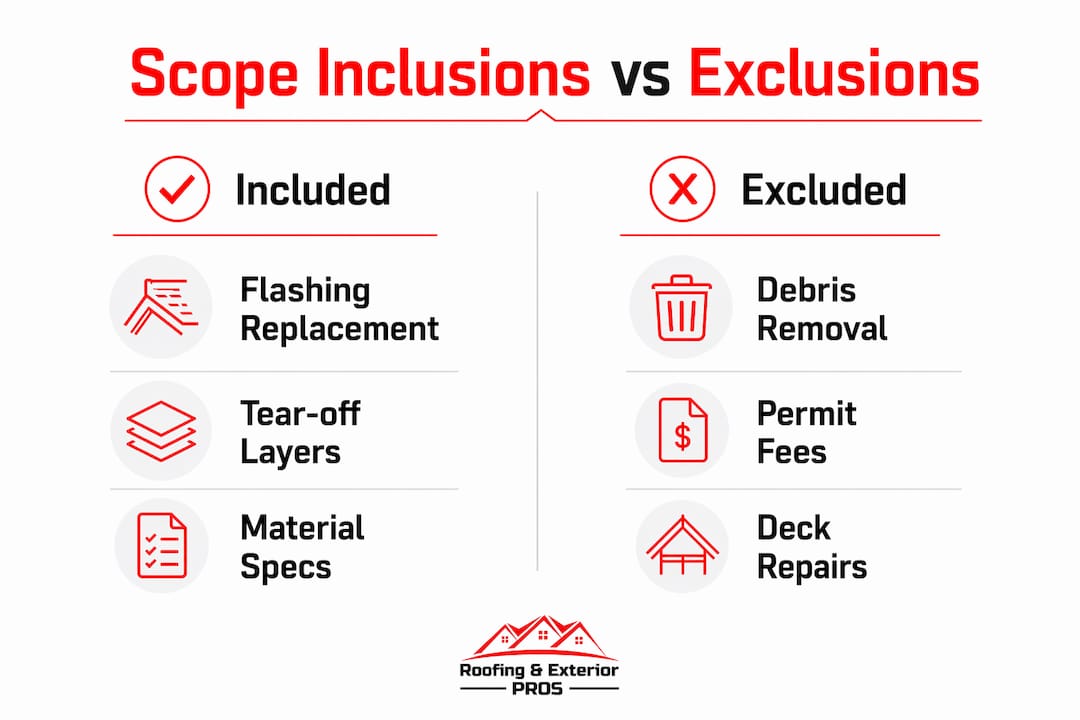
The table below shows how common scope inclusions and exclusions shift the true cost of a roofing project.
| Scope item | Included | Excluded |
|---|---|---|
| Flashing replacement | New step and counter flashing at all penetrations | Reuse existing flashing regardless of condition |
| Tear-off layers | Both existing layers removed and disposed | Single layer only; second layer billed as extra |
| Deck repair | Per-sheet allowance stated in contract | Billed at contractor’s discretion after tear-off |
| Drip edge | New aluminum drip edge on all eaves and rakes | Not mentioned; existing reused or omitted |
| Cleanup | Daily magnetic nail sweep and final haul-off | Single end-of-job cleanup only |
A documentation-ready scope includes identifiable roof sections, exact material and method descriptions, and proof of completion such as photos and marked plans. When you use this kind of scope to compare bids, you are comparing the same project across contractors, not three different interpretations of the same roof. Learning how to compare roofing estimates using scope documents is one of the most practical skills a homeowner or property manager can develop.
What are common pitfalls in roofing scopes of work?
Even experienced property managers miss these scope problems until they become expensive disputes. Knowing them in advance puts you in a much stronger position.
-
Vague flashing language. Phrases like “flash as needed” undermine warranty protection and lead to leaks and disputes. Every penetration type, chimney, skylight, and pipe boot, should have its own line item with material type and method specified.
-
Underestimated tear-off scope. Disputes tend to arise from unclear tear-off and deck condition scopes. If the scope does not state how many layers exist and what happens when rotten decking is found, you are exposed to unlimited cost overruns the moment the old roof comes off.
-
Missing manufacturer installation references. Warranties require compliance with manufacturer specs and registration. A scope that does not reference the specific installation standard, such as GAF’s installation requirements for their System Plus warranty, leaves you with a product-only warranty instead of the full coverage you paid for.
-
No defined change-order process. Without a written approval path for unexpected work, contractors can add charges and claim verbal authorization. The scope must state that all changes require a signed change order before work proceeds.
-
No measurable acceptance criteria. A scope without closeout deliverables, such as photo documentation, a punch list, and warranty paperwork, gives you no objective standard for accepting or rejecting the finished work.
Pro Tip: Before signing, read every line of the scope out loud and ask yourself: “If this goes wrong, can I prove what was agreed?” If the answer is no for any line, ask for clarification in writing before work begins.
How can you effectively use a roofing scope of work?
A scope of work is only as useful as your ability to read and apply it. These practices help homeowners and property managers get the most out of every scope document they receive.
- Read material specifications carefully. Verify that named brands, product lines, and warranty classes match what was discussed. A contractor who quotes GAF Timberline HDZ but installs a lower-tier shingle has violated the scope, and you need documentation to prove it.
- Use the scope to compare bids. Place each contractor’s scope side by side and check for inclusions and exclusions line by line. Price differences almost always trace back to specific scope items, not contractor quality.
- Clarify change-order protocols before signing. Ask the contractor to walk you through exactly what triggers a change order and what the approval process looks like. Get that process in writing as part of the contract.
- Confirm warranty registration responsibilities. The scope should name the party responsible for submitting manufacturer warranty registration and the deadline for doing so. Missing a registration window can reduce a 50-year warranty to a basic product warranty.
- Use scope documentation for project acceptance. Strong scopes reduce ambiguity by using repeatable roof section identifiers and measurable acceptance criteria like photo logs. Do a final walkthrough with the contractor using the scope as your checklist before releasing final payment.
Property managers overseeing multiple buildings benefit especially from standardized scope templates. Understanding property maintenance roofing practices helps you build consistent documentation across your entire portfolio, which makes future bids and insurance claims far easier to manage.
Key takeaways
A roofing scope of work is the single document that determines whether your project is completed correctly, your warranties are valid, and your costs stay predictable.
| Point | Details |
|---|---|
| Define materials by name | Generic terms like “30-year shingle” are not enforceable; require brand, product line, and warranty class. |
| Specify tear-off and deck repair | State existing layers to remove and the per-sheet cost for decking replacement to prevent surprise charges. |
| Address both warranty types | Manufacturer and workmanship warranties must each be named, documented, and assigned a registration responsibility. |
| Require written change orders | All unexpected work must follow a defined approval process before any additional charges are applied. |
| Use scope for final acceptance | Photo logs, punch lists, and warranty paperwork are measurable closeout deliverables that protect you at project end. |
Why I think most homeowners underestimate the scope document
After years of working on roofing projects across the St. Louis area, the pattern I see most often is this: homeowners focus on the price and trust the contractor’s reputation, then discover mid-project that “full replacement” meant something different to each party. The scope of work is where those differences live, and most people never read it carefully.
The cases that turn into real problems almost always involve one of two things. Either the tear-off scope was vague and rotten decking costs exploded, or the flashing language was generic and a leak appeared two years later that no warranty would cover. Both outcomes are preventable with a well-written scope reviewed before signing.
What I have found is that homeowners who ask for a detailed scope upfront, and push back on vague language, consistently have better project outcomes. Not because they found better contractors, but because the act of demanding specificity forces everyone to think through the project more carefully. A contractor who resists providing a detailed scope is telling you something important about how they manage surprises.
For property managers, the documentation value compounds over time. A scope with photo logs and closeout deliverables becomes your evidence file for future insurance claims, warranty disputes, and capital planning. That is worth far more than the hour it takes to review it carefully before signing.
— Jake
Get a detailed roofing scope from professionals you can trust

At Roofing & Exterior PROS, we provide written scopes of work for every residential and commercial roofing project we take on in the St. Louis metropolitan area. Our scopes name specific materials, define tear-off and deck repair allowances, outline both manufacturer and workmanship warranties, and include clear change-order procedures. Before you sign any roofing contract, visit our residential roofing materials review to understand which products and warranty classes belong in your scope. When you are ready to get a precise estimate backed by a thorough written scope, our team is here to walk you through every line. Contact Roofing & Exterior PROS for a free inspection and detailed roofing project quote today.
FAQ
What is a scope of work in roofing?
A roofing scope of work is a written document that details every task, material, timeline, and responsibility for a roofing project. It serves as the contract foundation and the standard against which the finished work is measured.
What does a roofing contract include beyond price?
A complete roofing contract includes material specifications with named brands, tear-off and deck repair terms, flashing details for all penetrations, ventilation requirements, warranty types and registration responsibilities, and a defined change-order process.
Why are roofing bids so different from each other?
Differences in contract scope explain most pricing variance between bids. Contractors may differ on tear-off layers, flashing replacement, deck repair allowances, and included materials, making direct price comparison unreliable without a matching scope.
Can a vague scope void my roofing warranty?
Yes. Warranties require compliance with manufacturer specs and proper registration. A scope that omits installation standard references or registration responsibilities can reduce full system coverage to a basic product-only warranty.
How do I use a roofing scope to compare contractors?
Place each contractor’s scope side by side and compare inclusions and exclusions line by line, focusing on flashing replacement, tear-off layers, deck repair pricing, and cleanup responsibilities. Price differences almost always trace directly to specific scope items rather than contractor quality.