
A roof insurance supplement is a formal, documented request to your carrier to add line items that were missed or underpaid on the original claim so the payout matches the real scope of the job. It’s not a second claim and it’s not a gray-area tactic. When it’s backed by photos, measurements, and code citations, a supplement is one of the most routine corrections in the property insurance world, and carriers approve them every day.
TL;DR:
- Most initial estimates are under-scoped due to software defaults, time pressure on adjusters, and varying policy interpretation, often missing items like drip edges or flashing.
- Well-documented supplements commonly increase the claim by 1,500 to 8,000 dollars, with faster approval for clear, organized submissions filed before tear-off.
- Submission timing affects approval: pre-build supplements are strongest, but mid-project or post-completion requests face longer review times and greater proof challenges.
- Proper documentation includes detailed photos, accurate measurements, and specific code citations, and better organization speeds up approval and reduces delays.
- Denials are usually due to insufficient evidence or missing documentation and can often be overturned with targeted resubmission and, if needed, reinspection.
Table of Contents
- What Is a Roof Insurance Supplement?
- Why Do Initial Insurance Estimates Come Up Short?
- Common Line Items Carriers Miss or Underpay
- When Should You Submit a Roof Insurance Supplement?
- How to Prepare and Submit a Roof Insurance Supplement Package
- What’s the Timeline for a Roof Insurance Supplement?
- What to Do If Your Roof Supplement Gets Denied
- Recoverable Depreciation vs. a Supplement: How the Money Actually Moves
- Red Flags: How to Spot an Abusive Supplement
- How Roofing & Exterior PROS Helps St. Louis Homeowners With Supplements
- Do Roofing Materials and Systems Change Supplement Outcomes?
- Do Supplement Standards Vary by Region?
- How to Work With Your Contractor on Supplement Documentation
- The Real Problem With How Homeowners Are Taught to Think About Supplements
- Get a Free Roof Inspection and Claims Review
- Sources
- FAQ
What Is a Roof Insurance Supplement?
A roof insurance supplement is a formal amendment to an already-approved claim. It doesn’t reopen the entire file or start a new dispute. It asks the carrier to revise the approved scope of work to include items the original estimate left out or priced too low, then reissue payment based on that corrected scope.
Understanding roof policies means understanding that the first adjuster estimate is a starting point, not a final verdict. Supplements are how the estimate catches up to the actual condition of the roof.
Here’s how a supplement fits into the mechanics of a typical claim:
- The insurer approves an initial scope and issues an Actual Cash Value (ACV) payment.
- The contractor or homeowner identifies missing or underpaid items once work begins or during a detailed pre-build audit.
- A supplement request, with documentation, goes to the carrier for review.
- Once approved, the Replacement Cost Value (RCV) increases, and additional recoverable depreciation becomes available.
A common example: a carrier’s original estimate skips drip edge entirely, even though local building code requires it on every re-roof. A supplement adds that line item, cites the applicable code section, and the carrier revises the payout. This isn’t a new claim. It’s the same claim, corrected.
Why Do Initial Insurance Estimates Come Up Short?
Most under-scoped estimates aren’t the result of a carrier trying to shortchange you. They’re the byproduct of how fast and how remotely the initial estimate gets built. Aerial measurement tools and estimating software generate a baseline scope in minutes, and that baseline often defaults to the simplest version of a roof rather than the actual one sitting on your house.
Three forces tend to drive the gap between the first estimate and reality:
- Aerial measurements and software defaults. Programs used to generate estimates often apply standard waste percentages and default material lists that don’t reflect steep slopes, complex valleys, or older decking.
- Field adjuster time pressure. Adjusters frequently handle multiple inspections in a single day, especially after a regional hailstorm, which limits how closely they can inspect flashing, decking, or ventilation components.
- Interpretation differences in policy language. Two reasonable people can read the same policy clause differently, particularly around “like kind and quality” replacement and code-upgrade coverage.
Contractors who audit estimates for a living note that under-scoping is rarely intentional. It’s a product of estimating software defaults and aerial measurement limits that simply don’t capture roof-specific complexity. A 6,000 square foot roof with six valleys and three layers of old shingles does not behave like the software’s default template, and the estimate needs a human to correct it.
That’s precisely the role a supplement plays. It’s the mechanism that turns a generic first pass into an accurate reflection of insurance for roof damage on your specific house.
Common Line Items Carriers Miss or Underpay
Some line items get missed on insurance estimates so often that experienced contractors run through the same mental checklist on every single job. If you’re reviewing an adjuster’s scope, these are the items worth checking first.
- Drip edge and starter strip. Both are code-required on most re-roofs, yet they’re frequently omitted from the first estimate entirely.
- Proper ridge cap. Estimates sometimes price ridge cap using field-shingle rates instead of the higher-cost ridge product actually required.
- Steep-pitch and story charges. Roofs above a 7/12 pitch, or homes with multiple stories, carry labor premiums that basic software often fails to apply.
- Ice-and-water shield and underlayment. Code often mandates ice-and-water shield along eaves and valleys in specific climate zones, and it’s an easy line for a fast estimate to skip.
- Flashing and pipe boots. Step flashing, counter-flashing, and pipe boot replacement are frequently underpriced or left off the scope.
- Waste factor. Complex rooflines need a higher material waste allowance than a simple gable roof, and default software waste percentages often undershoot that need.
- Decking repair. Rotted or delaminated decking discovered at tear-off is almost never included in a first estimate because nobody can see it from the ground or from an aerial photo.
- Haul-off, disposal, and permits. Dumpster fees, disposal costs, and municipal permit fees are line items that vanish from estimates more often than most homeowners realize.
Statistic to know: Practitioner sources tracking supplement outcomes report that well-documented supplements commonly shift a claim by $1,500 to $8,000, depending on the items involved and regional pricing. That range makes clear why skipping the audit step can leave real money on the table.
When Should You Submit a Roof Insurance Supplement?
Timing changes both your odds of approval and how much friction you’ll face during the process. There are three windows, and each one comes with a different tradeoff.
- Pre-build submission. Filing a supplement before tear-off starts is the strongest position, because it gives the carrier a chance to reinspect the roof before conditions get covered up by new material. A pre-tear-off submission is strategically the strongest move available to a contractor, since it avoids mid-project work stoppages entirely.
- During tear-off. Hidden decking damage or additional flashing issues often surface only once shingles come off. Document everything with time-stamped photos before repairing it, then pause and notify the carrier promptly.
- Post-completion. Supplements filed after the job is finished face a heavier burden of proof, since the carrier can no longer physically verify the condition. Expect a longer review and lean harder on photo and measurement documentation.
The best practice, whenever the schedule allows, is to front-load your documentation and submit before the crew ever picks up a pry bar.
How to Prepare and Submit a Roof Insurance Supplement Package
Filing roof insurance claims for missed items is a process, not a guessing game, and it rewards a methodical approach far more than an aggressive one. Contractor-facing guides describe a five-step audit-to-follow-up sequence that consistently produces cleaner approvals. Here’s how to run it.
- Audit the adjuster’s estimate line by line. Compare every item in the approved scope against what the roof actually needs. Check the roofing estimate against the insurance scope to spot gaps before you touch the roof.
- Photograph everything, twice. Take wide and close-up photos before tear-off begins, then take a second full set during tear-off to capture decking, flashing, and underlayment conditions the pre-work photos couldn’t show.
- Pull accurate measurements. Use a measurement report from a service like EagleView or HOVER rather than relying on the carrier’s aerial estimate alone, especially on roofs with complex valleys or dormers.
- Cite code and manufacturer requirements. Reference the specific ICC code section or manufacturer installation instruction tied to each disputed item. A generic request rarely moves a desk reviewer; a cited one usually does.
- Build the Xactimate line items with clear F9 notes. F9 notes that explicitly tie a code citation or manufacturer requirement to a specific photo are the single most effective justification a desk reviewer will see.
- Write a short cover letter. Summarize what’s being requested, why, and where the supporting documentation lives in the file. Keep it to a few sentences per item.
- Submit through the carrier’s preferred channel and follow up. Confirm receipt within a week, and if you haven’t heard anything in ten business days, call the adjuster directly rather than waiting.
Pro Tip: Organize your photos and F9 notes into the same order every time, matching the sequence of the Xactimate line items. Adjusters reviewing dozens of files a week move faster through submissions that follow a predictable structure, and faster reviews mean faster checks.
Disorganized packages are the single biggest cause of delay. A scattered submission with unclear notes typically doubles the back-and-forth compared to a clean one, simply because the reviewer has to chase down information that should have been included the first time.
What’s the Timeline for a Roof Insurance Supplement?
Approval windows vary more than most homeowners expect, and the range runs from a few days to over six weeks. A well-documented, single-item supplement submitted through a clean desk review can clear in under a week. A complex file with multiple disputed items, or one that requires a physical reinspection, can take a month or more.
- Clean, well-documented supplements with strong F9 notes often clear within days, according to practitioner tracking of typical review times.
- Files that get flagged for reinspection, rather than a desk review, add real time, since scheduling a field adjuster’s return visit can take one to two weeks on its own.
- Storm season volume is the biggest wildcard. When a regional hailstorm generates thousands of simultaneous claims, review queues stretch and six-plus-week timelines become common rather than rare.
If a file sits quiet for more than two weeks with no update, that’s usually a sign it needs a phone call, not more patience.
What to Do If Your Roof Supplement Gets Denied
A denial is not the end of the process. It’s feedback, and reading it correctly is what separates a homeowner or contractor who recovers the money from one who gives up too early.
- Request the specific reason in writing. Carriers are required to give a basis for denial, and a vague verbal explanation isn’t enough to work from.
- Identify the actual gap. Most denials come down to insufficient documentation, a missing code citation, or a measurement discrepancy the desk reviewer couldn’t verify.
- Add targeted evidence on resubmission. Bring sharper photos, a stronger code citation from the ICC codes library, or an updated measurement report that directly answers the stated objection.
- Ask for a reinspection when documentation alone won’t settle it. Some disputes, particularly around decking condition, genuinely need a second set of eyes on the roof.
- Escalate to a supervisor or request an appraisal. If the desk reviewer and the reinspection don’t resolve it, most policies include an appraisal clause as a formal dispute mechanism, and the NAIC outlines consumer protections that apply throughout this escalation path.
A denial addressed with better evidence usually succeeds on the second pass. A denial met with the same documentation resubmitted unchanged almost never does.
Recoverable Depreciation vs. a Supplement: How the Money Actually Moves
These two terms get confused constantly, and that confusion causes homeowners to assume money they haven’t actually received yet. A supplement changes what the carrier agrees is owed. Recoverable depreciation is money already built into that agreement, held back until the work is done. The Insurance Information Institute explains that most homeowner policies pay ACV upfront and release the depreciation difference once repairs are complete and proof of work is submitted.
Here’s the mechanic in plain terms:
| Term | What It Means | When You Get It |
|---|---|---|
| ACV (Actual Cash Value) | Replacement cost minus depreciation for age and wear | Paid upfront, at claim approval |
| RCV (Replacement Cost Value) | The full cost to replace the item with new material | Total ceiling of what the policy will pay |
| Recoverable Depreciation | The gap between ACV and RCV | Released after work is completed and documented |
| Supplement | An approved addition to the total scope | Increases RCV, which increases the recoverable depreciation available |
A simplified example: a roof’s RCV is approved at $12,000, with $9,000 paid as ACV and $3,000 held as recoverable depreciation. A supplement adds $2,000 in missed decking repair, raising the RCV to $14,000. Recoverable depreciation now totals $5,000, all released once the job is finished and proof is submitted.
Red Flags: How to Spot an Abusive Supplement
Most supplements are legitimate corrections. Some are not, and homeowners should know the difference before signing off on anything.
- A contractor who promises to “cover your deductible” through supplement money is describing insurance fraud, not a service.
- Line items that don’t match your actual roof, like steep-pitch charges on a low-slope roof, are a sign of inflated quantities rather than documented need.
- Any contractor unwilling to show you the photos, measurements, or Xactimate notes submitted on your behalf is hiding something you have every right to see.
How Roofing & Exterior PROS Helps St. Louis Homeowners With Supplements
Some contractors handle the parts of a roof insurance claim that decide whether a supplement succeeds: the inspection, the photo and measurement documentation, and the Xactimate paperwork that gets sent to the carrier. Experience shows that first estimates often miss decking damage that only shows up once tear-off begins.
If you’re staring at an adjuster’s estimate and something feels thin, the fastest next step is a free inspection. We’ll walk the roof, compare it against the approved scope, and flag anything that looks under-documented, including decking damage that often gets missed until tear-off starts. Bring your claim number, the adjuster’s written estimate, and any photos you already have. That’s usually enough to start the audit.
Do Roofing Materials and Systems Change Supplement Outcomes?
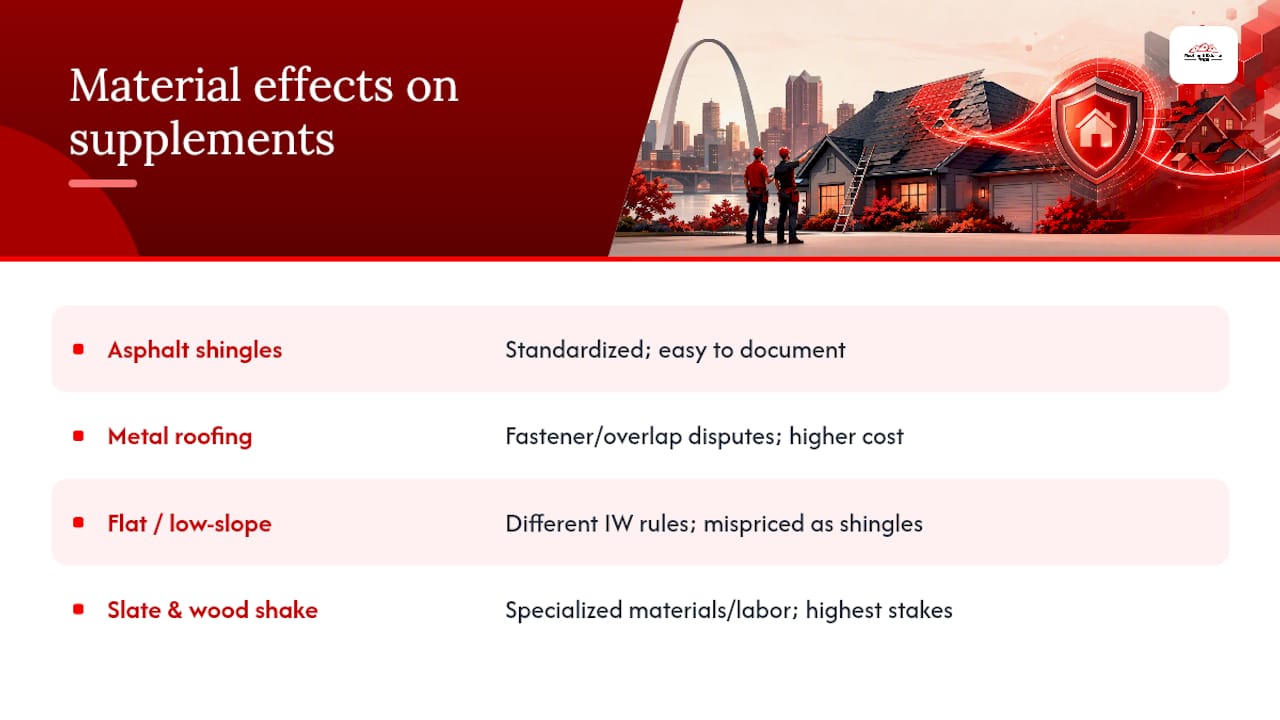
Material type changes both what gets missed and how hard it is to justify a supplement afterward. Asphalt shingle roofs, the most common system in the St. Louis area, generate the most standardized supplements because manufacturer specifications and code requirements for drip edge, starter strip, and ice-and-water shield are well documented and easy to cite.
Metal roofing supplements tend to involve different disputes entirely, often around fastener spacing, panel overlap requirements, or underlayment specifications unique to the panel manufacturer. Because metal systems cost more per square than shingles, an underpriced line item has a bigger dollar impact on the total claim.
Flat and low-slope roofs, common on additions and porches, bring their own complications. Ice-and-water shield coverage requirements differ from steep-slope roofs, and adjusters unfamiliar with membrane systems sometimes apply shingle-roof pricing logic by mistake, which is exactly the kind of software-default error that a supplement is built to correct.
Slate and wood shake roofs carry the highest supplement stakes of all, since specialized materials and labor rates are frequently underpriced by standard estimating software that defaults to more common roofing types. A slate supplement often needs manufacturer documentation and a specialty installer’s input just to establish the correct baseline price, not just the missing items.
Whatever the material, the same principle holds: the more unusual or complex the system, the more likely the first estimate missed something, and the more valuable a detailed, material-specific supplement becomes.
Do Supplement Standards Vary by Region?
Regional differences show up in three places: local building codes, climate-driven code requirements, and how busy the claims environment is after a major storm. Municipalities across the St. Louis metro area, including Saint Charles, Wentzville, Chesterfield, and Ballwin, can apply different permit requirements and code enforcement practices, even though many follow versions of the same base codes published by the International Code Council.
Climate is the bigger driver. Ice-and-water shield requirements, wind-rating expectations for shingles, and hail-impact-resistant material standards all vary by region because they’re written around local weather risk. A supplement built around a coastal wind code citation won’t hold up in a Midwest hailstorm claim, and vice versa.
Claims volume changes regional expectations, too. After a widespread hail event in the Missouri, Illinois, and greater Midwest region, carriers process thousands of claims in a compressed window, and desk reviewers move faster through supplements that are cleanly documented and slower through ones that aren’t. Homeowners filing during a high-volume season should expect longer timelines industry-wide, not just from one specific carrier.
Local contractors who work a specific region regularly tend to know which municipal inspectors are strict, which code sections carriers in that area accept without pushback, and which items routinely need extra justification. That local pattern recognition is difficult to replicate from a national call center or an out-of-state contractor unfamiliar with the area’s permitting quirks.

How to Work With Your Contractor on Supplement Documentation
The biggest predictor of a successful supplement isn’t the size of the claim. It’s how well the homeowner and contractor communicate before, during, and after the work.
Ask your contractor upfront how they document supplements, and ask to see an example from a past job with identifying details removed. A contractor who documents well won’t hesitate to show you their process. One who deflects the question is telling you something.
Keep your own copy of every photo, every measurement report, and every piece of correspondence sent to the carrier. You don’t need to manage the Xactimate file yourself, but you should always be able to see what was submitted on your behalf. Reviewing the insurance claim documentation your contractor files is a reasonable request, not an insult to their professionalism.
Finally, agree on communication expectations before work starts. Decide together how quickly your contractor will notify you if hidden decking damage or another supplement-worthy issue turns up mid-project, and confirm they’ll pause for photos before repairing anything unexpected. That single agreement prevents most of the disputes that come up later about what was found, when, and why it wasn’t documented.
The Real Problem With How Homeowners Are Taught to Think About Supplements
Most of what gets written about roof insurance supplements frames them as a fight, homeowner versus carrier, contractor versus adjuster. That framing is wrong, and it costs homeowners money. The data on approval timelines tells a different story: well-documented supplements clear quickly, often within days, because desk reviewers aren’t looking for a reason to say no. They’re looking for enough evidence to say yes without getting second-guessed by their own supervisor.
The conventional advice obsesses over negotiation tactics and adjuster psychology. It should obsess over photo quality and F9 notes instead. A homeowner who understands that a supplement is a documentation exercise, not a negotiation, will get further than one who’s rehearsing arguments for a phone call that never needs to happen.
If there’s one place readers should focus first, it’s the pre-tear-off audit. Catching missed items before the roof comes apart avoids the entire denial-and-resubmission cycle that eats weeks off everyone’s timeline. Everything downstream, the F9 notes, the code citations, the follow-up calls, gets easier when the documentation starts before the first shingle comes off.
— Jake Ehlinger
Get a Free Roof Inspection and Claims Review
If your adjuster’s estimate looks thin, or you’re not sure whether hidden decking damage was ever accounted for, a second set of eyes on the roof is the fastest way to find out. Roofing & Exterior PROS is the direct alternative to piecing together your own supplement paperwork. Our team documents the roof, builds the Xactimate case, and submits it, so you’re not learning insurance terminology while your roof sits exposed.

A free inspection covers the full roof surface, decking condition where accessible, flashing, and ventilation, then compares what we find against your adjuster’s approved scope. Bring your claim number, a copy of the adjuster’s written estimate, and any photos you’ve already taken. If we find gaps, we’ll walk you through what a supplement could recover before any work begins. Once repairs are approved, you can move straight into scheduling with our roof replacement process, or start with a storm damage restoration review if a recent storm is what triggered the claim in the first place. Schedule your free inspection today and find out what’s actually on your roof, not just what the first estimate assumed.
Sources
For readers who want to go straight to the originals: building-code citations come from the International Code Council, consumer insurance protections and regulatory guidance come from the NAIC, and ACV/RCV mechanics are explained in detail by the Insurance Information Institute. For a practitioner’s step-by-step breakdown, see The Roofing Manual’s supplement explainer, and for roofer-specific marketing and visibility strategy, see Roofer SEO Services.
- International Code Council codes
- National Association of Insurance Commissioners (NAIC)
- Insurance Information Institute (III) — homeowners & renters insurance facts
- Roof Insurance Supplements: Why First Checks Run Short | The Roofing Manual
FAQ
What Is a Roofing Supplement?
A roofing supplement is a formal request to amend an already-approved insurance claim so it includes line items, like drip edge, decking repair, or code-required underlayment that the original estimate missed or underpriced.
What Is the 25% Rule for Roofing?
The “rule” refers to a common building-code and manufacturer guideline suggesting that if a significant portion of a roof section needs replacement, the whole section (or in some cases the full slope) should be redone rather than patched; exact thresholds vary by local code and manufacturer requirement, so check the applicable ICC code section for your jurisdiction.
How Do I Supplement a Roof Claim?
Audit the adjuster’s estimate against the actual roof, document missing items with photos and measurements, cite the relevant code or manufacturer requirement in clear Xactimate F9 notes, then submit the package with a short cover letter and follow up if you don’t hear back within about two weeks.
Will Insurance Cover a 20 Year Old Roof?
Most standard homeowner policies still cover storm or wind damage to an older roof, though payout is typically based on Actual Cash Value rather than full Replacement Cost Value unless your policy includes RCV coverage; a supplement can still apply to correct missed items regardless of roof age, as long as the damage itself is a covered peril.
How Long Does a Roof Insurance Supplement Take to Approve?
Well-documented supplements often clear within days, while files needing reinspection or hitting a high-volume storm season can take six weeks or longer.