TPO is a single-ply, heat-welded white membrane that reflects sunlight and is usually quicker to install. Modified bitumen is a multi-ply, asphalt-based system that handles foot traffic and physical abuse well. For most St. Louis owners, the choice comes down to how the roof will be used, how it drains, how it will be installed, and what your building already has on top. Below we compare the two on the points that matter, and bring in EPDM and torch-down along the way.
TL;DR
- TPO is a lightweight thermoplastic membrane with heat-welded seams. It is white and reflective, and it is a strong fit for commercial roofs focused on energy use.
- Modified bitumen is a reinforced, multi-ply asphalt system. It is a strong fit where people walk on the roof often, and for retrofits over an existing asphalt roof.
- Torch-down is one way to install modified bitumen. It needs hot-work precautions, so ask how your roofer will attach the sheets.
- EPDM is the rubber alternative: easy to repair, but its seams are glued or taped rather than welded.
- Drainage, installation quality and maintenance affect results as much as the material does.
Table of Contents
- The basic difference between TPO and modified bitumen
- Side-by-side comparison
- Durability and lifespan
- Installation: torch-down, mopped, cold-applied and self-adhered
- Fire ratings
- Energy use and reflectivity
- Cost: what actually moves the price
- Where EPDM fits
- Which one fits which building
- Maintenance and leak prevention
- Our perspective
- Get a flat roof inspection in St. Louis
- FAQ
- Sources
The basic difference between TPO and modified bitumen
The two systems are built differently. According to Roofing Contractor magazine, TPO is a lightweight thermoplastic membrane that can be reheated to form monolithic seams. Modified bitumen is an asphaltic, multi-ply system that is factory-manufactured. Its polymer modifiers add durability and flexibility compared with older built-up roofing.
In practice, that means:
- TPO is one sheet. The installer rolls it out and welds the overlaps with hot air. The same article notes that TPO resists UV rays, chemicals, algae and mildew, and that it can be recycled.
- Modified bitumen is layers. A base sheet and a cap sheet, both reinforced, form a thicker, more rugged surface that tolerates puncture and traffic better.
If you have heard modified bitumen called “tar and gravel,” that is not quite right. Tar-and-gravel is the older built-up roof, made of alternating layers of asphalt and felt with a gravel top. Modified bitumen is its descendant, with polymer-modified sheets in place of plain felts, and it is usually sold as a finished cap sheet rather than a gravel surface.
Side-by-side comparison
| Factor | TPO | Modified bitumen |
|---|---|---|
| Build | Single-ply thermoplastic sheet | Multi-ply, asphalt-based, polymer-reinforced |
| Seams | Heat-welded | Torched, mopped, cold-adhered or self-adhered laps |
| Typical color | White, reflective | Dark or granule-surfaced; can be coated |
| Service life | 10 to 20 years typical | 15 to 25 years typical |
| Foot traffic | Fair | Good |
| Installation speed | Generally faster | Generally slower |
| Standing water | Handles it better | More vulnerable |
| Best fit | Energy-conscious commercial roofs | Rooftop equipment, retrofits, heavy access |
The service-life figures are general ranges. Roofing Contractor gives 10 to 20 years for TPO, and says modified bitumen typically lasts 15 to 25 years. A commercial flat roof guide from Projul places modified bitumen at 20 to 25 years. Either system can fall short of its range when installation, drainage or maintenance is poor, and that point matters more than any chart.
Durability and lifespan
What the field evidence says about modified bitumen
The most useful independent look at modified bitumen is a NIST field study of roofs in service. It found modified-bitumen roofs generally satisfactory. It also recorded the defects owners should watch for: surface cracking, granule loss, slippage of SBS sheets, and unsealed or heavily repaired laps on APP sheets. The study stressed that the membrane alone did not decide results. Poor drainage, poor design, missing maintenance and roof abuse were important contributors to defects.
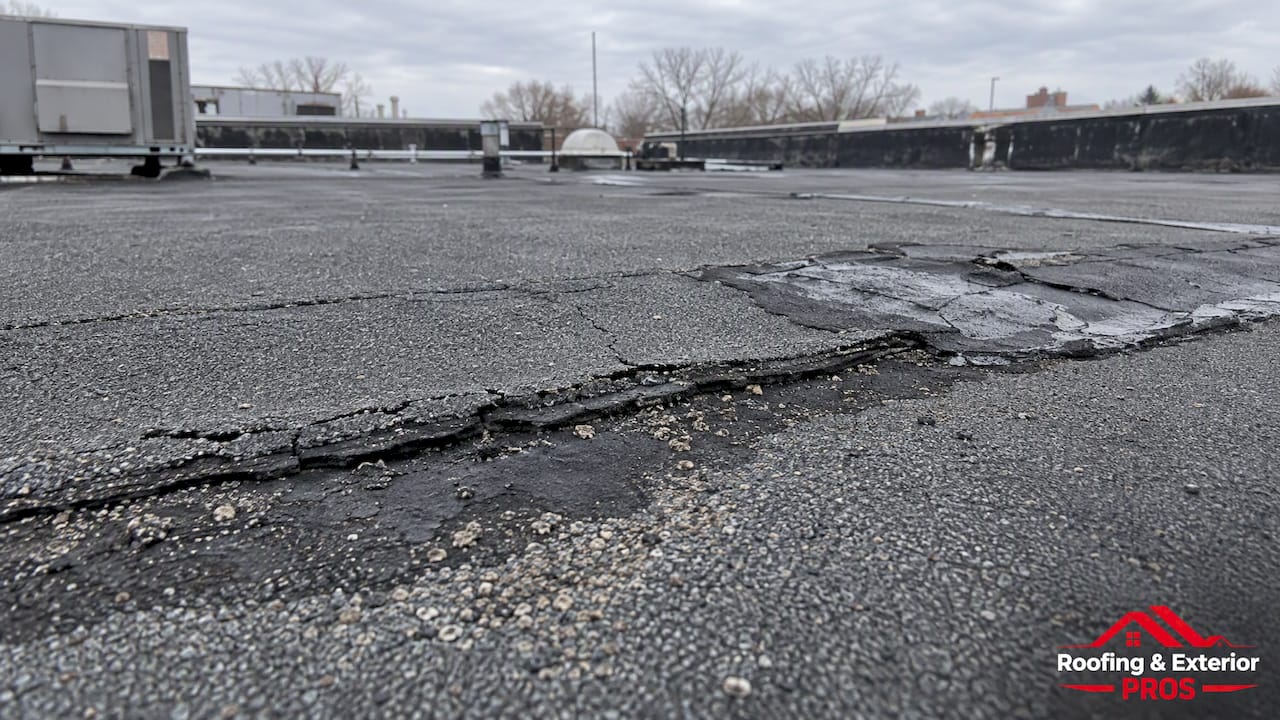
That study dates from 1993, so treat it as evidence about how roofs fail, not as a scorecard for today’s products. The lesson still holds: a good membrane on a badly drained roof is still a problem roof.
Where TPO is strong, and where it asks more of the installer
TPO’s selling point is the seam. A properly welded TPO seam is stronger than the membrane itself. The catch is the phrase “properly welded.” Weld quality depends on the operator’s skill and the calibration of the equipment, so the crew matters as much as the product. We cover that in more detail in our commercial TPO installation guide and our TPO system review for Missouri buildings.
TPO also handles water sitting on the roof better than modified bitumen. That helps on low-slope roofs where ponding is hard to avoid completely. It does not replace good drainage, though, and we would never design a roof around the idea that water can just sit there. See our guide to flat roof drainage solutions that prevent leaks.
Installation: torch-down, mopped, cold-applied and self-adhered
Modified bitumen can be installed in several ways: by torch, hot-mopping, cold adhesive, or self-adhesion. Self-adhered sheets need warm temperatures, which matters in a St. Louis winter schedule.
The torch method is what most people mean by “torch-down.” It melts the underside of the sheet with an open flame as it is rolled out. That creates a strong bond, and it also creates a fire risk. Torch-applied modified bitumen requires hot-work permits and fire precautions. TPO has no open flame; its seams are welded with hot air.
So when you compare torch-down with TPO, you are comparing:
- A heavier, layered system with a flame-based application, which needs careful fire-watch procedures on any building with combustible materials or occupied space below.
- A lighter single-ply system with a flameless application, where the quality control question is seam welding.
If you are leaning toward modified bitumen on an occupied building, ask about cold-applied or self-adhered options and ask your contractor to explain the fire plan in writing. We do not treat that as a formality.
Fire ratings
Fire performance is about the whole roof assembly, not just the top membrane. The Insurance Institute for Business & Home Safety explains that Class A-rated assemblies give the best protection against external fire sources such as embers, and that commercial roofs in some areas must meet specific fire ratings. Whichever system you choose, ask for the rating of the full assembly you are buying, including the insulation and cover board underneath, and confirm it with your local building department. Our fire ratings guide for commercial roofing explains how to read those ratings.
Energy use and reflectivity
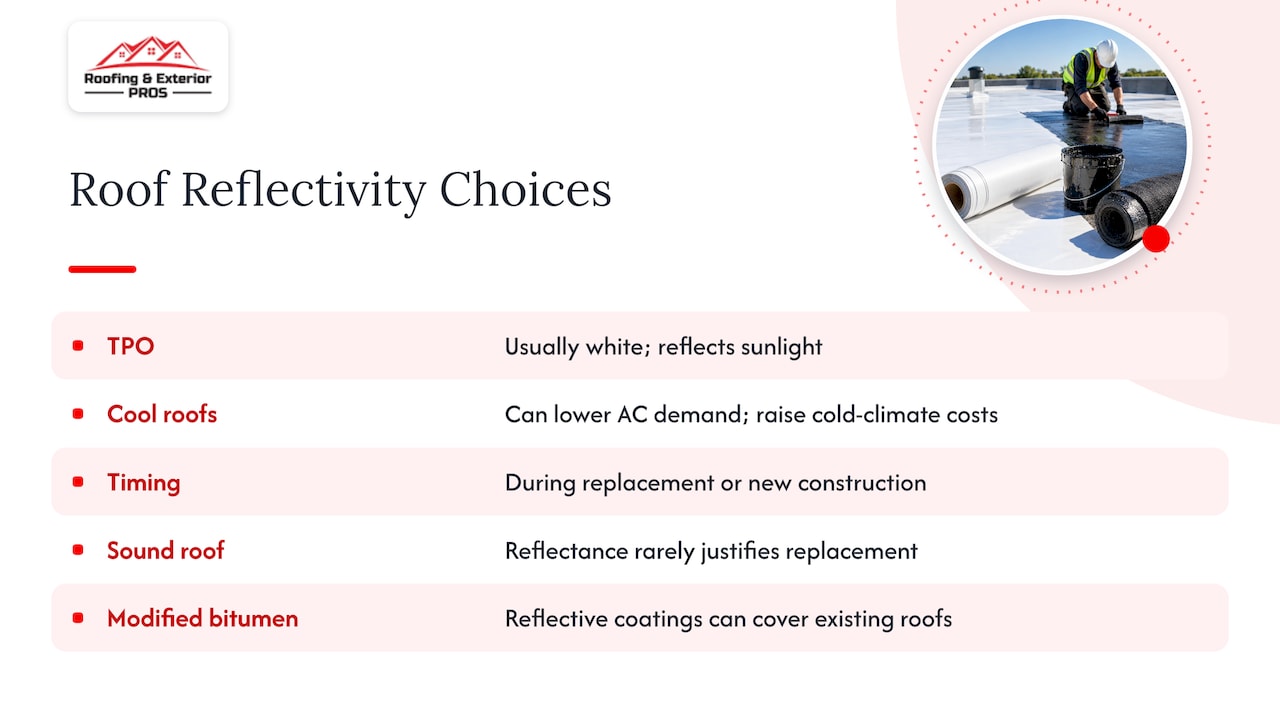
TPO is usually white, which reflects sunlight. The U.S. Department of Energy’s cool roof materials guidance explains that solar reflectance and thermal emittance determine how hot a roof gets, and that cool roofs can lower air-conditioning demand. It also warns that in cold climates a cool roof can raise energy costs. Savings vary with location, insulation, HVAC efficiency and utility rates.
The Department’s Guide to Cool Roofs adds a practical point for owners. Reflectivity should be weighed when you are already replacing a roof or building new, but replacing a sound roof just to gain reflectance is rarely economical. For a St. Louis building with hot summers and cold winters, that means TPO’s reflectivity is a real advantage, but not a reason to tear off a healthy modified bitumen roof.
Modified bitumen is not stuck with a dark surface forever. Reflective coatings can be applied over existing roofs. See our commercial roof coating guide for when that makes sense.
Cost: what actually moves the price
We do not publish flat roofing prices, because the number depends on your building. The factors that matter most are:
- Roof size and building height, which affect labor and material handling
- Current roof condition and whether a tear-off is needed
- Membrane thickness and the number of plies
- Amount and type of insulation
- Drainage changes, flashing and rooftop penetrations
- Installation method and the contractor you choose
In general, TPO is considered the more economical system and modified bitumen the more labor-intensive one, since it is slower to install. The lowest bid is not always the lowest cost over the life of the roof. A cheap TPO job with poorly welded seams will cost you more than a well-installed modified bitumen roof, and the reverse is also true. Ask every bidder to price the same scope, with the same insulation and the same warranty terms, so you can compare like with like.
Where EPDM fits
Many owners searching this topic are really choosing among three systems. EPDM is a thermoset synthetic rubber membrane. Roofing Contractor notes that it is easier to repair than TPO but not typically reinforced, so it can be vulnerable to punctures, and its adhesive-bonded seams cannot be made monolithic by heat. The same article gives typical service lives of 20 to 30 years for EPDM. Its seam performance depends on surface preparation, adhesive quality and application conditions. EPDM is usually black, though it can be made in white or cool colors.
In short:
- EPDM vs. modified bitumen: EPDM is lighter and easier to patch. Modified bitumen takes foot traffic and punctures better.
- EPDM vs. torch-down: EPDM involves no flame. Torch-down gives a thicker, layered surface.
- EPDM vs. TPO: TPO has welded seams and a reflective surface. EPDM has a longer typical lifespan and simple repairs.
We go deeper on that pairing in TPO roofing vs. EPDM.
Which one fits which building
Use these as starting points, not rules.
Choose TPO when:
- Cooling costs are a significant part of your operating budget
- The roof is mostly left alone, with limited rooftop traffic
- You want a faster installation with no open flame
- You are replacing the roof anyway and can plan for good drainage
Choose modified bitumen when:
- Technicians or tenants regularly walk the roof to service equipment
- You are retrofitting over an existing asphalt roof
- You want a thicker, layered surface that tolerates abuse
- The project may run into colder weather, where installation methods other than self-adhered are available
Consider EPDM when:
- Repairs need to be simple and inexpensive
- The building is in a cold climate and a dark surface helps in winter
For wider comparisons, our guides on the best commercial roof systems and commercial roofing materials lay out the full list.
Maintenance and leak prevention
Most flat roof failures start at details, not at the middle of the membrane. Check these at least twice a year and after major storms:
- Drains and scuppers: clear debris so water leaves the roof.
- Seams and laps: look for lifting, cracking or open edges.
- Flashings and curbs: these are the usual leak points around equipment.
- Penetrations: vents, pipes and exhaust outlets need sound flashing. Issues with dryer vent roof problems are a good example of how a vent can cause leaks and other hazards.
- Surface wear: on modified bitumen, watch for cracking and granule loss; on TPO, look for seam or flashing failures.
Keep a written record of each inspection and repair. It helps with warranty claims and with insurance when storm damage hits.
Our perspective
We are a family-owned company, and we install and repair roofs on St. Louis homes and commercial buildings. When an owner asks us which flat roof is better, we start with questions about the building. How is the roof used? Where does the water go? What is on the roof now? Who services the equipment up there? The material is the last choice, not the first.
We like TPO for many commercial buildings because of its reflectivity, welded seams and clean, flameless installation. We recommend modified bitumen when the roof will see regular traffic or when the existing roof makes it the practical option. In both cases, we tell owners the same thing: the quality of the installation and the drainage plan will decide how the roof performs more than the name on the roll.
We also believe in transparency. We walk you through what we find on your roof, explain the options in plain words, and give you a written quote so you can compare it against anyone else’s.
— Jake Ehlinger
Get a flat roof inspection in St. Louis
If you are weighing TPO against modified bitumen, the quickest way to a real answer is to have someone look at your roof. We offer free inspections and quotes for commercial and residential roofs across the St. Louis area, and we can help with insurance claims when storms are the cause. See our roofing services or learn how we handle commercial roofing that holds up. If a storm has already done damage, our 24/7 emergency repair and tarping service can protect the building while you decide on a permanent fix.
FAQ
Is modified bitumen a good roof?
Yes, when it is well installed and maintained. A NIST field study found modified-bitumen roofs generally satisfactory, and the material is known for handling foot traffic and puncture better than single-ply membranes. The defects to watch for are surface cracking, granule loss and open laps, which are usually tied to drainage and upkeep.
What are the common problems with modified bitumen roofing?
The NIST field study recorded surface cracking, granule loss, slipping SBS sheets and unsealed or heavily repaired APP laps. Torch-down installation also carries a fire risk, so it needs hot-work permits and fire precautions. Poor drainage and neglected maintenance make every one of these problems worse.
Is torch-down better than TPO?
Neither is better in every case. Torch-down gives a thicker, layered surface that suits roofs with regular traffic, while TPO has welded seams, a reflective surface and no open flame. The right pick depends on your building’s use, drainage and the quality of the crew installing it.
Can I put TPO over an existing modified bitumen roof?
Sometimes, but it depends on the condition of the existing roof, its moisture content and the assembly details. A roofer needs to inspect it and tell you whether a recover is sound or whether a tear-off is the better investment. Ask for that recommendation in writing.
Sources
- Choosing the Best Low-Slope Roofing System for Your Building, Roofing Contractor
- Commercial Flat Roof Systems Compared, Projul
- Observations from a field study of the performance of modified bitumen roofs, NIST
- Cool Roofs, U.S. Department of Energy
- Guide to Cool Roofs, U.S. Department of Energy
- Commercial Roofs Best Practices, IBHS
- Dryer Vent Roof Problems