TL;DR:
- Fire ratings in commercial roofing classify entire roof assemblies based on their tested fire resistance, with Class A offering the highest protection. These ratings affect building code compliance, insurance premiums, and legal liabilities, requiring the full assembly to meet testing standards, not just individual materials. Proper maintenance, accurate documentation, and working with qualified contractors are essential for sustaining the rated integrity over time.
Fire ratings in commercial roofing classify complete roof assemblies by their tested ability to resist fire exposure, with Class A providing the highest level of protection against flame spread and penetration. The role of fire ratings in commercial roofing goes far beyond a label on a product spec sheet. These classifications directly affect your building code compliance, insurance premiums, and legal liability. Understanding how fire ratings work at the assembly level, not just the material level, is the single most important thing a commercial property owner can do before specifying or replacing a roof.
How are fire ratings determined for commercial roofing?
Fire ratings for commercial roofs are determined through standardized testing under ASTM E108/UL 790, which evaluates flame spread, fire penetration, and resistance to burning brands on complete roof assemblies. These are not simple material tests. They simulate real fire conditions, including wind-driven flames and glowing embers landing on the roof surface.
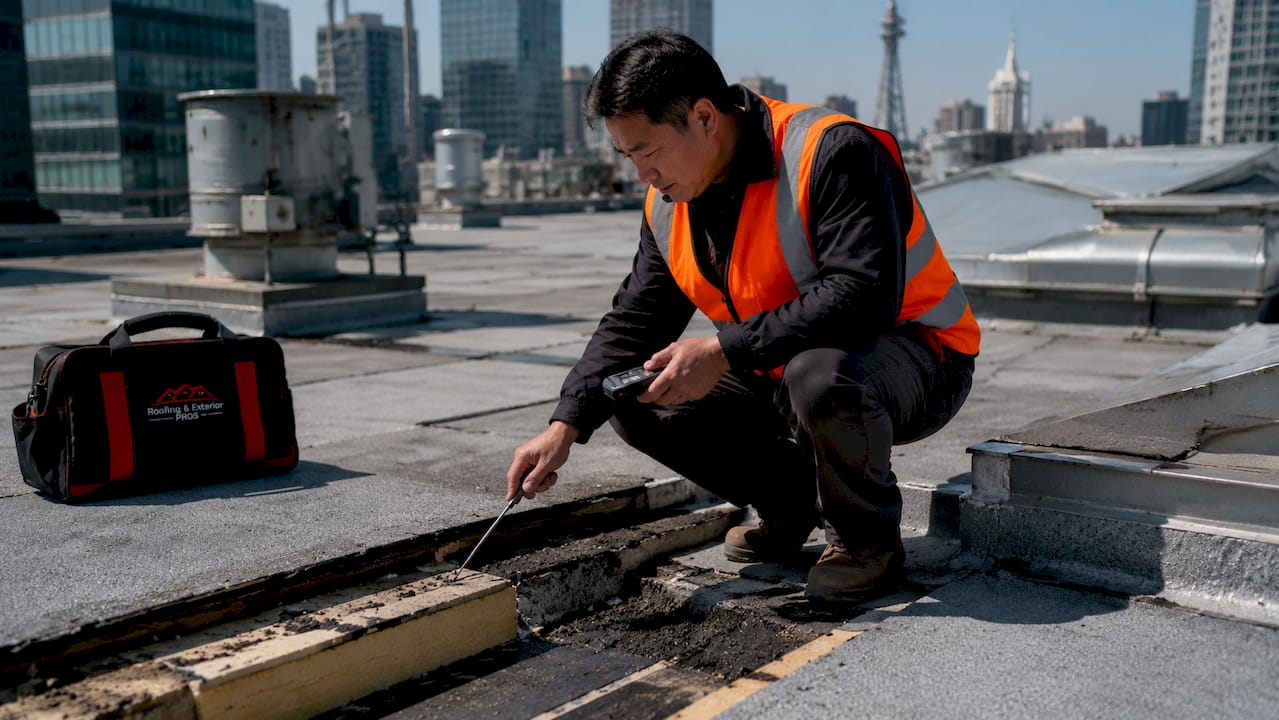
The tests measure three specific performance factors. First, surface flame spread measures how far fire travels across the roof surface. Second, fire penetration tests whether flames break through to the underside of the assembly. Third, burning brand resistance evaluates whether the roof ignites from airborne embers, which is the most common ignition source in wildfire events.
One of the most common misconceptions in commercial roofing fire safety is that a membrane rated Class A makes the whole roof Class A. That is not how it works. Fire ratings apply to entire roof assemblies, meaning the deck, insulation, fasteners, cover board, and membrane must all be tested together as a system. A Class A membrane installed over the wrong insulation or deck type may produce a Class B or Class C assembly result.
Pro Tip: Always request the UL assembly number from your roofing contractor before installation. That number confirms the exact tested combination of materials that achieves your target fire rating.
What are the 2026 building code minimums for commercial roofs?
The 2026 International Building Code does not require Class A for all commercial buildings. Six of eight IBC construction types require a minimum Class B rating, while the remaining types require only Class C. Class A is not mandated for any construction type under the IBC, though it is strongly recommended in wildfire-prone or high-risk zones.
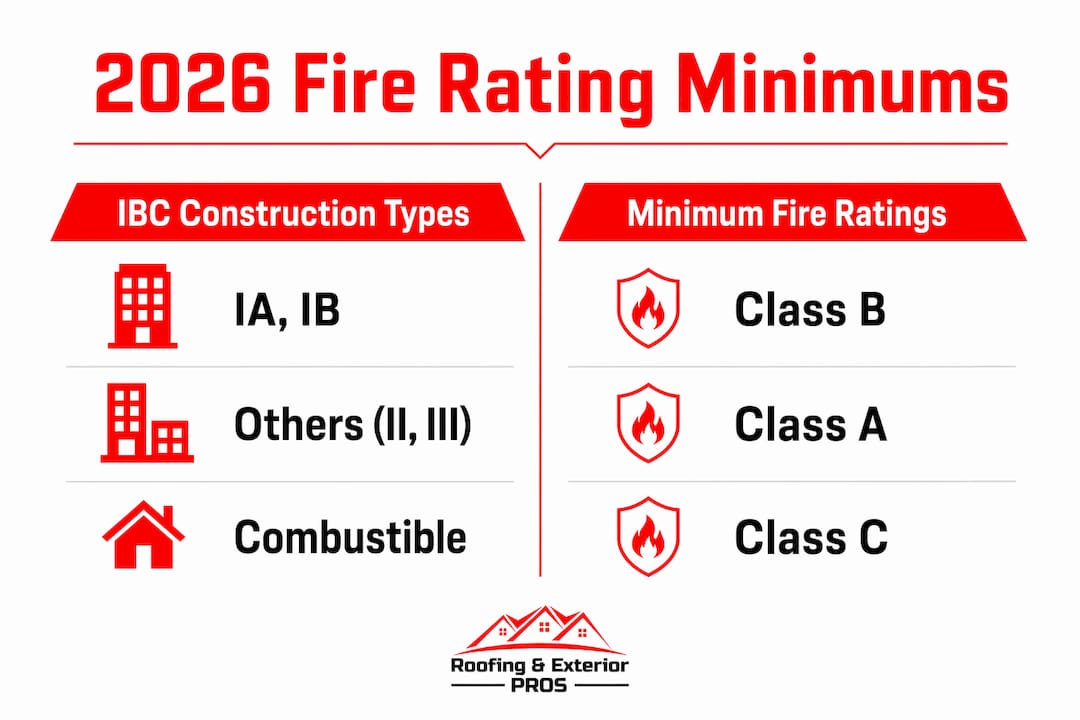
Here is how the 2026 IBC maps construction types to minimum fire rating requirements:
| IBC Construction Type | Minimum Required Fire Rating |
|---|---|
| IA, IB (noncombustible, protected) | Class B |
| IIA, IIIA (mixed, protected) | Class B |
| IV (heavy timber) | Class B |
| VA (wood frame, protected) | Class B |
| IIB, IIIB (unprotected) | Class C |
| VB (wood frame, unprotected) | Class C |
This table matters because many property owners assume they need Class A when their code only requires Class B. That assumption can lead to unnecessary cost. At the same time, local amendments, state fire codes, and insurance carrier requirements often push the effective minimum higher than the IBC baseline. If your building sits in a wildfire interface zone or a high-density urban area, your local authority having jurisdiction may require Class A regardless of construction type.
Working with a certified roofing contractor who knows your local code environment is the most reliable way to confirm your actual compliance threshold.
How do fire ratings affect insurance and liability?
Class A roofs in wildfire and high-risk zones often qualify for insurance premium reductions, though the specific discount depends on your carrier’s underwriting guidelines. The financial benefit is real, and it compounds over time. A lower annual premium across a 20-year roof lifespan can offset a meaningful portion of the upfront cost difference between a Class B and Class A assembly.
The liability side is less discussed but equally serious. Failing to maintain fire-rated roof assemblies can expose property owners to legal liability and insurance coverage denial. Specific failure points include:
- Unsealed penetrations from HVAC upgrades or new rooftop equipment
- Repairs made with materials that do not match the tested assembly
- Removal of fire-rated components without replacement in kind
- Skipping scheduled inspections that would catch assembly degradation
Insurance policies can deny claims if the fire-rated assembly was not properly maintained at the time of a loss. That denial can leave you personally responsible for rebuilding costs, tenant losses, and third-party damages. The importance of fire ratings extends directly into your financial exposure, not just your safety score.
Pro Tip: Document every rooftop repair and equipment installation with photos and contractor sign-off. If a claim ever goes to dispute, that paper trail proves your assembly was maintained to its rated standard.
Class a vs. b vs. c: what are the real differences?
Class A provides the highest fire resistance, Class B offers moderate protection, and Class C provides limited resistance against light fire exposure. The performance gap between these classes is not just a number. It reflects how long a roof can resist active fire before flame spreads or penetrates to the building interior.
Here is a direct comparison of the three classes across key performance factors:
| Performance Factor | Class A | Class B | Class C |
|---|---|---|---|
| Flame spread resistance | Severe fire exposure | Moderate fire exposure | Light fire exposure |
| Penetration resistance | High | Moderate | Low |
| Burning brand resistance | Yes, tested | Limited | Minimal |
| Typical materials | TPO, KEE, PVC, modified bitumen with cover board | Some modified bitumen, built-up roofing | Basic built-up, some single-ply without cover board |
One detail that surprises many property owners: Class A does not mean fireproof. It means the assembly burns slowly enough under test conditions to limit flame spread and delay penetration. That delay is what saves buildings and lives, but it is not an absolute barrier.
Assembly design choices make a significant difference within each class. Cover boards made from gypsum or cement are now considered essential components in achieving and maintaining UL Class A ratings. They add a noncombustible layer between the membrane and the insulation, slowing heat transfer and preventing the insulation from contributing to flame spread. Cover boards have moved from optional upgrade to required element in high-performance assemblies. Skipping them to cut costs often drops an assembly from Class A to Class B.
Membrane chemistry also matters. KEE (ketone ethylene ester) membranes outperform standard TPO in flame spread tests under certain conditions, making them a preferred choice in high-risk applications. Your commercial roofing materials comparison should always include fire rating performance alongside cost and durability metrics.
How can you keep your roof’s fire rating compliant over time?
A fire rating is not permanent. It reflects the performance of a specific tested assembly in a specific condition. Once that assembly is altered, damaged, or improperly repaired, the rating may no longer apply. Maintaining commercial roof fire compliance requires active management, not just a one-time installation decision.
The most effective practices for sustaining fire rating compliance include:
- Schedule annual professional inspections focused specifically on fire-rated assembly integrity, not just leak detection. A commercial roof inspection should verify that all penetrations are sealed, cover boards are intact, and membrane seams are sound.
- Control rooftop work carefully. Every time an HVAC contractor, electrician, or telecom crew accesses your roof, they create penetration risk. Require all contractors to use fire-rated sealants and document their work.
- Use only assembly-matched materials for repairs. A patch made with a different membrane type or insulation board can break the tested assembly configuration and void the rating.
- Include fire rating compliance in your service contract. Your roofing service contract should explicitly require that all repairs maintain the original UL assembly number or an equivalent rated substitute.
- Keep documentation current. Store your original UL assembly certification, all repair records, and inspection reports in a single file. Insurers and code inspectors will ask for this during audits or after a loss event.
The commercial roof maintenance checklist you follow should treat fire rating integrity as a first-tier item, not an afterthought after addressing leaks and drainage.
Key takeaways
Fire ratings in commercial roofing are assembly-level classifications that determine code compliance, insurance eligibility, and legal liability for property owners.
| Point | Details |
|---|---|
| Ratings apply to full assemblies | The deck, insulation, cover board, membrane, and fasteners must all be tested together to achieve a valid fire rating. |
| Class A is not always required | The 2026 IBC mandates Class B for most construction types; Class A is recommended in high-risk or wildfire zones. |
| Cover boards are now essential | Gypsum or cement cover boards are required components in achieving UL Class A ratings, not optional upgrades. |
| Maintenance protects your rating | Unsealed penetrations and mismatched repair materials can void your assembly’s fire rating and trigger insurance denial. |
| Insurance rewards higher ratings | Class A roofs in high-risk zones often qualify for premium reductions, making the upgrade cost-effective over time. |
Why fire ratings deserve more attention than they get
I have worked with commercial property owners across the St. Louis area for years, and the same gap keeps showing up. Owners know they need a fire-rated roof. They ask their contractor for “Class A.” The contractor installs a Class A membrane. Everyone moves on. Nobody checks whether the full assembly, including the insulation and cover board, actually achieved a tested Class A rating.
That gap is where liability lives. I have seen situations where a building passed its initial inspection, then had rooftop HVAC equipment added two years later by a mechanical contractor who left penetrations unsealed. The roof looked fine. The fire rating was effectively gone. When the owner went to renew their property insurance, the underwriter flagged the unsealed penetrations during a site visit and required remediation before renewing coverage.
The uncomfortable truth about fire ratings is that they require ongoing ownership, not just a one-time specification decision. The rating you install is only as good as the maintenance program you put behind it. Working with a certified roofing contractor who understands assembly-level compliance, not just membrane selection, is the most direct way to protect your investment and your tenants.
— Jake
Fire-rated commercial roofing from roofing & exterior PROS
If you manage or own commercial property in the St. Louis area, getting your fire rating right from the start protects your building, your tenants, and your bottom line. Roofing & Exterior PROS specializes in fire-rated commercial roofing systems that meet 2026 code standards and are installed to maintain their UL assembly certification over time.
We work closely with property owners to evaluate existing assemblies, identify compliance gaps, and recommend upgrades that align with your insurance requirements and local code environment. Whether you need a full replacement or targeted repairs to restore your assembly’s rating, our team brings the documentation and certified expertise to back every project. Contact Roofing & Exterior PROS today for a free commercial roof inspection and a clear picture of where your fire rating stands.
FAQ
What does a class a fire rating mean for a commercial roof?
A Class A fire rating means the complete roof assembly has been tested under ASTM E108/UL 790 and demonstrated the highest level of resistance to severe fire exposure, including flame spread, penetration, and burning brand ignition. It does not mean the roof is fireproof.
Does the 2026 IBC require class a roofing on all commercial buildings?
No. The 2026 International Building Code requires a minimum of Class B for most commercial construction types and Class C for a few unprotected types. Class A is not mandated by the IBC but is recommended in wildfire-prone or high-risk zones.
Can a single roofing material carry its own fire rating?
No. Fire ratings apply to complete roof assemblies, not individual components. A Class A membrane installed over incompatible insulation or without a cover board may result in a lower-rated or unrated assembly.
How do unsealed roof penetrations affect my fire rating?
Unsealed penetrations from rooftop equipment installations or repairs can void the fire rating of the entire assembly. This can also trigger insurance coverage denial if a fire loss occurs after the penetration was left open.
How often should a fire-rated commercial roof be inspected?
Annual professional inspections are the standard recommendation for maintaining fire-rated assembly compliance. Each inspection should verify penetration seals, cover board integrity, membrane condition, and consistency with the original UL assembly specification.