
Appraisal can resolve a disputed roof claim amount, but only when your insurer has already accepted the claim and the disagreement is over the dollar figure or scope, not whether the damage is covered at all. If your insurer paid less than your contractor’s estimate, start by documenting exactly where the numbers diverge, then prepare a written demand for appraisal backed by independent estimates and photos.
TL;DR:
- Appraisal only addresses the valuation of covered roof damage after coverage is accepted, not disputes over coverage denial or policy exclusions.
- Initiating appraisal requires written proof of coverage acceptance, detailed independent estimates, and prompt demand before delays or legal actions occur.
- The process involves naming appraisers within a set timeframe, selecting a neutral umpire, and conducting an on-site inspection to produce a binding award signed by any two parties.
- Effective documentation, including timestamped photos, detailed contractor estimates, and a clear dispute summary, significantly strengthens the homeowner’s case during appraisal.
- Choosing qualified, disinterested appraisers with roofing and local knowledge is crucial, and early umpire agreement reduces delays and improves fairness.
Table of Contents
- What appraisal is and what it cannot decide
- When appraisal applies, and when it does not
- Step-by-step appraisal workflow for roof claims
- Evidence and documentation that strengthen a homeowner’s appraisal position
- Choosing appraisers and the umpire: qualifications, common conflicts, and red flags
- Costs, timing, and what happens after the award
- Alternatives to appraisal and when to choose them
- Practical checklist and sample written demand
- How Roofing & Exterior PROS helps homeowners prepare for appraisal
- What actually moves the needle in a roof appraisal
- Sources
- FAQ
What appraisal is and what it cannot decide
Appraisal is a contractual process built into most homeowners policies to settle disagreements over the “amount of loss,” meaning the dollar value of covered damage. It is not a tool for deciding whether something is covered in the first place. According to the NAIC’s post-disaster claims guide, appraisal exists to resolve settlement amount disputes after coverage has already been acknowledged, not to settle coverage denials.
That distinction matters because appraisal, arbitration, and litigation serve different purposes:
- Appraisal typically addresses valuation and sometimes causation, but rarely policy interpretation.
- Arbitration can cover broader contract disputes when the policy allows it.
- Litigation is the only path when coverage itself is denied or contested.
Most appraisal clauses require each side to name a competent, disinterested appraiser, who then select a neutral umpire. An award agreed to by any two of the three is binding as to amount of loss, a standard structure described in analyses of first-party insurance disputes.
When appraisal applies, and when it does not
Appraisal fits a specific situation: your insurer agrees the roof damage is covered but the check you received does not match what the repair actually costs. It is the wrong tool when the insurer says the damage was not caused by a covered event or claims a policy exclusion applies. Those are coverage fights, and appraisal clauses generally do not reach them.
Before sending a demand, run through this readiness checklist:
- Get the insurer’s coverage acceptance in writing, even if it is buried in a claim letter.
- Gather at least one independent contractor estimate that itemizes the disputed scope.
- Identify the specific line items in dispute, such as decking replacement, code upgrades, or matching shingles.
- Send your demand promptly. Waiting too long, or taking inconsistent action like filing a lawsuit first, can waive your right to appraisal.
Pro Tip: Reread your policy’s appraisal clause before you do anything else. Some policies set strict deadlines for invoking appraisal after a denial or partial payment.
Step-by-step appraisal workflow for roof claims
Once you decide appraisal fits your dispute, the process follows a fairly consistent sequence, though the details depend on your policy language and state.
- Send a written demand. Address it to your insurer’s claims department, reference your policy number, summarize the disagreement (for example, insurer paid actual cash value on a full slope replacement your contractor scoped at a higher amount), and state clearly that you are invoking the appraisal clause. Send it by certified mail or another method that creates a delivery record.
- Name your appraiser. Most policies give each side a set window, often 20 days, to name a qualified appraiser after a demand is made.
- Select or appoint an umpire. The two appraisers choose a neutral umpire. If they cannot agree, either side can ask a court to appoint one, which adds time.
- Complete the on-site inspection. Appraisers walk the roof together, measure the disputed scope, and often prepare independent itemized estimates before comparing notes.
- Issue the award. The appraisers and umpire (if needed) produce a written, itemized award. Any two of the three signatures make it binding on amount of loss.
A few procedural details shape how smoothly this goes:
- Appraiser qualification standards vary but generally require documented roofing or estimating experience, not just a general contractor’s license.
- Agreeing on an umpire, or at least a shortlist, before a dispute even reaches the deadlock stage shortens delays significantly, according to legal commentary on the appraisal remedy.
- Courts generally confirm appraisal awards unless there is fraud, misconduct, or a clear procedural defect. A judge disagreeing with the panel’s math is not grounds to overturn it.
Filing the award typically means submitting it to the insurer, who then issues payment for the difference. If the insurer refuses to pay a properly issued award, that becomes a breach of contract claim, a different and more serious escalation than the appraisal itself.
Evidence and documentation that strengthen a homeowner’s appraisal position
Appraisal panels work from evidence, not impressions, so what you hand your appraiser matters as much as who you pick.
- Timestamped photos and video of the roof, taken before and after the loss and again before any repairs, establish the baseline condition appraisers need.
- Contemporaneous notes, written the day you noticed damage or the day the insurer’s adjuster visited, carry more weight than a memory reconstructed months later.
- An independent contractor estimate that itemizes materials, labor rates, code upgrade costs, and matching or waste calculations gives your appraiser a defensible starting point.
Package everything into a single PDF packet with labeled exhibits and a short summary that lists exactly which line items are disputed and by how much. Appraisers move faster when they are not hunting through scattered emails and text photos.
Pro Tip: Ask your contractor for a scope comparison that lines up your estimate against the insurer’s scope, item by item. That side-by-side is often the single most persuasive document in the packet.
Choosing appraisers and the umpire: qualifications, common conflicts, and red flags
Most policies require appraisers to be “competent” and “disinterested,” but rarely define either term, which is exactly why the practitioner literature stresses vetting appraisers carefully before you name one, according to a practitioner guide on the appraisal process.
Look for these qualities in your appraiser:
- Several years of hands-on roofing estimating experience, ideally with claims specifically, not just construction.
- Familiarity with your local building code, since code upgrade costs are one of the most commonly disputed line items.
- No contingency-fee arrangement tied to the size of the award. Courts have disqualified appraisers over exactly this kind of financial stake, per the same analysis of umpire and appraiser disputes.
The umpire matters even more than either appraiser. Practitioners consistently point to umpire quality as the single biggest factor separating a fair award from a contested one. Propose a written protocol early that names an agreed umpire or a shortlist of candidates with demonstrated experience in complex scope disputes, rather than leaving the selection to chance if your two appraisers deadlock.
Pro Tip: If your appraiser suggests an umpire, ask about that umpire’s track record on roof-specific claims before you agree. A general property umpire without roofing background can slow the process down.
Costs, timing, and what happens after the award
Each side typically pays its own appraiser, and umpire fees plus administrative costs are usually split evenly, though your specific policy language and state law can change that arrangement. The process may take from a few weeks to several months, depending on circumstances, with most delays traced back to slow umpire selection rather than the on-site inspection itself.

Umpire selection speed is the biggest lever homeowners and insurers have over how long appraisal takes, according to practitioner guidance on the appraisal process, which recommends agreeing on an umpire early rather than waiting for a deadlock.
Once the award is issued, a few things can happen next:
- The insurer pays the difference between its original settlement and the award amount.
- The insurer may still contest a separate coverage issue that appraisal never addressed.
- Either side can challenge the award in court, though only on narrow grounds like fraud or a fundamental procedural defect, not simple disagreement with the numbers.
Alternatives to appraisal and when to choose them
Appraisal is not always the right first move. If the disagreement might be resolved with a fresh look at the roof, request a reinspection or a second contractor estimate before invoking the clause. That is faster and cheaper than a formal appraisal.
- A public adjuster or an attorney is often the better first step when the dispute involves a coverage denial, suspected bad faith, or multiple tangled issues beyond just the dollar amount.
- Arbitration or litigation offers broader remedies than appraisal, including coverage interpretation, but both typically cost more and take longer to resolve.
- Appraisal works best as a narrow, faster tool specifically for valuation disagreements, not as a substitute for legal advice on a denied claim.
Practical checklist and sample written demand
Before you send anything, gather these documents:
- Timestamped photos and video of the roof damage.
- Your insurer’s written coverage acceptance or claim correspondence.
- An itemized independent contractor estimate.
- Your policy declarations page and the appraisal clause language.
- A one-page summary of the disputed line items and dollar amounts.
A written demand for appraisal should include:
- Your policy number and the date of loss.
- A brief, factual summary of the disagreement (for example: “Insurer’s scope omits full ridge cap replacement documented in the attached contractor estimate”).
- A clear statement invoking the appraisal clause and naming your chosen appraiser.
- Your contact information and a request for the insurer’s appraiser designation within the policy’s stated timeframe.
Roofing & Exterior PROS helps homeowners across the St. Louis area with the inspection and itemized estimate work that appraisal demands rely on, including documentation of code upgrades and scope differences that often decide the outcome. Our guide to filing a roof claim covers the documentation steps that come before appraisal ever becomes necessary.
How Roofing & Exterior PROS helps homeowners prepare for appraisal

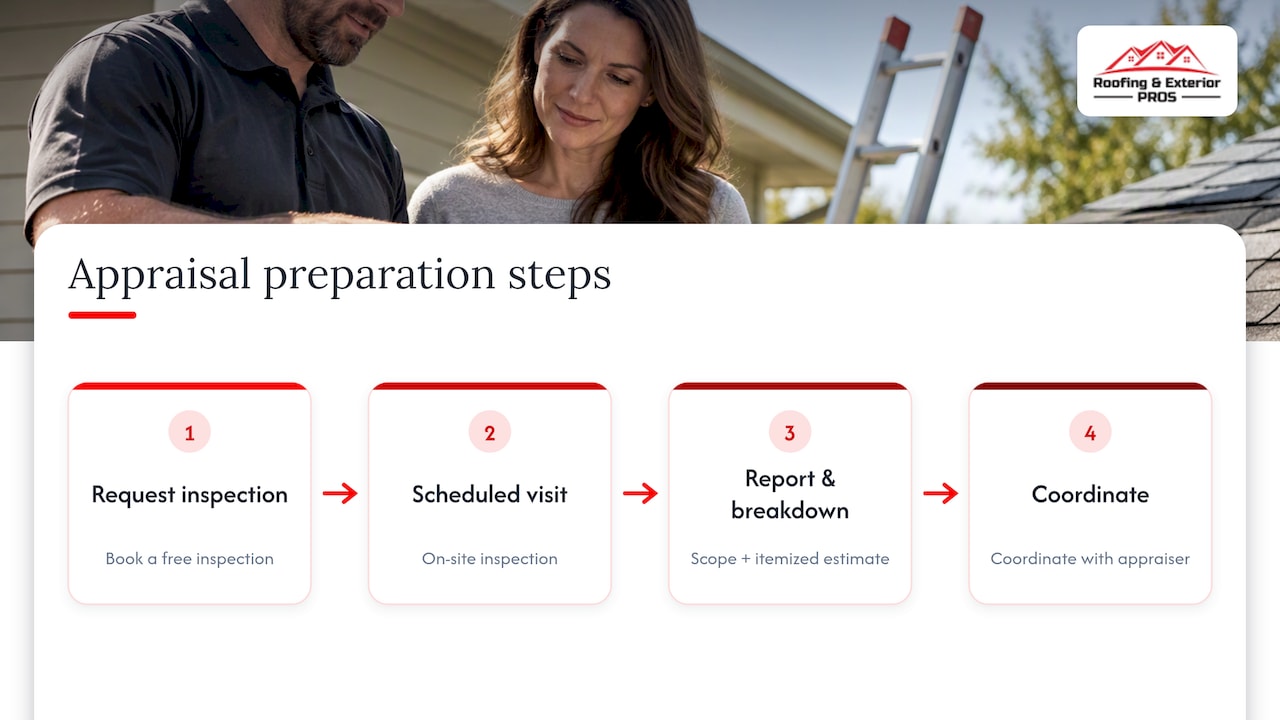
When your insurer’s number does not match your roof’s real repair cost, the strongest move is showing up to appraisal with documentation the insurer’s own adjuster cannot easily dispute. Roofing & Exterior PROS provides free inspections and itemized estimates that spell out code upgrade costs, material specifications, and labor line items, the exact detail an appraiser needs to weigh your side fairly. As a local, family-owned company serving the St. Louis metropolitan area, we work directly with homeowners to document damage thoroughly and coordinate with appraisers when a claim needs that extra step.
After you request an inspection, expect a scheduled visit, a written scope of the damage, and a clear breakdown you can hand straight to an appraiser or your insurer. Book a free inspection and get the documentation your appraisal demand needs.
What actually moves the needle in a roof appraisal
The single habit that separates a smooth appraisal from a drawn-out one is documenting the damage and getting an independent contractor estimate the moment you notice the disagreement, not after weeks of back and forth with the adjuster. A clearly written scope and a competent, genuinely neutral umpire settle more disputes fairly than any amount of arguing over who is right. Homeowners who treat the estimate and the umpire selection as the two decisions that matter tend to walk away from appraisal with a number that reflects the actual roof, not the first offer.
— Jake Ehlinger
Sources
- First-Party Insurance Disputes, Alternative Dispute Resolution Mechanism and Issues with Umpires and Appraisers
- Post-Disaster Claims Guide (NAIC)
- Appraisal: The appraisal remedy for property insurance
- The Appraisal Process (practitioner guide)
FAQ
What happens when an insurance claim goes to appraisal?
Each side names an appraiser, the two appraisers select a neutral umpire, and the panel inspects the roof and issues a written award. An award signed by any two of the three, per standard appraisal clause structure, becomes binding on the amount of loss.
How much does a roof appraisal cost?
Each party generally pays its own appraiser’s fee, while umpire and administrative costs are typically split between the homeowner and the insurer unless the policy states otherwise. Exact costs vary by policy language and state, so check your declarations page for specifics.
What is the 25% rule in roofing?
Definitions vary by state and insurer, but it generally refers to a matching or slope-based rule some insurers apply when deciding whether a percentage of undamaged roofing must be replaced to match repaired sections. This is not a standardized national rule, so it should be confirmed against your specific policy and state guidance rather than treated as universal.
How does an insurance claim work for a roof?
You report the damage, an adjuster inspects the roof and issues a coverage decision and settlement offer, and if you disagree with that dollar amount after coverage is accepted, you can invoke your policy’s appraisal clause. The NAIC’s post-disaster claims guide recommends documenting damage and reporting claims promptly to avoid delays at every step of that process.