Choosing the wrong roofing service contract can cost you thousands of dollars and leave you without coverage when you need it most. Yet most homeowners and property managers sign these agreements without fully understanding what they are getting. The different types of roofing service contracts vary widely in scope, pricing, duration, and legal protections. Some cover routine maintenance while others only apply to a single repair visit. Knowing the distinctions before you sign protects your property, your budget, and your peace of mind.
Table of Contents
- Key takeaways
- 1. What to look for in roofing service contracts
- 2. One-time roofing service contracts
- 3. Ongoing roofing maintenance agreements
- 4. Fixed-period service contracts
- 5. Emergency and storm damage repair agreements
- 6. Government and commercial roofing contract types
- 7. Warranty types and how they connect to your contract
- 8. Comparing roofing contract types side by side
- 9. How to choose the right roofing service contract
- My take on roofing contracts after years in the industry
- Work with a roofing team that makes contracts simple
- FAQ
Key takeaways
| Point | Details |
|---|---|
| Three core contract categories | Roofing contracts generally fall into one-time, ongoing maintenance, and fixed-period service agreements. |
| Warranty types differ significantly | Manufacturer warranties cover materials while workmanship warranties cover installation quality and are contractor-dependent. |
| Missing clauses cause disputes | Change order provisions and material lead time clauses are frequently absent but critical to protecting both parties. |
| Documentation protects your coverage | Keeping original contracts and invoices is required to successfully make warranty claims. |
| Match contract to your situation | Your roof’s condition, budget, and property management style should determine which contract type fits best. |
1. What to look for in roofing service contracts
Before you compare specific roofing contract types, you need a clear evaluative framework. Not all contracts are created equal, and the details buried in the fine print often determine whether you are protected or exposed.
Scope of work is the most critical element. A well-written contract should spell out exactly which services are included, which materials will be used, and what the contractor is responsible for completing. Vague language like “general roofing work” is a red flag.
Here are the key criteria to review in any service agreement for roofing:
- Scope of work: Specific tasks, materials, and areas of the roof covered
- Contract duration and renewal terms: How long the agreement lasts and whether it auto-renews
- Payment structure: Lump sum, installment schedule, or monthly billing
- Warranty coverage: Whether the contract includes a manufacturer warranty, a workmanship warranty, or both
- Exclusions: What the contract specifically does not cover, such as interior water damage or pre-existing conditions
- Change order provisions: How modifications to the original scope are handled and priced
- Dispute resolution: Whether disputes go to mediation, arbitration, or litigation
Missing change order clauses are among the most common sources of roofing litigation. If your contract does not address how scope changes are documented and priced, you are exposed to billing disputes the moment anything unexpected comes up.
Pro Tip: Ask every contractor to walk you through the exclusions section before signing. Most disputes start not from what the contract says but from what it leaves out.
Pay close attention to warranty language. Manufacturer warranties cover material defects while workmanship warranties cover the contractor’s installation quality. These are two separate protections, and many homeowners assume one covers both.
2. One-time roofing service contracts
A one-time contract is the most straightforward of all roofing contract types. You hire a contractor for a specific, defined job, such as replacing damaged shingles, patching a flat roof section, or completing a full roof installation. The scope is fixed, the price is agreed upon upfront, and the agreement ends when the work is done.
This type of contract works well for isolated repairs or planned replacements where you know exactly what needs to be done. The residential roof installation process typically falls under this category, with a clearly defined scope covering tear-off, underlayment, and material installation.
The main limitation is that one-time contracts offer no ongoing protection. Once the job is complete and the workmanship warranty period passes, you are on your own for future issues.
3. Ongoing roofing maintenance agreements
Ongoing roofing maintenance agreements are structured around regular, scheduled service visits rather than a single project. These contracts typically include biannual or annual inspections, gutter cleaning, minor repairs, sealant touch-ups, and written condition reports after each visit.
For property managers overseeing multiple buildings, this type of agreement is often the most cost-effective roofing service plan option available. Catching small problems early prevents them from becoming expensive structural failures. Poor record-keeping can void warranty benefits, and ongoing maintenance contracts create a paper trail that supports future warranty claims.
The pricing model for these agreements is usually a flat annual fee or a monthly retainer. Expect to pay more upfront than a single inspection would cost, but the bundled pricing typically offers savings compared to booking each service separately.
4. Fixed-period service contracts
Fixed-period contracts combine elements of both one-time and ongoing agreements. They run for a defined term, often one to three years, and include a scheduled mix of maintenance visits, periodic upgrades, and priority repair response. Think of them as a subscription to consistent roof care with a defined end date.
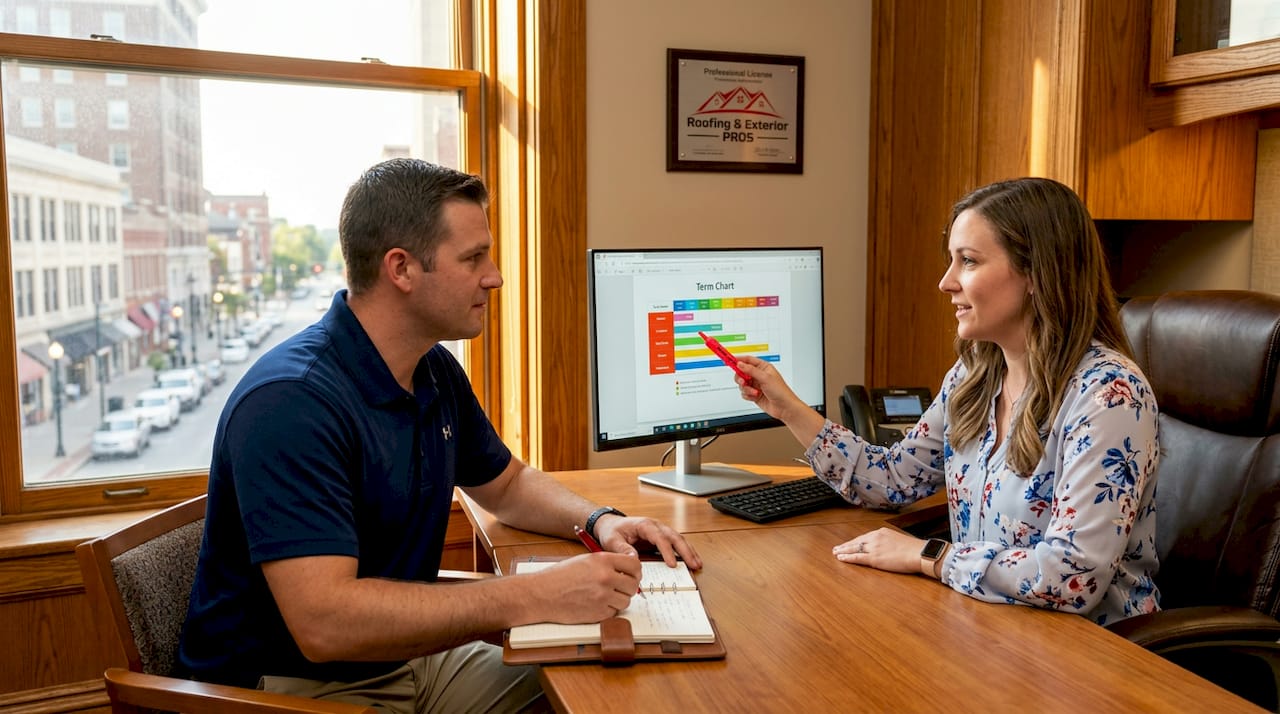
These contracts are common in commercial property management where building owners want predictable maintenance costs without committing to an indefinite service relationship. They are also useful for homeowners who recently had a new roof installed and want professional oversight during the critical early years when installation issues are most likely to surface.
Roofing contracts commonly fall into one-time service, ongoing service, and fixed-period service categories, each designed for a different project and ownership context. Understanding which category you are signing matters before you agree to any terms.
5. Emergency and storm damage repair agreements
Emergency agreements are a distinct category that many homeowners only discover after a major weather event. These contracts authorize a contractor to perform immediate protective work, such as tarping, boarding, or temporary patching, before a full assessment or permanent repair plan is in place.
The terms in emergency agreements move fast by necessity, and that speed creates risk. Contractors sometimes include broad authorization language that allows them to perform and bill for work beyond what you expected. Read these carefully even under pressure.
If your area experiences severe weather, having a pre-established relationship with a contractor who offers emergency roof repair services gives you a significant advantage. You skip the scramble to find someone reliable while your roof is actively leaking.
Storm damage situations also involve insurance claims, and your repair contract needs to align with your insurer’s documentation requirements. A contractor experienced in insurance claim processes can help you avoid gaps between what your policy covers and what the repair agreement specifies.
6. Government and commercial roofing contract types
While most homeowners will never deal with a government contract directly, understanding these structures adds useful context when evaluating commercial service agreements. Government roofing contracts use fixed-price, cost-plus, and time-and-materials models, each with different risk and payment profiles.
A fixed-price contract puts the cost risk on the contractor. You pay an agreed amount regardless of what the job actually costs them. A cost-plus contract reimburses the contractor for actual costs plus a fee, putting more financial risk on the property owner. A time-and-materials contract bills by labor hours and material costs, which can be unpredictable if the scope is not tightly defined.
Commercial property managers often encounter these models when hiring larger roofing firms. Knowing which model you are working under tells you immediately where your financial exposure lies.
7. Warranty types and how they connect to your contract
The warranty attached to your roofing contract is often more important than the contract itself. Yet many property owners treat it as an afterthought.
Most new roof leaks result from installation mistakes rather than material defects. That means your workmanship warranty, the one your contractor provides, is your first line of defense. The problem is that workmanship warranties are only as reliable as the contractor’s business. If they close up shop, that warranty disappears with them.
Manufacturer warranties, by contrast, are backed by the material supplier and often last 25 to 50 years on premium products. However, many warranties do not cover interior damage caused by roof leaks. Your homeowner’s insurance policy is what covers that, not the roofing warranty.
Third-party certifications offer a stronger layer of protection. A transferable roof certification from an independent inspection body covers both workmanship and materials comprehensively, and it can increase your property’s resale value because it transfers to the new owner.
8. Comparing roofing contract types side by side
Here is a direct comparison of the most common roofing service contract types to help you evaluate your options clearly.
| Contract type | Scope | Cost model | Duration | Best for |
|---|---|---|---|---|
| One-time service | Single project or repair | Fixed lump sum | Days to weeks | Specific, defined repairs or installations |
| Ongoing maintenance | Scheduled inspections and minor repairs | Annual or monthly fee | Open-ended | Homeowners wanting consistent roof health monitoring |
| Fixed-period service | Maintenance plus periodic upgrades | Flat fee per term | 1 to 3 years | Commercial properties or new roof owners |
| Emergency repair | Immediate protective work | Variable, often time-and-materials | Days | Post-storm or urgent leak situations |
| Commercial or government | Full project or long-term service | Fixed-price, cost-plus, or T&M | Project-based | Large commercial or institutional properties |
The contract type you choose also determines how quickly a contractor responds to problems. Ongoing and fixed-period agreements typically include priority response commitments. One-time contracts do not.
Pro Tip: Before signing any roofing contract, ask specifically whether the workmanship warranty is transferable and what happens to your coverage if the contractor goes out of business. These two questions reveal more about the quality of the agreement than almost anything else.
Legal protections also vary. Fixed-period and ongoing contracts tend to include more formal dispute resolution clauses. One-time contracts are simpler but may leave you with fewer options if something goes wrong after the work is complete.
9. How to choose the right roofing service contract
Matching the right contract to your specific situation requires honest assessment of three things: your roof’s current condition, your management style, and your budget.
Start by having a professional free roof inspection completed before you commit to any contract. The inspection results will tell you whether you need immediate repair work, preventive maintenance, or a full replacement. That answer should drive your contract choice.
Use this checklist when evaluating your options:
- Assess roof condition first: Know whether you are dealing with an aging roof, a new installation, or active damage before choosing a contract type
- Match scope to your management style: Property managers overseeing multiple units benefit from ongoing maintenance agreements; individual homeowners may prefer fixed-period contracts for simplicity
- Review budget and payment flexibility: If cash flow is a concern, look for contractors who offer installment billing rather than lump-sum payment. Roof financing options can also make larger contracts more manageable
- Verify warranty terms in writing: Confirm what is covered, what is excluded, and whether the warranty is transferable
- Check documentation requirements: Keep every invoice, inspection report, and signed contract. Missing paperwork can void your warranty coverage
- Negotiate change order provisions: Insist on written authorization for any work beyond the original scope before it begins
If your roof shows early warning signs of failure, an ongoing maintenance agreement is almost always the smarter financial choice over repeated one-time repair contracts.
Pro Tip: Get at least two contract proposals from different contractors for the same scope of work. Comparing them side by side often reveals which contractor is more thorough and transparent about what they are actually promising.
My take on roofing contracts after years in the industry
I have seen more roofing disputes than I care to count, and nearly all of them trace back to the same problem. Someone signed a contract without reading it carefully, or the contractor handed over a thin one-page agreement that left out the details that actually matter.
What surprises most property owners is how often the issue is not the contractor’s quality of work. It is the absence of a clear change order clause. A job starts at a quoted price, unexpected decking damage appears once the old shingles come off, and suddenly there is no written process for how that additional cost gets approved. That gap turns a routine project into a billing dispute.
I have also learned that workmanship warranties deserve far more scrutiny than they typically receive. Workmanship warranties are often less reliable than manufacturer warranties because they depend entirely on the contractor staying in business. A five-year workmanship warranty from a company that closes in year two is worthless. Ask for proof of business longevity and check their track record before you put weight on that coverage.
The property owners who fare best long-term are the ones who invest in ongoing maintenance agreements and treat their roof as a system that needs consistent attention, not just emergency intervention. A biannual inspection that catches a failing sealant joint costs a fraction of what a full interior water damage repair runs. That math is not complicated, but it requires a proactive mindset that many owners only develop after one expensive lesson.
— Jake
Work with a roofing team that makes contracts simple
Understanding roofing service contracts is the first step. Working with a contractor who explains every term, stands behind their work, and builds agreements around your actual needs is the next one.

At Roofingandexteriorpros, we work closely with homeowners and property managers across the St. Louis area to provide transparent, clearly written contracts for every type of roofing service we offer. From single repairs to long-term maintenance plans, our team covers residential and commercial roofing with workmanship warranties you can count on. We also offer free roof inspections so you know exactly what your roof needs before you commit to any agreement. Contact our team today to discuss your options and get a no-obligation quote.
FAQ
What are the main types of roofing service contracts?
The three core types are one-time service contracts, ongoing roofing maintenance agreements, and fixed-period service contracts. Each differs in scope, duration, and cost structure.
What does a roofing maintenance agreement typically include?
Most roofing maintenance agreements include scheduled inspections, minor repairs, gutter cleaning, sealant touch-ups, and written condition reports after each visit.
What is the difference between a manufacturer warranty and a workmanship warranty?
A manufacturer warranty covers defects in roofing materials, while a workmanship warranty covers the contractor’s installation quality. Most new roof leaks stem from installation issues, making the workmanship warranty your most immediate protection.
How do I know which roofing contract type is right for my property?
Start with a professional roof inspection to assess current condition, then match the contract scope to your budget and management style. Properties with aging roofs or multiple units benefit most from ongoing maintenance agreements.
Can a roofing warranty be transferred to a new owner?
Standard workmanship warranties are often not transferable, but third-party roof certifications from independent inspection bodies can be transferred to new owners, adding value at the time of sale.