
If you have a stain on the ceiling, damp insulation or drips in the attic, the first question is whether water is coming through the roof or forming inside the attic. The fastest clue is timing. A leak usually shows up during or after rain or melting snow, and often in one spot. Condensation tends to appear in cold weather, with or without precipitation, and spreads across a wide area of the underside of the roof deck. The two problems need different fixes, so it pays to know which one you are dealing with before anyone replaces a roof.
Below, we walk through the signs of each, a simple way to check your attic safely, why moisture can show up after a new roof, what the repairs and insurance questions look like, and when to have us take a look.
TL;DR
- Leak: tied to rain or snowmelt, usually in one place, often near a chimney, skylight, vent or valley.
- Condensation: tied to cold weather and indoor humidity, widespread dampness, frost, or rust on nail tips under the roof deck.
- New roof, new moisture: it is often condensation from house air reaching the attic, not a defective roof. Check whether it follows rain.
- The fix for condensation is usually sealing air leaks from the house, venting fans outdoors and correcting ventilation, not just adding vents.
- Can’t tell? Photograph and date what you see, then have a roofer inspect it. We offer free inspections and quotes across the St. Louis area.
Table of Contents
- The quickest test: does it follow the weather?
- Signs of a roof leak
- Signs of attic condensation
- Side by side
- How to check your attic safely
- What causes moisture in an attic
- Why moisture can show up after a new roof
- Fixing condensation: seal first, then ventilate
- What a roof leak repair costs, and what insurance does
- Our perspective
- When to have a roofer take a look
- Get a clear answer from a local team
- FAQ
- Sources
The quickest test: does it follow the weather?
Start with when the moisture appears, because that single detail separates most cases.
A leak is typically linked to precipitation. Roof leaks usually correlate with rain or melting snow and are often localized near penetrations such as chimneys, skylights, vents or valleys. This Old House makes the same point: a leak is often more apparent after heavy rain or snow.
Condensation follows temperature and humidity instead. Attic condensation often occurs during cold weather, even without precipitation, and shows up as widespread dampness, frost or rust on nail tips across the underside of the roof deck. GAF’s homeowner guidance frames it similarly: condensation usually appears during a cold spell, while moisture from a leak often occurs during or after a downpour.
So ask yourself three things:
- Did the stain appear or grow after a rainstorm, or after a cold, dry stretch?
- Is the wet area one patch, or spread out across several rafters or the whole underside of the roof?
- Does it dry out in mild weather and come back when it gets cold?
Rain-linked and single-spot points toward a leak. Cold-linked and widespread points toward condensation. Both can happen in the same house, which is why the details below matter.
Signs of a roof leak
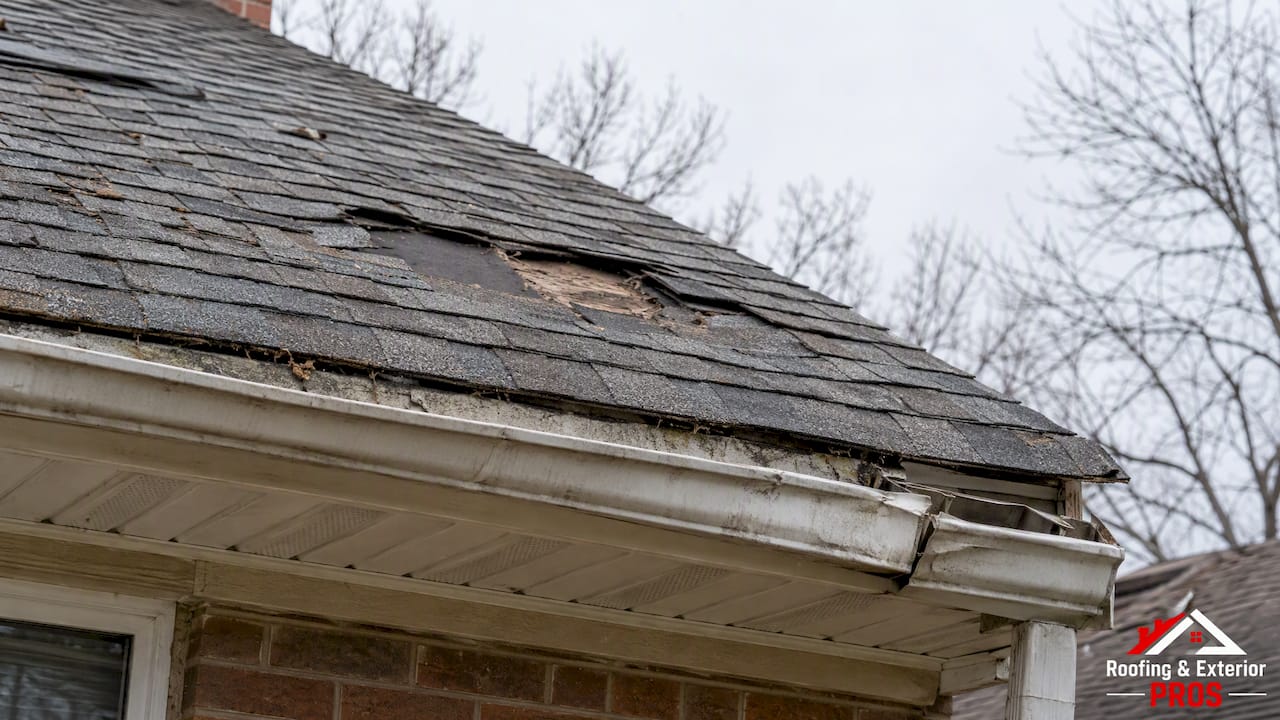
Leaks come from a breach: a lifted or missing shingle, failed flashing, a cracked vent boot, a worn skylight seal, or a damaged valley. Water enters at one point and travels. Common signs, drawn from This Old House’s checklist, include:
- Water stains on ceilings
- Peeling paint or blistering drywall
- Puddles in the attic
- Dripping sounds
- Musty odors and mold
- Moisture trails on rafters or roof sheathing
The last one is the most useful. Water rarely drops straight down from the hole. This Old House advises tracing moisture uphill in the attic, because the spot where water appears indoors may not be where it enters the roof. Follow the dark trail along a rafter or the sheathing until you find where it starts. If you want a deeper look at early warning signs, our guides on how to spot roof leaks before damage spreads and hidden roof leaks cover what to look for inside and out.
Clues from outside
You do not need a ladder. GAF notes homeowners can do routine checks from the ground with binoculars, looking for dark spots, missing shingles, sagging areas or damaged gutters. If a recent storm came through, our checklist of top signs of roof storm damage is a good companion, because a storm-lifted shingle is exactly the kind of small breach that leads to a single-spot leak.
Signs of attic condensation
Condensation happens when humid air meets a surface cold enough to pull the moisture out of it. The EPA’s moisture control guidance explains this basic mechanism and recommends limiting both indoor humidity and the movement of water vapor by airflow and diffusion. In an attic, the cold surface is the underside of the roof deck on a winter day, and the humid air comes from the living space below.
What you typically see:
- Frost on the underside of the roof deck on cold mornings, melting into drips when the sun hits the roof
- Rust on nail tips poking through the sheathing
- Damp or darkened sheathing across a broad area rather than a single trail
- Mold or mildew spread over many rafters
- Wet insulation, especially near the eaves. The Department of Energy’s attic guide lists warped or rotted wood, wet insulation near eaves, and mold or mildew as signs of water intrusion
Frost is the one that surprises people. A frosty deck that drips when it warms up looks like a leak, and it is easy to blame the roof. Per the same Marin Roof Repair breakdown, that pattern is characteristic of condensation. Our own explainer on attic moisture and roof problems goes further into what this looks like in practice.
Condensation can fool the ceiling too
Moisture indoors is not always the roof’s fault in either direction. This Old House cautions that damp walls, foggy windows, buckled ceiling materials and musty odors can result from condensation, and that broken pipes or HVAC leaks are other possible causes. If a stain sits below a bathroom, an air handler or a plumbing run, check those before assuming the roof. Even professional standards bodies acknowledge the confusion: ASTM notes that condensation can be incorrectly attributed to rainwater leakage, and that investigating dampness from condensation takes special expertise.
Side by side
| What you notice | More likely a roof leak | More likely condensation |
|---|---|---|
| Timing | During or after rain or snowmelt | Cold spells, often with no rain |
| Pattern | One spot or a trail running uphill | Broad, spread across the deck or many rafters |
| Location | Near chimneys, skylights, vents, valleys | Along the whole roof underside, often near the eaves |
| Telltale signs | Puddles, dripping, moisture trails on rafters | Frost, rusty nail tips, widespread dampness |
| Dries out | Soon after the rain stops, unless the leak is slow | Mild weather, then returns in the cold |
| Typical root cause | Breach in shingles, flashing or seals | Warm, humid house air reaching a cold roof deck |
Treat the table as a guide, not a verdict. A slow leak can feel constant, and a house with both a damaged vent boot and poor air sealing can show both patterns at once.
How to check your attic safely
You can gather useful information in about fifteen minutes, and none of it requires touching the roof.
- Pick your moment. Look once during or soon after a rainstorm, and again on a cold morning. Two visits tell you more than one.
- Use a flashlight and stay on the framing. Step only on joists or boards laid across them, never on insulation or drywall between joists. If you see wet insulation around wiring or light fixtures, stay away and call a professional.
- Look at the whole underside of the deck. Scattered frost, rusty nails or uniformly damp wood suggest condensation. A single dark trail points to a leak.
- Trace uphill. Follow any trail along rafters to its highest point, which is closest to the entry.
- Check the air paths. Condensation is frequently made worse by warm, moist air leaking up through gaps around light fixtures, plumbing stacks, attic hatches or unsealed ducts. Look for stained insulation around those spots.
- Check the exhaust ducts. Make sure bathroom fans, the kitchen range and the dryer vent all lead outdoors, not into the attic.
- Document it. Photos with dates and weather notes make a useful record for contractors or insurance claims.
For a more detailed walkthrough of locating the entry point, see how to find roof leaks before damage spreads.
What causes moisture in an attic
Most attic moisture comes from inside the house. A few of the usual suspects:
- Fans venting into the attic. The Department of Energy describes venting kitchen ranges, bathroom exhaust fans and dryers into the attic as a major moisture source and a bad practice that may violate local building codes.
- Air leaks from the living space. InterNACHI explains that moisture vapor from indoors can move through small openings with air currents. Recessed lights, attic hatches and wiring holes are the usual routes.
- Poor ventilation. The same InterNACHI page notes that humid outdoor air from improper attic or roof venting can condense on roof framing.
- High indoor humidity. Unvented humidifiers, long showers with no fan, and drying laundry indoors all load the air with moisture.
The chimney effect makes it all worse. Canada Mortgage and Housing Corporation describes a heated house as acting like a chimney, pushing warm air upward into the attic. The warmer and more humid the house, the more moisture rides that air current into a cold attic. That source is Canadian, but the physics apply to any heated home in a cold-winter climate, including ours here in Missouri.
Why moisture can show up after a new roof
This is one of the most common worried calls we hear: the roof is brand new, and now the attic is damp. The reaction is to blame the install. Sometimes that is right, but often it is not.
Two things commonly happen. First, the new roof may be tighter than the old one, so air and moisture that used to escape slowly through aging materials now stay put. Second, moisture problems that already existed in the attic (humid house air leaking up, fans venting into the space, thin ventilation) were not addressed during the install, because a roof replacement fixes the roof, not the house below it. The EPA guidance linked above points to the same underlying mechanism: humid air meets a cold surface. A new deck is just as cold as an old one.
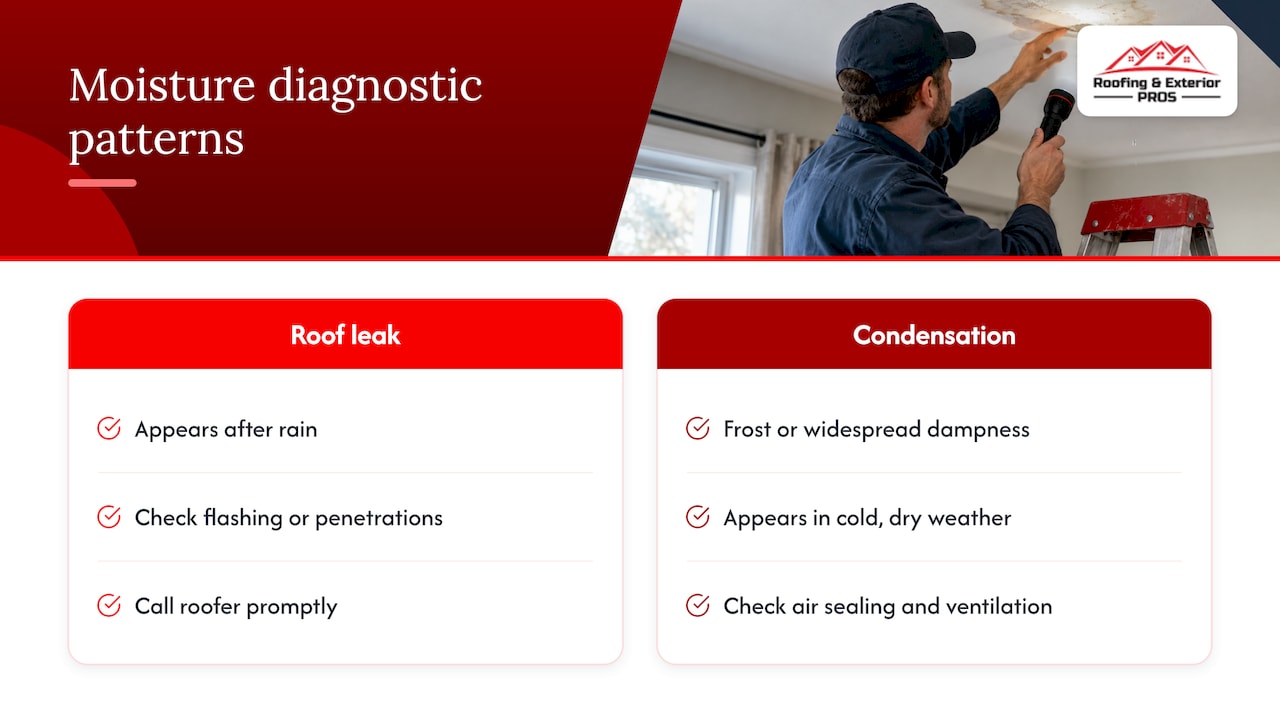
So the same test applies. If the moisture shows up after rain, ask your roofer to look for a flashing or penetration problem, and call them back promptly while any workmanship warranty is in effect. If it appears in cold, dry weather as frost or widespread dampness, look at air sealing and ventilation first. Our residential roof installation process guide explains what a proper install includes, and our roof replacement guide covers questions worth asking before a job begins.
Fixing condensation: seal first, then ventilate
When the cause is condensation, the repair is about the attic and house, not the shingles. Here is the order we would usually think about it.
- Stop the air leaks. Seal gaps around light fixtures, plumbing stacks, attic hatches and ducts. CMHC notes that increasing attic ventilation is not always the correct fix for a wet attic, and that sealing air paths from the house is often the most effective solution.
- Reroute exhaust. Bathroom fans, range hoods and dryers should discharge outdoors. Marin Roof Repair’s guidance lists stopping air leaks, rerouting fans, clearing soffit vents, improving ventilation and managing indoor humidity as the core steps.
- Clear and balance ventilation. Insulation stuffed into the eaves can block soffit vents. The Department of Energy’s guide recommends keeping attics dry, well ventilated and insulated, and pairing soffit vents with a ridge vent for better effectiveness. Our articles on what your attic needs for ventilation and ventilation problem signs go into this.
- Manage indoor humidity. Run fans during and after showers and cooking, and keep humidifier settings modest in cold weather.
Ventilation is not a cure-all. InterNACHI’s inspection guidance says ventilation and insulation help control condensation by limiting moisture-vapor buildup and drying small amounts of condensation on the roof deck underside, but that ventilation in hot, humid conditions can sometimes add moisture. That is why the right remedy depends on the house. Condensation in any roofed, enclosed space comes down to humidity and airflow, and this look at garden room ventilation and condensation shows the same balance in a smaller structure.
Some homes take a different approach. In cold climates, unvented attics can be built with closed-cell spray foam or rigid foam above the deck so interior moist air never reaches cold roof surfaces. That is a design decision to discuss with a qualified contractor, not a quick patch.
What a roof leak repair costs, and what insurance does
If you do have a leak, repair costs vary widely. ConsumerAffairs reports average U.S. roof leak repair costs of about $360 to $1,550, with straightforward jobs often around $300 to $600. The same page lists examples such as $200 to $500 for flashing damage, $300 to $800 for a leaking skylight and $10 to $20 for a cracked vent boot. Price moves with the extent of the damage, how accessible the roof is, the material, local labor rates and whether interior damage needs repair too. We do not publish set prices, because a fair number needs an inspection first. Those figures are national, not St. Louis quotes.
On insurance, the Missouri Department of Commerce and Insurance explains that standard homeowners policies typically do not cover wear and tear or gradual deterioration of a roof, though they may cover damage from sudden events like windstorms. In practice, a leak from a storm-damaged roof and a leak from an aging roof are treated differently. Condensation damage that builds up slowly is more likely to fall into the gradual category, so read your policy and talk to your agent. Good records help: the photos and dates from your attic check are exactly what a claim file needs. Our storm damage guide for Missouri homes explains the restoration process, and we can help you with the insurance claim side.
Our perspective
We are a family-owned company, and most of our roof leak calls start the same way: a homeowner sees a stain, assumes the worst about the roof and braces for a replacement. Our first goal is to find out whether the roof is actually the problem. A roof that is fine does not need replacing, and a roof that is failing should not be patched over because the stain looked like frost.
We think the best inspection looks at both sides of the roof deck. That means the shingles, flashing and penetrations outside, and the insulation, air sealing, exhaust routing and ventilation inside. We tell homeowners what we see and show them photos, so you can judge it with us. When the problem is condensation, we will say so, even though it is not a roofing sale, because honest answers are what keep a local business in the neighborhood. When the roof is the problem, we will explain the repair, and whether a replacement is really needed or a targeted fix will do.
One habit we would encourage in every homeowner: check your attic in spring and again in the dead of winter. Missouri’s extension service recommends that homeowners check the accessible underside of the roof for water stains or dampness, and check fascias and soffits for paint failure and decay, in spring. Small signs caught early cost far less than rotted decking.
— Jake Ehlinger
When to have a roofer take a look
Call for an inspection when:
- A stain grows after each rain, or you can see dripping or standing water in the attic
- You find wet or moldy insulation, soft or warped decking, or rusty nails across a wide area
- Moisture appears after a new roof and you cannot tell whether it follows rain
- A recent storm has passed and you see missing or lifted shingles, damaged flashing or clogged gutters
- You are not sure: this is a case where an expert is worth it, since even ASTM’s roof leakage guide excludes condensation problems from its scope
If water is actively coming in, our 24/7 emergency repair and tarping service can limit damage until a permanent repair is made. Before you call, jot down when the moisture appears and take your photos.
Get a clear answer from a local team
We handle residential and commercial roofing across the St. Louis area, including leak repair, storm damage restoration and insurance claim assistance. We also work on the gutters, fascia and soffit that so often play a part in moisture problems. Our inspections and quotes are free, and we will tell you plainly whether you have a leak, a condensation issue or both.

If you would like a second set of eyes, contact Roofing & Exterior PROS to schedule an inspection. If your fascia or soffit looks stained or soft, see our fascia and soffit repair and replacement page too.
FAQ
Is my roof leaking or is it condensation?
Look at timing and pattern. A leak usually shows up with rain or snowmelt and sits in one place or follows a trail uphill. Condensation shows up in cold weather, often without rain, as frost, rusty nail tips or widespread dampness under the deck. If you cannot tell, document it and have a roofer inspect it.
Can condensation cause water stains on my ceiling?
Yes. Heavy attic condensation can soak insulation and drip onto the ceiling below, and it can also cause buckled ceiling materials and musty odors. It can look just like a leak, which is why checking the attic is worth doing. Plumbing and HVAC leaks can cause similar stains, so rule those out too.
Why is my attic damp after a new roof?
Often the cause is warm, humid house air reaching the cold roof deck, or moisture problems that existed before the install and were never fixed. Check whether the dampness follows rain. If it does not, look at air sealing, exhaust routing and ventilation. If it does follow rain, call your roofer promptly.
Does homeowners insurance cover a roof leak?
It depends on the cause. Per the Missouri Department of Commerce and Insurance, standard policies typically do not cover wear and tear or gradual deterioration, but may cover sudden events such as windstorms. Read your policy, ask your agent, and keep dated photos of the damage.
Will adding more attic vents stop condensation?
Not always. Sealing air paths from the house is often the most effective fix, and ventilation helps only when it is balanced and unblocked. A roofer can look at both before you spend money on new vents.
Sources
- ASTM D7053/D7053M guide on roof leakage and condensation
- This Old House: How to find and fix a roof leak
- Marin Roof Repair: Roof leak or condensation
- GAF: Understanding roof condensation solutions
- GAF: How to identify roof damage
- U.S. EPA: Moisture control guidance
- U.S. Department of Energy: Guide to durable attics
- U.S. Department of Energy: Unvented conditioned attics
- InterNACHI: Moisture problems
- InterNACHI: How to inspect for moisture intrusion
- CMHC: About your house
- ConsumerAffairs: Cost to repair a roof leak
- Missouri Department of Commerce and Insurance: Raising the roof on insurance coverage
- University of Missouri Extension: Home repair inspection and specifications