
Report roof storm damage to your insurer within days, not weeks. Missouri policies often carry a suit deadline near 12 months, but your carrier’s own reporting window is much shorter. Document everything with photos, make temporary repairs and keep every receipt, then call your insurer or agent the same day you spot damage.
TL;DR:
- Most Missouri roof claims are acknowledged within 10 working days and concluded with a decision in four to six weeks if well-documented.
- Filing a claim promptly within your policy’s specified window and keeping detailed photos and receipts are crucial to prevent delays or denials.
- Insurers have 30 days to investigate and 15 days to respond after receiving a complete proof of loss, but storm volume can extend these timelines.
- A claim journal with timestamped records, photos, and receipts greatly increases the chances of faster approval and reduces disputes.
- Disputes or delays can be challenged by requesting supplements, enforcing deadlines in writing, and consulting consumer advocacy resources or legal counsel if needed.
Table of Contents
- How Long Does a Roof Claim Take in Missouri?
- What Are Missouri’s Claim Deadline Rules, Hour by Hour?
- Building a Claim Journal That Protects Your Payout
- Emergency Repairs Without Losing Your Claim
- Where Policy Language Overrides General Timelines
- What to Do When a Claim Stalls or Gets Denied
- How Roofing & Exterior PROS Helps Missouri Homeowners Stay on Track
- Authoritative Missouri Resources for Roof Claims
- The Gap Between Regulatory Deadlines and What Actually Happens
- Sources
- FAQ
How Long Does a Roof Claim Take in Missouri?
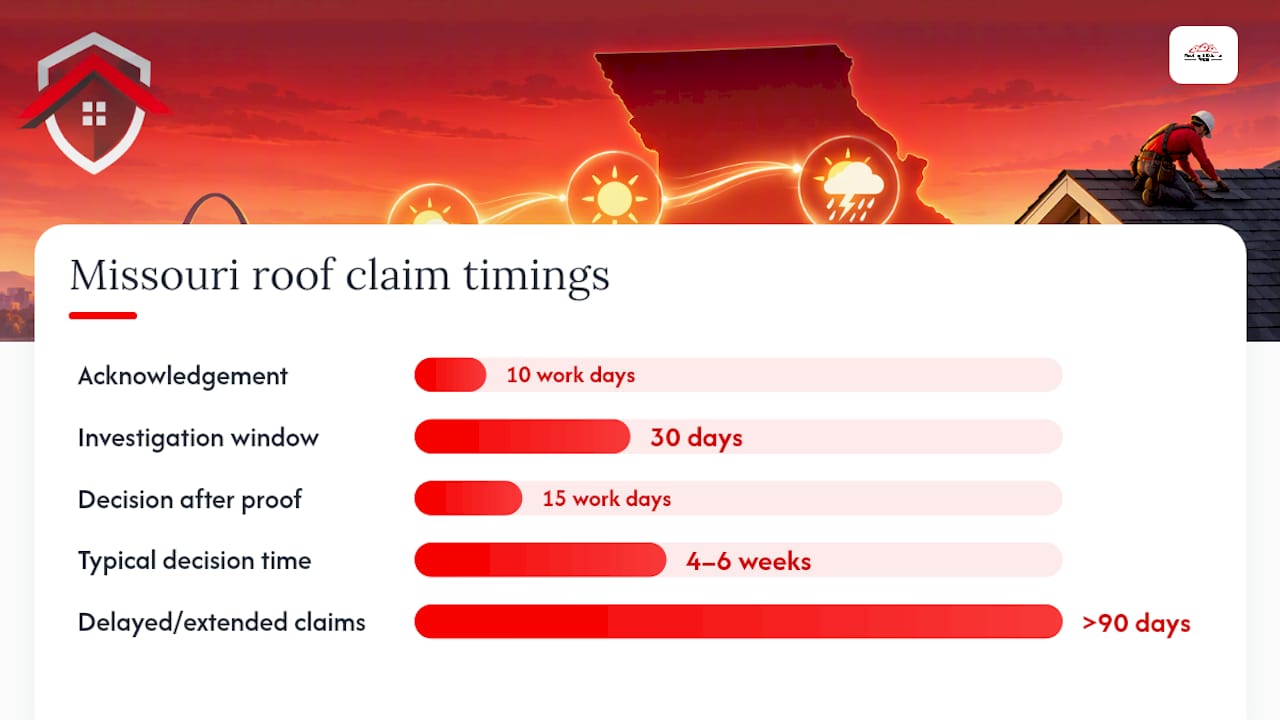
The roof claim timeline in Missouri runs on a predictable rhythm once you understand the regulatory checkpoints. State rules require insurers to acknowledge your claim and send forms within 10 working days, finish the investigation within 30 days unless they need more time, and tell you whether they’re paying or denying within 15 working days after they receive a completed proof of loss. Homeowners who report fast and document well often see a decision inside four to six weeks. Homeowners who wait, or who hand adjusters incomplete paperwork, can watch that same claim stretch past 90 days.
Missouri doesn’t set a hard legal deadline for when you must first report storm damage, but nearly every homeowner policy does, and that policy language controls. Some carriers want notice “promptly” or “as soon as reasonably possible.” Others name a specific window. Waiting three weeks because you’re busy, or because you assumed the damage was “just cosmetic,” is the single most common reason Missouri roof claims get delayed or denied outright.
The Missouri Department of Commerce & Insurance, often called Missouri DCI, publishes guidance that spells out what happens once you call. The agency tells homeowners to contact their insurer or agent immediately, photograph and video the roof and any interior damage, and make temporary repairs to stop further harm while keeping every receipt. That last part matters more than most people realize. Insurers reimburse documented emergency repairs, not vague claims that “we tarped it ourselves.”
Here’s the practical roof claim process Missouri homeowners walk through, start to finish:
- Confirm the damage is safe to inspect, then photograph the roof from the ground, the attic if accessible, and any interior water intrusion before you touch anything.
- Call your insurance agent or carrier directly to open the claim. Ask for your claim number, the assigned adjuster’s name and phone number, a copy of your policy’s reporting deadline, and any required proof of loss forms.
- Arrange an independent contractor inspection separate from the insurance adjuster. A local roofer who inspects the same damage often catches missed hail hits or wind lifted shingles that a rushed adjuster visit overlooks.
- Meet the adjuster on site if possible. Having your contractor present when the adjuster inspects tends to produce a more complete first estimate and fewer disputes later.
- Review the written estimate line by line against your contractor’s own measurements. Missing flashing, insufficient ventilation upgrades, or code-required underlayment are common gaps.
- File a supplement request for anything the adjuster’s estimate missed, backed by photos and your contractor’s itemized bid.
- Track payment phases. Expect an initial advance, then a final payment once repairs are complete and, if your policy pays actual cash value first, a recoverable depreciation check after the work is done and documented.
Supplements are routine, not confrontational. Insurance estimating software frequently underprices labor and material costs for the St. Louis region, and adjusters working large storm events move fast across dozens of properties in a day. A detailed contractor estimate that itemizes decking replacement, ice and water shield, and code upgrades gives the adjuster something concrete to approve rather than argue over.
Pro Tip: Ask your adjuster in writing for the specific reporting deadline in your policy before you hang up the phone. Verbal answers get misremembered; a written deadline in an email or claim portal message protects you if a dispute comes up later.
What Are Missouri’s Claim Deadline Rules, Hour by Hour?
Missouri’s insurance claim timeframes break into distinct windows, and knowing them turns a confusing waiting game into a checklist you can hold your insurer to.
0 to 72 hours after the storm: This is when you document and stabilize. Photograph the roof, gutters, and any interior leaks before cleanup disturbs the scene. Tarp exposed areas to prevent secondary water damage, save every receipt for materials or contractor labor, and call your insurer or agent to open the claim. Missouri DCI’s post-disaster guidance names this exact sequence as the foundation for a smooth claim.
3 to 10 days: Regulations require your insurer to acknowledge your claim and send required forms within 10 working days of notification. In practice, smaller, non-catastrophe claims often move faster, with adjuster contact in three to five business days. Widespread hail or wind events that trigger hundreds of claims across the St. Louis metro at once routinely push that timeline toward the full 10-day window or beyond, since every carrier in the region is fielding calls simultaneously.
Up to 30 days: Missouri rules give insurers 30 days to complete the investigation unless they need more time, in which case they must tell you why. This is the phase where the adjuster inspects, your contractor’s estimate gets compared against theirs, and any obvious supplement gaps come to light.
15 working days after proof of loss: Once you submit a properly completed proof of loss, your insurer must communicate acceptance or denial within 15 working days. This is arguably the single most useful number in the entire Missouri claims process, because it’s the one deadline you can hold a carrier to with a specific citation if they go silent.
Beyond 30 to 45 days: If your claim stays open past the standard investigation window, Missouri’s rules require the insurer to keep you updated on why. A reasonable habit is requesting a status explanation roughly every 45 days if the claim remains open, which keeps the file active on their end and creates a paper trail on yours.
Months to a year, for major disasters: Large-scale catastrophe events, the kind tracked in NOAA’s billion-dollar disaster data, can keep claims open for months as adjusters, contractors, and material suppliers all work through backlogs at once. United Policyholders notes that Missouri’s typical 12-month suit deadline can sometimes be extended after a major disaster, but you should never assume that extension applies without confirming it with your carrier in writing.
Statewide, the average roof claim time from first report to final payment tends to fall somewhere between 30 and 60 days for a well-documented, single-property claim, and considerably longer during a declared catastrophe. Your own claim timeline depends heavily on how fast you report and how complete your documentation is from day one.
Building a Claim Journal That Protects Your Payout
A claim journal is the single cheapest thing you can do to shorten your own timeline. NAIC’s consumer guidance is blunt about this: a complete damage list, photos, receipts, and policy details in hand mean the adjuster spends less time chasing basic information and more time approving your estimate.
Start with photos and video, shot before anyone starts cleanup:
- Wide shots of each roof slope from the ground, showing the full extent of visible damage.
- Close-ups of individual hail hits, torn shingles, or lifted flashing with a coin or ruler for scale.
- Interior ceiling stains, attic insulation soaked from leaks, and any damaged personal property.
- Gutters, downspouts, siding, and window screens, since wind and hail rarely stop at the roofline.
Timestamp every photo automatically through your phone’s camera app, and back the files up to cloud storage the same day. Losing your only copy of pre-repair photos is one of the fastest ways to turn a straightforward claim into a drawn-out dispute.
Your journal itself should track:
- The date and time of every call, with the name of who you spoke to and what was said.
- Your claim number, written at the top of every page or document so nothing gets misfiled.
- The adjuster’s name, direct phone number, and every deadline they give you verbally.
- Copies of every contractor estimate, itemized by line, since a detailed inspection checklist makes supplement requests far easier to defend.
Hold onto damaged shingles, flashing, or gutter sections until the adjuster has inspected, and keep every receipt tied to emergency repairs. Missouri DCI’s guidance is explicit that emergency repairs are reimbursable when properly documented, but permanent repairs made before an inspection can create disputes over what damage existed before the storm.
Emergency Repairs Without Losing Your Claim
Temporary repairs are not just allowed, they’re expected. Tarping a hole in the roof or covering broken windows prevents secondary water damage that could otherwise reduce your payout or give the insurer grounds to argue neglect. What you should not do is authorize permanent repairs before the adjuster inspects, unless your carrier specifically tells you to proceed.
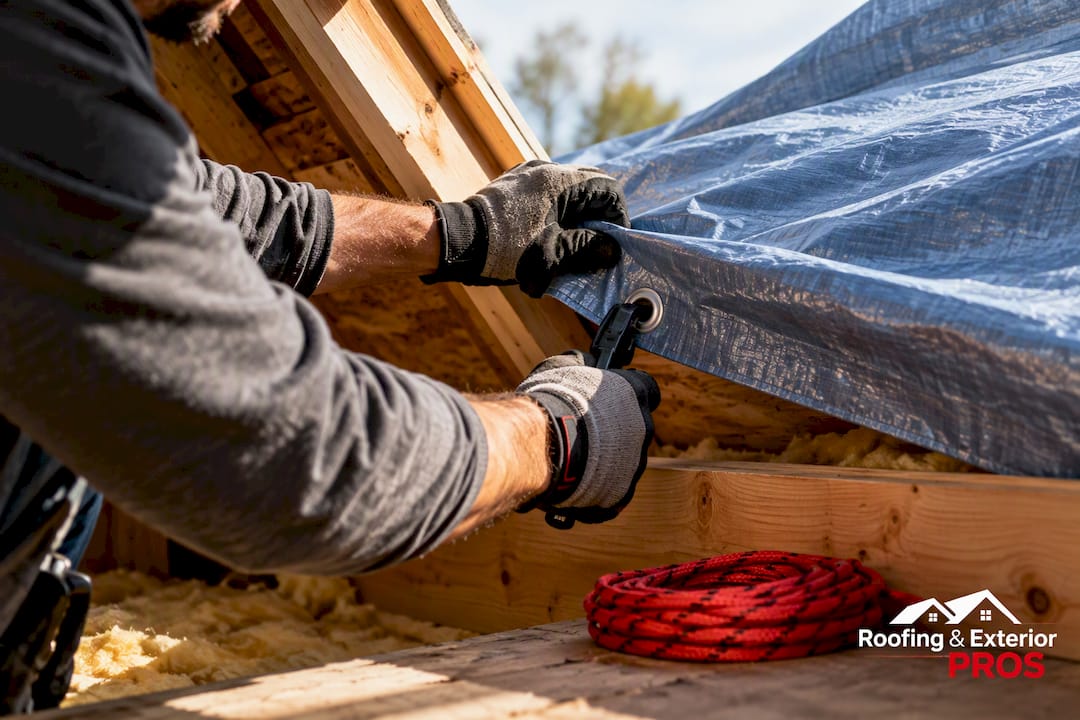
When a local roofer meets the adjuster on site, it changes the dynamic in your favor. A contractor who documents the same slopes, the same hail hits, and the same flashing issues creates a second set of eyes that often catches what a rushed inspection misses, especially during a busy catastrophe season when adjusters are covering dozens of homes a day.
Watch for these warning signs from door-knocking contractors after a storm:
- Pressure to sign a contract on the spot, before you’ve even called your insurer.
- Offers to “waive your deductible” or pay it for you, which is illegal in Missouri and a common fraud tactic.
- Demands for full payment upfront, before any work begins.
- Vague or missing license and insurance information when asked directly.
Pro Tip: If a contractor promises a roof “for free” through your insurance, walk away. Legitimate roofers explain the deductible clearly and never claim to eliminate it.
Call for emergency tarping when active leaks threaten your ceiling, attic, or belongings. If the damage is cosmetic and weather tight, it’s often fine to wait for adjuster guidance before spending money on temporary fixes.
Where Policy Language Overrides General Timelines
Every Missouri homeowner policy has three clauses that quietly control your entire claim, and most people never read them until there’s a problem. Look for “notice of loss,” “proof of loss,” and “suit against us” in your policy’s conditions section. These sections spell out exactly how fast you must report, what paperwork counts as complete, and how long you have to sue if you disagree with the outcome.
The proof of loss clause matters because it starts the clock on the 15-working-day decision window. An incomplete or informally submitted proof of loss doesn’t trigger that deadline, which is why submitting it in writing, with proof of delivery, protects you if the insurer later claims they never received it or received something incomplete.
Replacement cost value and actual cash value show up in nearly every roof claim dispute. RCV pays the full cost to replace your roof with materials of similar kind and quality. ACV pays RCV minus depreciation, meaning older roofs often get a smaller initial check with a recoverable depreciation payment released once repairs are complete and documented. Some Missouri policies apply ACV specifically to roofs regardless of your overall dwelling coverage, a detail buried in an endorsement most homeowners never notice until claim time.
Special deductibles complicate the math further:
- Percentage deductibles, sometimes 1% or 2% of your dwelling coverage rather than a flat dollar amount, can make a marginal claim not worth filing.
- Separate wind and hail deductibles, common in storm-prone regions, may apply instead of your standard deductible.
- Named-storm deductibles occasionally apply to specific catastrophic weather events, though these are less common in Missouri than in coastal states.
Call your agent before you file and ask them to confirm, in writing, your exact reporting deadline and which deductible applies to wind and hail claims specifically. That single email can save you from a denial based on a technicality you never knew existed. United Policyholders’ Missouri consumer guide reinforces that policy wording, not general assumptions, controls every one of these deadlines.
What to Do When a Claim Stalls or Gets Denied
A slow or lowball claim is frustrating, but Missouri gives you concrete steps to push back rather than just waiting and hoping.
- Request a formal reconsideration or supplement, attaching your contractor’s itemized estimate, photos, and any documentation the adjuster’s original inspection missed.
- Contact Missouri DCI’s Insurance Consumer Hotline at (800) 726-7390 if your carrier won’t respond or the dispute stalls. DCI investigates complaints about claim handling and coverage disputes and can intervene directly with the insurer.
- Consider a public adjuster only for large, complex, or disputed claims. Public adjusters typically charge a percentage of your settlement, so they make the most sense when the disagreement involves tens of thousands of dollars, not a routine shingle repair.
- Track your suit deadline carefully. Missouri policies commonly set a 12-month window to sue after a denial, but that period runs from specific policy language, not a universal statute, so confirm the exact date with your policy or an attorney.
- Consult an attorney for complex denials, especially ones involving bad faith allegations or disputes over whether damage is storm related versus pre-existing wear.
Document every step of this process the same way you documented the original damage. A clear paper trail is often what turns a stalled claim into a paid one.
How Roofing & Exterior PROS Helps Missouri Homeowners Stay on Track
We work with homeowners in the St. Louis metro area at every stage of a storm claim. Our free roof inspections document damage the same day you call, giving you photos and a written estimate before the adjuster ever shows up.
We can meet adjusters on site to provide a second set of eyes, which often helps reduce missed line items and later supplement disputes. When a roof needs immediate protection, our emergency tarping and storm restoration crews respond quickly to stop secondary damage while your claim moves through the insurer’s review.
During major regional storm events, when high claim volume slows insurer response times, assistance with documentation and supplement requests can help get approvals without a second visit. That groundwork, done right the first time, is usually what separates a 30-day claim from a 90-day one.
Authoritative Missouri Resources for Roof Claims
For official rules and complaint filing, Missouri DCI’s severe weather resource page and consumer hotline are the fastest path to a real answer about a stalled claim. The full regulatory text governing insurer timeframes lives in Mo. Code Regs. tit. 20, § 100-1. National consumer guidance from NAIC and United Policyholders rounds out the picture with practical advice that applies across states, while NOAA’s disaster tracking data explains why catastrophe-level events strain claim timelines the way they do.
The Gap Between Regulatory Deadlines and What Actually Happens
Missouri’s 10, 30, and 15 working day rules read like guarantees. They’re not. They’re maximum windows an insurer is legally allowed to take, and plenty of adjusters treat them as the target rather than the ceiling. The homeowners who get paid fastest aren’t the ones who wait patiently for the system to work. They’re the ones who document obsessively in the first 72 hours and then use those specific regulatory numbers as leverage when a claim starts to drift.
Conventional advice tells you to “call your insurance company and wait for the adjuster.” That’s incomplete. The real work happens before the adjuster ever arrives, in the photos you take, the receipts you keep, and the written record you build of every phone call. A claim journal isn’t busywork. It’s the difference between an adjuster who has to take your word for what happened and one who has a dated, timestamped record that makes disputing your estimate more trouble than it’s worth.
If you take one thing from this, prioritize the 15 working day proof of loss deadline above all else. It’s the most concrete, most enforceable number in the entire process, and most homeowners never even know it exists.
— Jake Ehlinger
Sources
- Missouri Department of Commerce & Insurance — post-disaster guidance
- Mo. Code Regs. tit. 20, § 100-1 (insurance claim handling rules)
- Resources for Severe Weather Victims — Missouri Department of Commerce & Insurance
- What you need to know when filing a homeowners claim — NAIC
- Insurance consumer rights in Missouri — United Policyholders
FAQ
How Long Does It Take for a Roof Claim to Be Approved?
Most well-documented Missouri roof claims get a decision within a few weeks to a couple of months of filing, though Missouri rules give insurers up to 30 days to investigate and 15 working days to decide once they receive a complete proof of loss. Catastrophe-level storm events with heavy claim volume regularly push that timeline longer.
How Long Does an Insurance Company Have to Settle a Claim in Missouri?
Missouri regulations require insurers to acknowledge your claim within 10 working days, complete the investigation within 30 days unless more time is genuinely needed, and communicate acceptance or denial within 15 working days of receiving a properly completed proof of loss. These are maximum windows, not typical wait times for a simple claim.
How Long After a Storm Do You Have to File a Roof Claim?
Missouri law doesn’t set one universal deadline, but most homeowner policies require notice “promptly” or within a specific window stated in your policy, and suit deadlines commonly run around 12 months from the date of loss. Report damage within days of discovering it, and confirm your exact policy deadline with your agent in writing.
What Is the 25% Rule for Roofing?
The so-called 25% rule refers to a matching or code upgrade provision some policies and local building codes apply, requiring full replacement of a roof slope or system if damage affects roughly a quarter or more of it, rather than a partial patch repair. Whether this applies to your claim depends entirely on your specific policy language and local building code, so confirm it directly with your insurer or contractor rather than assuming it’s universal.