TL;DR:
- Managing commercial roofing contracts requires thorough preparation, detailed bids, and precise agreements to prevent disputes and safeguard investments. Property owners should gather comprehensive roof records, obtain multiple bids with clear scope and cost breakdowns, and include essential clauses such as scope of work, payment schedule, insurance proof, and dispute resolution in their contracts. Effective project management, documentation, and adherence to legal requirements ensure successful roofing projects and protect against common pitfalls.
Managing a commercial property means making dozens of decisions that affect your bottom line, and few carry more financial weight than your roofing contracts. When you handle commercial roofing contractor contracts without a clear system, you risk costly disputes, poor workmanship, and unexpected expenses that blow through your budget. Property owners and managers who approach these agreements with preparation and a structured review process consistently get better results. This guide walks you through everything you need to evaluate bids with confidence, build airtight contracts, and protect your investment from the first signature to the final inspection.
Table of Contents
- Key Takeaways
- What you need before handling roofing contracts
- How to evaluate commercial roofing contractor bids
- Key contract components you must include
- Managing and verifying roofing contracts in practice
- Avoiding common mistakes in commercial roofing contracts
- My take on handling these contracts after years in the field
- Work with a contractor who gets the contract right
- FAQ
Key Takeaways
| Point | Details |
|---|---|
| Prepare before you sign | Gather roof history, inspection reports, and service records before approaching any contractor. |
| Get at least 3 detailed bids | Comparing multiple proposals helps you catch red flags and control costs across all properties. |
| Know your contract components | Every agreement must include scope of work, payment terms, insurance proof, and dispute resolution. |
| Document every change | All project changes must be approved in writing to prevent scope creep and billing surprises. |
| Treat the roof as an asset | Routine mid-year reviews and strategic planning reduce emergency repair costs over time. |
What you need before handling roofing contracts
Before you review a single bid or sign anything, you need a clear picture of what you are working with. Property owners who skip this step often discover mid-project that the scope was never defined correctly, leading to change orders that inflate the final cost.
Start by assembling your property’s roofing records. This includes prior inspection reports, service logs, dates of previous repairs, and the original installation date. ASTM E2018 standards recommend comprehensive property condition assessments to support intelligent asset management. Knowing your roof’s age and service history directly shapes what any contractor should be proposing.
Next, set a realistic budget with payment structure in mind. Industry best practices call for upfront payments in the range of 10 to 15 percent of the total contract value. Anything significantly higher should raise questions before you proceed.
Here is what to have ready before soliciting bids:
- Current roof inspection report (within the last 12 months if possible)
- Documentation of any recent storm damage claims or insurance correspondence
- Roof dimensions and layout drawings, if available
- A list of known problem areas such as leaks, ponding water, or membrane failures
- Your budget range and preferred project timeline
- Copies of any existing service contracts or warranties still in effect
Understanding relevant local regulations matters too. Some states have specific disclosure and cancellation requirements written into law. For example, Colorado law C.R.S. § 6-22-103 mandates specific contract details and a 72-hour cancellation right for roofing agreements. Check what applies in Missouri or wherever your properties are located before you commit to terms.
Pro Tip: Order a fresh third-party roof inspection before requesting bids. It gives you an independent baseline that keeps contractors honest about what work is actually needed.
How to evaluate commercial roofing contractor bids
Understanding how roofing contractor bids work is one of the most practical skills a property manager can develop. A bid is not just a price. It is a window into a contractor’s process, professionalism, and cost structure.

Every legitimate commercial roofing bid should break down into four core components: materials, labor, overhead, and profit margin. Industry profit margins in roofing typically run between 10 and 20 percent, so an unusually low bid almost always means something is missing, whether that is insurance coverage, quality materials, or realistic labor estimates.
What to compare across bids
When you evaluate commercial roofing contractor bids, use this comparison framework:
| Bid Element | What to Look For | Red Flag |
|---|---|---|
| Material specifications | Named product brands and grades | Vague descriptions like “standard membrane” |
| Labor breakdown | Hours and crew size estimated | Lump-sum labor with no detail |
| Warranty terms | Manufacturer plus workmanship coverage | Warranty on materials only, no labor |
| Insurance documentation | General liability and workers’ comp certificates | Verbal promises with no paperwork |
| Payment schedule | Milestone-tied installments | Large upfront deposit over 25 to 30 percent |
| Timeline | Start date, milestones, and completion date | No defined completion timeline |
Comparing 3 to 4 contractor bids is the standard practice among experienced property owners, and for good reason. Gathering multiple proposals reveals the true market rate for your project and helps you spot outliers on both ends.
When evaluating bids across multiple properties, create a master comparison spreadsheet. Track each line item side by side rather than comparing totals. A contractor may appear cheaper overall but charge significantly more for the specific materials your building requires.
Watch for these bid red flags in particular:
- A price 30 percent or more below competing bids without explanation
- No written itemization of materials or labor
- Pressure to sign the same day the bid is presented
- Refusal to provide license or insurance certificates before contract signing
- Bids that reference vague scopes like “repair as needed” without specification
Pro Tip: Ask every bidding contractor to use the same written scope of work when pricing. This forces true apples-to-apples comparison and removes ambiguity from the evaluation process.
Understanding roofing materials affects how you read bid line items. If you do not know the difference between TPO, EPDM, and modified bitumen, a contractor can substitute a lower-cost material without you noticing until problems appear.
Key contract components you must include
Once you select a contractor, the contract itself is where protection lives or disappears. Clear and itemized contracts that include annotated drawings and detailed scope descriptions reduce disputes and increase client confidence significantly. A signed agreement that lacks specifics is nearly as risky as having no agreement at all.
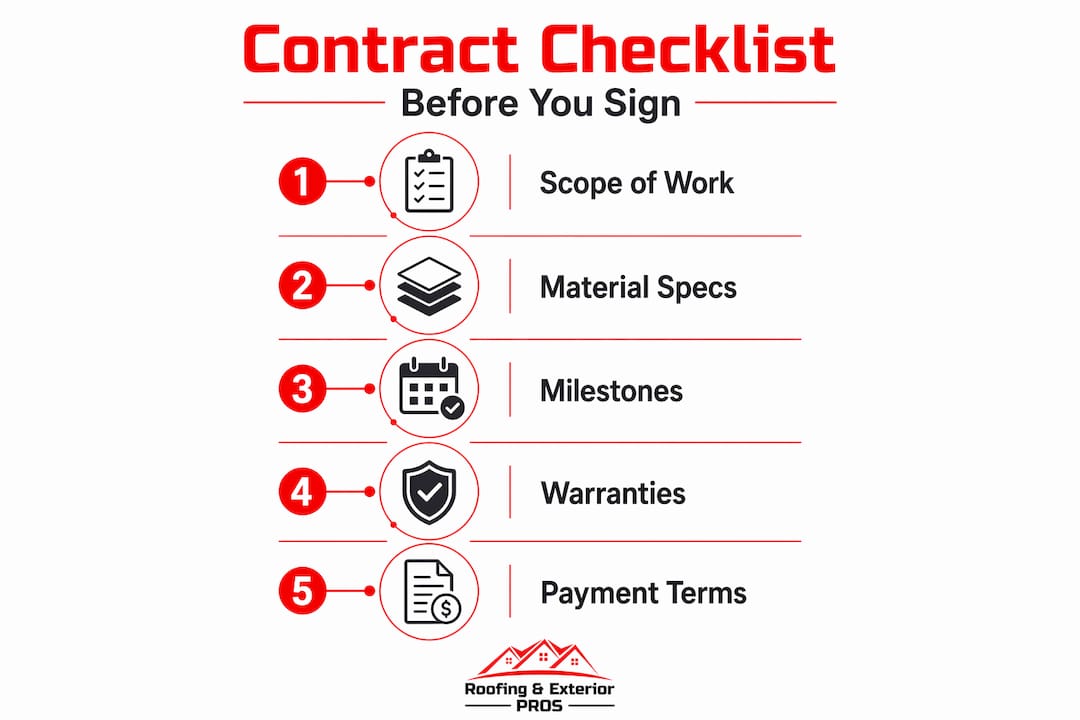
Here are the non-negotiable elements every commercial roofing agreement must contain:
- Scope of work: Detailed description of all work to be performed, materials to be used with brand names and specifications, and areas explicitly excluded from the project
- Payment schedule: Milestone-based installments tied to verifiable progress points, not contractor-requested draws
- Start and completion dates: Specific calendar dates with defined milestones, not ranges or estimates
- Insurance requirements: Certificates of general liability and workers’ compensation insurance, naming you as an additional insured
- Warranty terms: Separate warranty coverage for materials and workmanship, with clear terms for claims
- Dispute resolution process: A defined mechanism such as mediation or arbitration before litigation
Beyond those six, two additional clauses deserve direct attention.
Cancellation rights. Your contract should state your right to cancel within a defined window without penalty. State law may mandate this. Know the terms before you sign.
Deductible prohibition. In insurance-related roofing work, the contractor must never offer to waive or absorb your insurance deductible in exchange for the job. This practice is illegal in many states and is a signal of broader ethical problems.
A contract without a defined scope of work is not a contract. It is a blank check. Before signing anything, confirm that every line of the agreed scope is written out. If a contractor resists specifics, that tells you everything you need to know.
Use this checklist before executing any commercial roofing agreement:
- Verify contractor license number with your state licensing board
- Confirm active insurance certificates are dated and cover the project period
- Read every exclusion clause, not just the scope of work
- Confirm the payment schedule matches project milestones, not contractor preferences
- Verify the dispute resolution clause is specific and mutually agreed upon
- Check for any automatic renewal clauses if this is a service contract arrangement
Managing and verifying roofing contracts in practice
Signing the contract is the beginning, not the finish line. Managing roofing contracts well through the project lifecycle is what separates property owners who get what they paid for from those who spend months resolving disputes.
Follow these steps from kickoff to completion:
- Conduct a pre-construction meeting. Walk the site with the contractor before work begins. Confirm the scope in person, document existing conditions with photos, and set the communication protocol for daily updates.
- Require written change orders. Any deviation from the original scope must be submitted in writing, priced out, and approved before work proceeds. Verbal approvals on job sites are one of the leading causes of billing disputes.
- Schedule milestone inspections. Do not wait until the project is complete to check quality. Inspect at each payment milestone using your commercial roof maintenance checklist as a reference for what good workmanship looks like.
- Document everything. Keep a project log with dates, photos, and notes from every site visit. If a dispute arises, this documentation is your primary defense.
- Hold final payment until final inspection. Never release the last payment until you have completed a thorough walkthrough, verified all punch list items, and received all warranty documentation in writing.
Pro Tip: Hire an independent roofing consultant for projects over $50,000. Their fee is typically a fraction of the cost of one undetected construction defect, and their presence keeps contractors accountable throughout the project.
Treating your roof as a strategic asset with scheduled mid-year budget reviews lets you separate routine maintenance spending from capital repair planning. This approach keeps you ahead of the project cycle instead of reacting to failures.
Avoiding common mistakes in commercial roofing contracts
Even experienced property managers fall into predictable traps. Knowing where the problems concentrate helps you sidestep them before they cost you money.
The most common mistakes include:
- Accepting a vague scope of work because the bid price looks attractive
- Collecting only one or two bids instead of the recommended three to four
- Skipping license and insurance verification because the contractor came as a referral
- Missing auto-renewal clauses in multi-year service agreements
- Failing to require lien waivers from subcontractors and suppliers after payment
Uninsured contractors routinely bid lower precisely because they carry less overhead. That savings disappears instantly if a worker is injured on your property and you have no coverage indemnifying you.
If a contractor asks for more than 30 percent upfront, demands you waive your right to cancel, or cannot produce a current certificate of insurance within 24 hours of your request, walk away. These are not minor concerns. They are consistent patterns of contractors who cause serious problems.
When disputes do arise, refer to the contract’s dispute resolution clause first. If none exists, you are in a weaker position. Use this as motivation to get that clause in writing on the next project. A 2026 commercial roofing planning guide outlines how pre-project planning and documented scope dramatically reduce conflict during construction.
My take on handling these contracts after years in the field
I’ve seen property owners hand over five-figure checks based on a one-page proposal and a handshake. I’ve also seen the bills that came after. The honest truth is that most bad outcomes in commercial roofing contracts are not the result of dishonest contractors. They come from agreements that were too vague to hold anyone accountable.
What I’ve learned is that the contract review process is where property owners have the most leverage, and most don’t use it. You have every right to request revisions, push for itemization, and ask for references specific to projects like yours. A quality contractor will welcome the scrutiny because it protects them too.
The property owners I’ve seen manage the best outcomes consistently do a few things differently. They gather their roof documentation before the first phone call. They compare bids line by line rather than bottom line to bottom line. And they treat change orders as formal events, not casual conversations.
Commercial roofing is a long-term investment. Spending a few extra hours reviewing a contract before signing is worth far more than spending months untangling a poorly written one after something goes wrong.
— Jake
Work with a contractor who gets the contract right

At Roofing & Exterior PROS, we work with commercial property owners and managers throughout the St. Louis metropolitan area, including St. Charles and O’Fallon, MO. We understand that clear communication and detailed contracts are not optional. They are the foundation of every successful roofing project we complete. Our team provides thorough written proposals, itemized scopes, and full insurance documentation on every job. Whether you need a full commercial roof replacement or are navigating storm damage and insurance claims, we give you the transparency and workmanship you deserve. Contact Roofing & Exterior PROS today to request your free inspection and quote.
FAQ
What should a commercial roofing contract always include?
Every commercial roofing contract must include a detailed scope of work, itemized material specifications, milestone-based payment terms, start and completion dates, and current proof of insurance from the contractor.
How many bids should I get for a commercial roofing project?
You should collect at least three to four bids. Research shows 63 percent of property owners compare this many estimates to control budgets and identify pricing outliers effectively.
What deposit is normal for a commercial roofing contract?
A standard upfront deposit runs between 10 and 15 percent of the total contract value. Any contractor requesting more than 25 to 30 percent upfront is a red flag and may indicate financial instability or poor business practices.
Can a roofing contractor waive my insurance deductible?
No. Offering to waive or absorb an insurance deductible is illegal in many states and violates most insurance policies. If a contractor makes this offer, it disqualifies them from serious consideration.
How do I handle changes during a commercial roofing project?
Require every change to the original scope to be submitted as a written change order with a revised price before any new work begins. Verbal approvals create disputes that are nearly impossible to resolve without documentation.