TL;DR:
- Choosing the right flat roof system is essential to ensure durability and prevent costly failures caused by ponding water or membrane deterioration. Building type, climate, drainage, and material performance guide selection, with proper drainage design and professional assessment being critical. Selecting a high-quality membrane, ensuring correct slope, and maintenance extend the roof’s lifespan to 20-30 years, protecting your investment effectively.
When you need to choose a flat roof system for a building, the decision carries more weight than most property owners expect. The right system protects your structure for decades. The wrong one leads to ponding water, membrane failure, and costly repairs within just a few years. Whether you own a commercial warehouse, a retail strip, or a residential home with a low-slope roof, the principles guiding your selection are rooted in building type, climate, drainage design, and material performance. This guide gives you a clear, practical framework for making that decision with confidence.
Table of Contents
- Key takeaways
- How to choose a flat roof system for your building
- Comparing popular flat roofing materials
- Evaluating and selecting the right system
- Common mistakes to avoid
- What a well-chosen flat roof system delivers
- My take on choosing flat roof systems
- Ready to move forward with your flat roof project?
- FAQ
Key takeaways
| Point | Details |
|---|---|
| Pitch determines your options | Roofs below a 2:12 pitch require membrane systems; conventional shingles will not waterproof them adequately. |
| Drainage must come first | Minimum 1/4 inch per foot slope is required to prevent ponding water that damages membranes and stresses structure. |
| Material choice affects energy costs | Reflective membranes like white TPO and EPDM reduce cooling loads significantly in hot climates. |
| Commercial roofs need more planning | Rooftop equipment, foot traffic, and drainage engineering make commercial system selection more complex than residential. |
| Lifecycle cost beats upfront savings | A more durable membrane that costs more initially will almost always outperform a cheaper one over a 20-year span. |
How to choose a flat roof system for your building
Before you compare materials or request quotes, you need to understand what a flat roof system actually is and what makes selecting one different from choosing materials for a pitched roof. The industry term is a “low-slope roofing system,” referring to any roof with a pitch below roughly 4:12. These roofs rely on waterproof membranes rather than overlapping shingles, because membrane systems are required at pitches below 2:12 where gravity alone cannot shed water fast enough.
Your building type shapes every decision that follows. A commercial facility with rooftop HVAC units, refrigeration equipment, or regular maintenance foot traffic has very different demands than a residential addition with a simple flat section. Commercial properties typically need puncture-resistant membranes that integrate with mechanical systems and engineered drainage. Residential flat sections are often smaller and simpler, but they are no less critical to waterproof correctly.
Here are the core factors to evaluate before selecting any system:
- Building use and occupancy. A roof that sees foot traffic regularly needs a harder, more abrasion-resistant membrane than one that is never walked on.
- Local climate. Hot climates favor reflective membranes that reduce cooling loads. Cold climates benefit from materials with strong thermal resistance and flexibility at low temperatures.
- Slope and drainage design. A minimum slope of 1/4 inch per foot (a 2% grade) is the accepted standard for preventing ponding. If your deck does not meet this, tapered insulation may be required before any membrane goes down.
- Structural capacity. Ponding water weighs approximately 5.2 pounds per square foot per inch of depth. On a large roof, that load adds up quickly and may exceed your structure’s engineering limits.
- Code and permit requirements. Many jurisdictions require engineering reviews for flat roofs, particularly on commercial buildings.
Pro Tip: Before ordering materials, have a structural engineer or licensed roofing contractor assess your roof deck slope. This single step prevents the most expensive mistakes.
Comparing popular flat roofing materials
Understanding the main material categories puts you in control of the conversation with any contractor. Here is a breakdown of the most widely used flat roofing systems for both residential and commercial buildings.
| System | Typical Lifespan | Best For | Relative Cost |
|---|---|---|---|
| TPO | 20–30 years | Commercial, hot climates | Moderate |
| EPDM | 25–30+ years | Residential, cold climates | Low to moderate |
| PVC | 20–30 years | Chemical exposure, restaurants | Moderate to high |
| Modified bitumen | 15–25 years | Residential, retrofit projects | Low to moderate |
| Built-up roofing (BUR) | 20–30 years | High traffic, large commercial | Moderate to high |
TPO (Thermoplastic Polyolefin) has become the dominant choice for commercial flat roofs. Its white reflective surface reduces cooling loads, and its heat-welded seams create watertight bonds that outperform adhesive-sealed alternatives. One caution: TPO formulation quality varies significantly by manufacturer, so the brand behind the membrane matters as much as the material category itself.
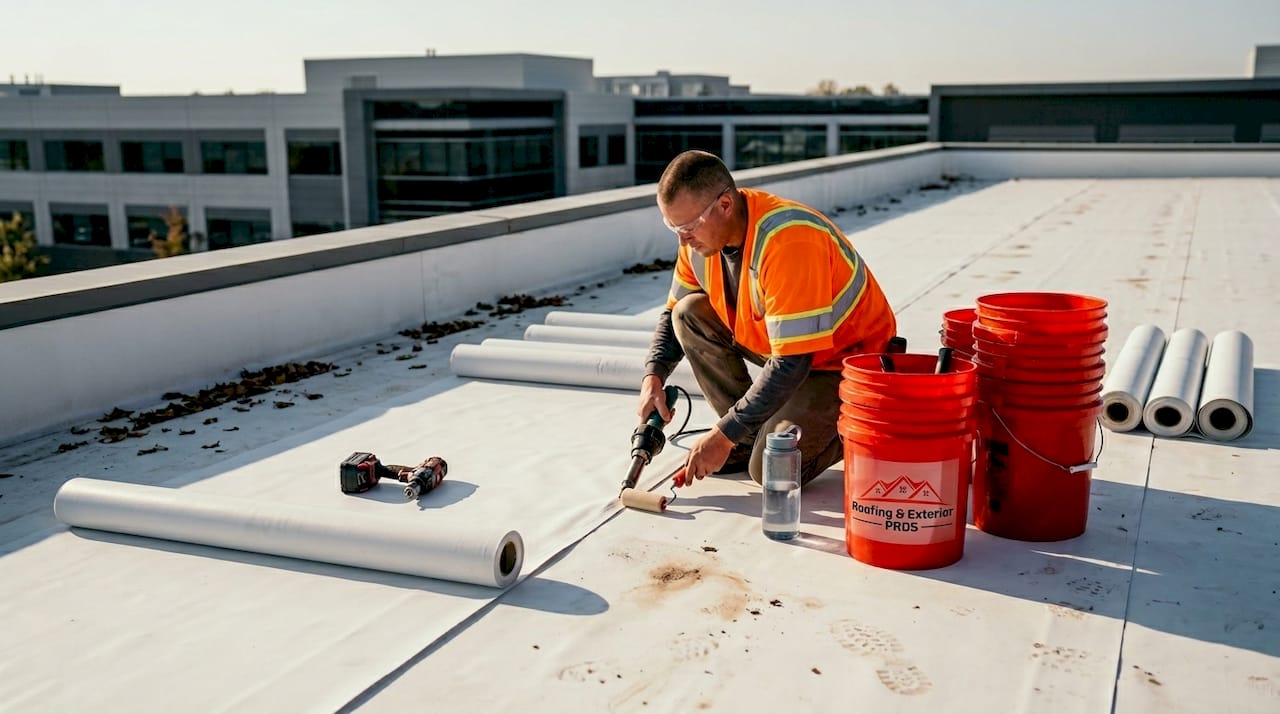
EPDM (Ethylene Propylene Diene Monomer) is a synthetic rubber membrane known for durability exceeding 30 years with proper maintenance. Black EPDM absorbs heat, which benefits buildings in cold climates where winter heating loads are the main concern. White EPDM reflects heat and works better in hot climates. You can read more about EPDM membrane specifics if this material looks like a fit for your project.
PVC carries the highest chemical resistance of the single-ply membranes, making it the right call for restaurants, food processing facilities, or any building where grease-laden exhaust contacts the roof surface. It costs more than TPO but justifies the premium in the right environment.
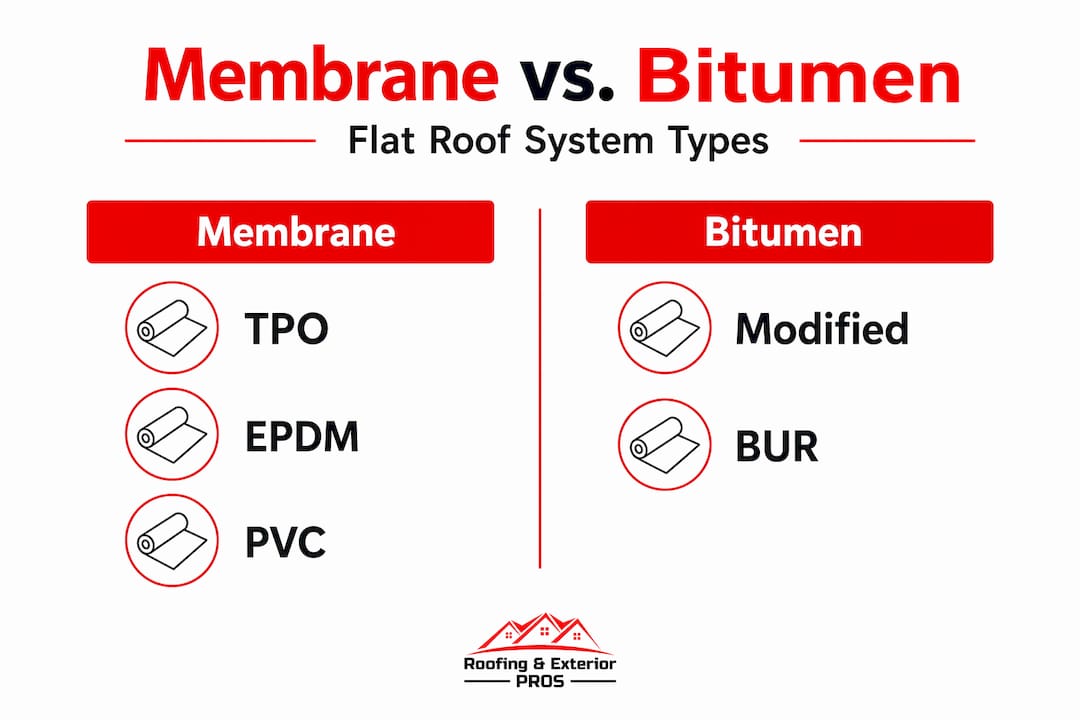
Modified bitumen is an asphalt-based system reinforced with polymers. It installs in layers and handles moderate foot traffic well. It is a common choice for residential flat roof sections and retrofit projects where budget is a constraint.
Built-up roofing (BUR) uses multiple layers of bitumen and reinforcing fabrics topped with aggregate or a cap sheet. It is heavy, proven, and extremely durable under foot traffic. It works well on large commercial roofs with heavy use but requires more labor to install and repair.
Pro Tip: For single-ply membrane options like TPO, EPDM, and PVC, ask your contractor about manufacturer-backed warranties. Many offer 20-year coverage, but only when installation is completed by a certified installer.
Evaluating and selecting the right system
With a clear picture of your building’s conditions and the material options available, you can work through selection methodically. Here is the process we recommend to our clients at Roofing & Exterior PROS.
- Audit your existing roof deck. Measure the actual slope across multiple points. If any area reads below 1/4 inch per foot, plan for tapered insulation to correct drainage before the membrane goes down. Skipping this step causes repeated failures at low points over time.
- Identify all penetrations and rooftop equipment. Every HVAC unit, pipe, vent, and curb is a potential leak point. The membrane system and flashing details must account for all of them. Flashing deterioration and improper sealant application around penetrations are among the most common causes of premature flat roof failure.
- Match membrane type to climate and use. In the St. Louis area, where summers are hot and winters bring ice and freeze-thaw cycles, EPDM and TPO both perform well. EPDM’s flexibility in cold temperatures makes it reliable through winter stress. TPO’s reflectivity helps control summer cooling costs.
- Assess foot traffic requirements. If your roof needs regular access for maintenance personnel or HVAC servicing, choose a system with adequate puncture resistance. BUR and modified bitumen handle traffic better than single-ply membranes. When single-ply is preferred for other reasons, add walk pads in high-traffic areas.
- Calculate lifecycle cost, not just material price. A lower-cost membrane that requires re-coating every five years and replacement in fifteen will cost more over twenty years than a premium membrane installed once with minimal maintenance.
Consider the following additional factors before you finalize your selection:
- Verify local building codes and permit requirements with your municipality.
- Confirm that your contractor carries manufacturer certification for the system you choose.
- Ask for references from completed projects on similar building types.
- Get the drainage plan reviewed by a licensed professional, not just the roofing contractor.
Common mistakes to avoid
The gap between a flat roof that performs for thirty years and one that fails in five often comes down to a handful of avoidable errors.
- Ignoring drainage from the start. Treating drainage as an afterthought is the single most damaging mistake in flat roof projects. Ponding water persisting after 48 hours degrades membranes, increases structural load, and accelerates leak development. Design drainage first, then select materials.
- Choosing materials by price alone. The cheapest membrane on the market may not be designed for your climate, roof pitch, or use case. Matching material properties to conditions matters far more than saving a few dollars per square foot upfront.
- Overlooking ventilation and condensation control. Proper ventilation reduces moisture buildup inside the roofing assembly. Without it, condensation degrades insulation and the membrane from below, which is damage you cannot see until it has progressed significantly.
- Hiring unqualified contractors. Flat roofing requires specific skills and manufacturer certification for many systems. An installer without that training voids manufacturer warranties and increases the risk of installation errors at seams and flashings.
- Skipping a maintenance plan. Even the best flat roof systems require periodic inspection, cleaning of drains, and minor seam or flashing repairs. Neglecting this turns small problems into full replacements.
Pro Tip: Schedule a commercial roof maintenance inspection twice a year, in the spring after winter stress and in the fall before heavy rainfall season. This single habit extends membrane life by years.
What a well-chosen flat roof system delivers
When you select the right system and have it installed by qualified professionals, the results are concrete and lasting. A properly specified flat roof provides sustained waterproofing that protects your building’s structure, insulation, and interior finishes without constant intervention. Reflective membranes like white TPO meaningfully reduce summer cooling loads. That translates to lower energy bills year after year, which adds real value to your property beyond the roof itself.
A well-installed membrane on a correctly sloped deck with sound flashing details can realistically serve your building for twenty-five to thirty years with routine maintenance. For commercial property owners, that means fewer disruptions to tenants or operations. For residential owners, it means genuine peace of mind. You also gain the assurance of code compliance and, when working with a certified installer, a manufacturer warranty that backs your investment.
My take on choosing flat roof systems
I’ve been involved in residential and commercial roofing projects long enough to say this plainly: most flat roof problems I’ve seen were predictable. They trace back to two things. Drainage was not designed properly at the start, or the wrong membrane was selected because the decision was driven by price rather than performance.
The misconception I encounter most often is that all flat roof membranes are essentially the same and that installation quality does not matter much. That is not true. A TPO membrane from a reputable manufacturer with properly heat-welded seams performs completely differently from one with glued seams or poor-quality material. I’ve seen brand-new roofs fail within three years because of installation shortcuts.
My honest advice: invest in drainage engineering before you invest in membrane material. If the slope and drainage are right, almost any quality membrane will perform adequately. If the slope is wrong, even the most expensive membrane will pond, degrade, and leak. And please, talk to a qualified roofing professional before you commit to a system. The consultation costs you nothing compared to the cost of a premature replacement.
— Jake
Ready to move forward with your flat roof project?
At Roofing & Exterior PROS, we work with property owners and developers across the St. Louis area to specify, install, and maintain flat roofing systems for both residential and commercial buildings. Our team evaluates your building’s slope, drainage, and usage requirements before recommending any system. We work with TPO, EPDM, modified bitumen, and BUR, and our installers carry manufacturer certifications that protect your warranty.
Whether you are starting a new construction project or preparing for a roof replacement, we will walk you through every decision with full transparency. We also offer ongoing inspection and maintenance programs to protect your investment long after installation. For commercial buildings, explore our durable commercial roofing services or contact us directly for a free consultation and estimate.
FAQ
What is a flat roof system?
A flat roof system is a low-slope roofing assembly that uses a waterproof membrane rather than overlapping shingles to seal the roof surface. It is designed for roofs with a pitch below approximately 4:12.
What are the best flat roof materials for commercial buildings?
TPO is widely used for commercial flat roofs because of its reflective surface, heat-welded seams, and cost-effectiveness. EPDM and PVC are also strong options depending on climate and building use.
How do I prevent ponding water on a flat roof?
Ponding water is prevented by maintaining a minimum slope of 1/4 inch per foot across the entire roof deck. Retrofit projects often require tapered insulation to restore adequate drainage where the deck is insufficient.
How long does a flat roof system last?
Most quality flat roof systems last between 20 and 30 years with proper installation and regular maintenance. EPDM membranes can exceed 30 years under the right conditions.
Do flat roof systems require special maintenance?
Yes. Flat roofs should be inspected at least twice per year to clear drains, check flashing condition, and identify minor seam issues before they become leaks. A consistent maintenance schedule is the most cost-effective way to extend membrane life.