TL;DR:
- A commercial roof inspection is a professional evaluation that identifies damage, assesses wear, and verifies compliance standards. It combines visual assessments, advanced diagnostics, and detailed documentation to support maintenance, warranties, and insurance claims. Regular inspections, especially after severe weather, help prevent small issues from developing into costly structural problems.
A commercial roof inspection is a structured, professional evaluation of a building’s roofing system designed to identify damage, assess wear, and verify that the roof meets maintenance and compliance standards. Property owners and building managers who understand how commercial roof inspections work gain a direct advantage: they can schedule evaluations at the right time, interpret findings accurately, and act before minor issues become expensive structural problems. The commercial roof inspection process typically combines visual assessment, advanced diagnostics like infrared thermography and drone surveys, and detailed documentation that supports both warranty claims and insurance filings.
How commercial roof inspections work: the step-by-step process
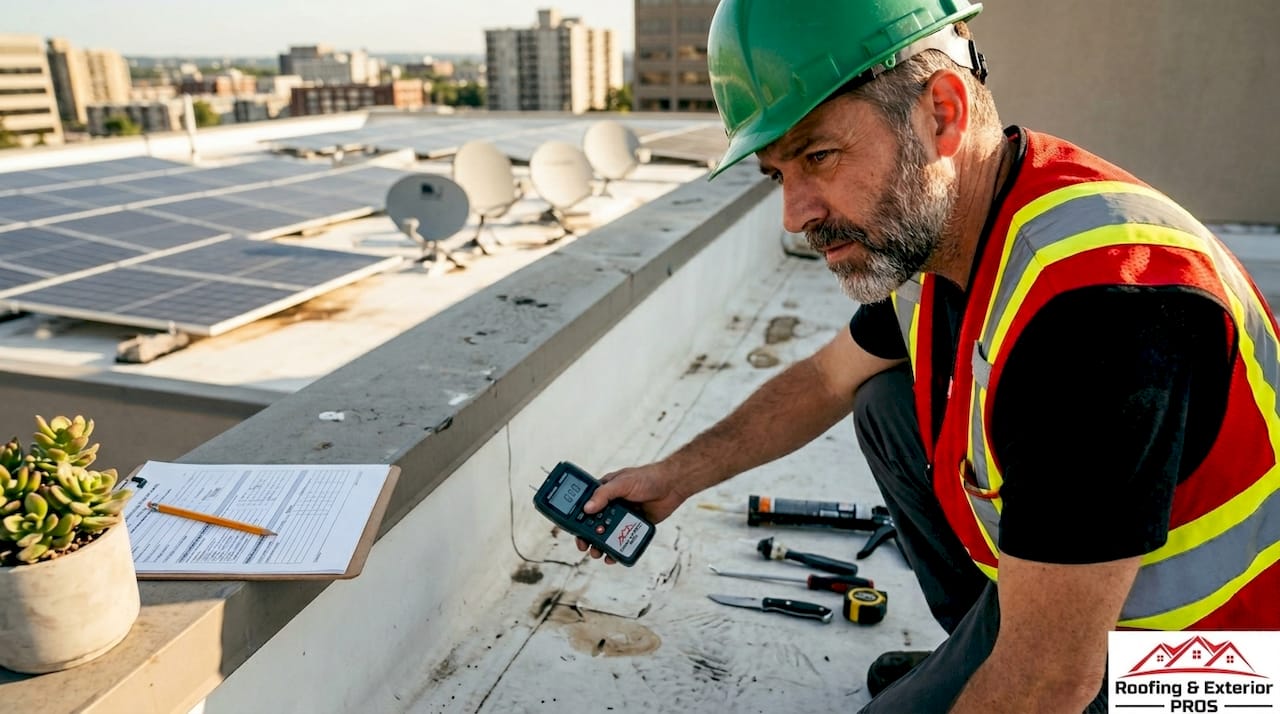
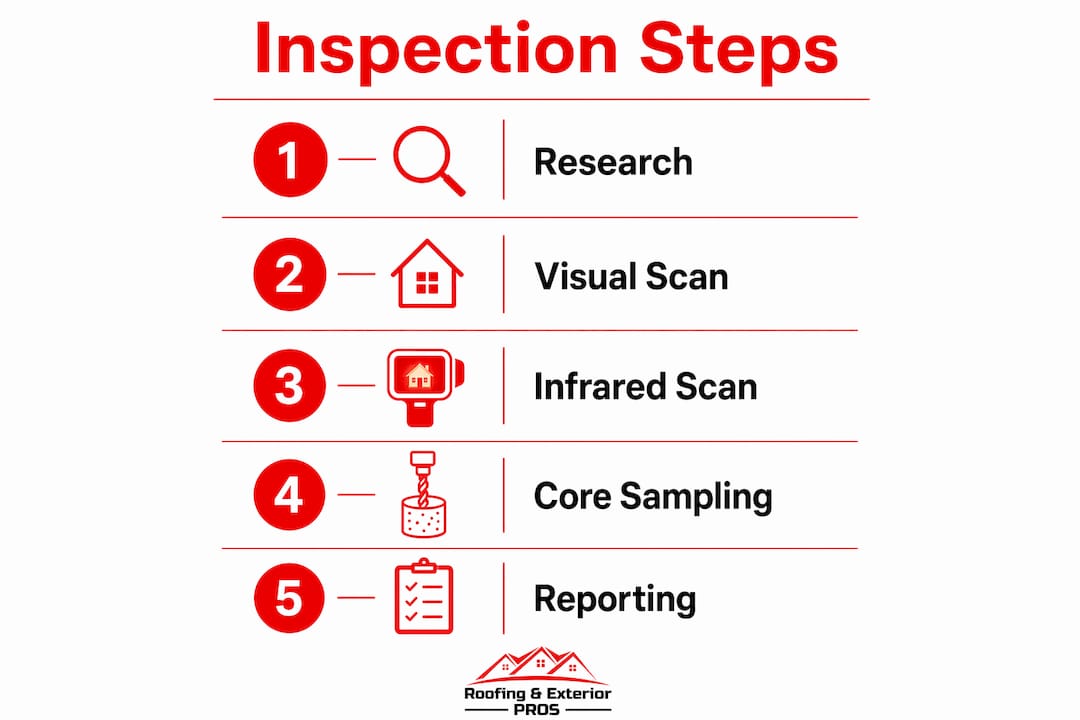
A professional commercial roof inspection follows a defined sequence, and knowing each phase helps you prepare your building and get the most out of every evaluation.
-
Pre-inspection preparation. The inspector reviews the roof’s history, including previous repair records, warranty documents, and any known problem areas. They check weather forecasts, confirm safe roof access, and identify the roofing system type. Inspection techniques differ for thermoplastic membranes, modified bitumen, and built-up roofing, so this step shapes everything that follows.
-
Ground-level assessment. Before stepping onto the roof, the inspector photographs the building perimeter, examines drainage outlets, and looks for signs of water staining or structural movement on exterior walls. This baseline documentation establishes a before-and-after record.
-
On-roof surface evaluation. The inspector walks the entire roof surface, checking the membrane for cracks, blisters, and punctures. Seams, flashings around penetrations like HVAC units and skylights, and edge details receive close attention because these are the most common failure points on flat and low-slope commercial roofs.
-
Advanced diagnostics. Depending on the building’s age and condition, the inspector may deploy infrared thermographic scanning, core sampling, or nuclear moisture testing. These methods detect problems that a visual check alone cannot confirm, particularly trapped moisture within the roof assembly.
-
Interior and attic inspection. Where accessible, inspectors examine the underside of the roof deck for water staining, mold growth, and insulation compression. Interior evidence often confirms what surface diagnostics suggest.
-
Report generation. The inspector compiles findings into a structured report with geo-tagged photographs, severity ratings, and repair recommendations. This document becomes the foundation for maintenance planning, contractor bids, and insurance submissions.
Pro Tip: Request that your inspector provide a digital report with photos organized by roof zone. This makes it far easier to track recurring problem areas across multiple inspection cycles and builds a clear maintenance history for your property.
What specialized technologies are used in commercial roof assessments?
Modern commercial roofing evaluation relies on four core diagnostic technologies, each suited to different conditions and problem types.
-
Infrared thermography. Thermal imaging cameras detect temperature differences in the roof surface caused by trapped moisture. Wet insulation retains heat longer than dry insulation, so it appears as a warm spot on a thermal scan taken after sunset. Thermal scans work best after warm, sunny days with at least 48 hours of dry weather and clear skies. This is a critical point: scheduling a thermal scan on the wrong day produces unreliable data. Thermal scanning should always be a dedicated survey, not an add-on to a standard visual inspection.
-
Drone inspections. Drones equipped with high-resolution cameras and thermal sensors capture detailed imagery and can produce orthomosaic maps and 3D models of the entire roof surface. This technology is especially valuable for large industrial roofs or buildings where safe foot access is limited. Drones reduce inspection time and improve coverage without putting inspectors at risk.
-
Core sampling. A core sample involves cutting a small plug through the roof assembly to examine each layer directly. Core sampling provides definitive data on insulation condition, membrane adhesion, and the number of existing roof layers. It is the most reliable method for deciding whether a roof needs targeted repair or full replacement.
-
Nuclear moisture testing. This non-destructive method uses a handheld gauge to detect hydrogen atoms in moisture trapped within the roof assembly. It covers large areas quickly without cutting into the membrane, making it a practical complement to infrared scanning on roofs where core sampling is not feasible.
Pro Tip: Never treat infrared scanning as a substitute for core sampling when a repair-versus-replace decision is on the table. Thermal imaging identifies where moisture exists; core sampling tells you how bad it is and what layers are compromised.
Technology comparison at a glance
| Method | Best use case | Limitation |
|---|---|---|
| Infrared thermography | Detecting trapped moisture across large areas | Requires specific weather conditions to be accurate |
| Drone survey | Full-roof coverage, 3D mapping, hard-to-access areas | Thermal data still needs ground verification |
| Core sampling | Definitive layer-by-layer diagnosis | Invasive; creates small penetrations that need patching |
| Nuclear moisture testing | Non-destructive moisture mapping over large areas | Does not identify the specific layer holding moisture |
How often should commercial roofs be inspected?
Routine commercial roof inspections should be conducted at least twice per year, with spring and fall as the standard scheduling windows. This timing aligns with the two most damaging weather transitions: winter freeze-thaw cycles that stress seams and flashings, and summer heat that accelerates membrane degradation.
Beyond the standard bi-annual schedule, several conditions trigger additional evaluations:
- Post-storm inspections. After hail, high winds, or heavy rain, inspections within 48 to 72 hours of the weather event maximize documentation effectiveness for insurance claims. Waiting longer allows secondary damage to develop and weakens your claim position.
- Warranty compliance. Many commercial roofing warranties require documented inspections at defined intervals. Missing a scheduled inspection can void coverage, leaving you fully liable for repair costs.
- Lease and insurance requirements. Some commercial property insurance policies and tenant lease agreements specify minimum inspection frequencies. Keeping records on file protects you in disputes.
- Post-repair verification. Any time a contractor performs significant repairs, a follow-up inspection confirms the work was completed correctly and documents the roof’s updated condition.
Metal roofs in high-wind zones and roofs carrying heavy mechanical equipment may warrant quarterly checks rather than the standard bi-annual schedule. The commercial roof maintenance checklist from Roofing & Exterior PROS outlines material-specific inspection intervals that align with manufacturer recommendations for the St. Louis region.
What do inspectors commonly find, and what should you do about it?
The most frequent findings during a commercial roofing evaluation fall into four categories, and each one has a clear response path.
- Membrane cracks and blisters. UV exposure and thermal cycling cause the membrane surface to crack or form air pockets. Small cracks caught early are straightforward patch repairs. Widespread cracking signals that the membrane is nearing the end of its service life and a full replacement assessment is warranted.
- Seam separations and lap failures. Seams are the weakest points in any membrane system. Separation allows water to enter the roof assembly, where it migrates laterally before appearing as an interior leak. Early detection of seam failures prevents the kind of widespread moisture damage that turns a $500 repair into a $50,000 replacement.
- Ponding water and drainage blockages. Water that stands on a flat roof for more than 48 hours accelerates membrane deterioration and adds structural load. Inspectors check drains, scuppers, and gutters for debris and verify that the roof surface slopes correctly toward drainage points.
- Flashing deterioration. Flashings around HVAC curbs, pipes, and parapet walls are the most common entry points for water. Cracked sealant and lifted metal flashings are quick fixes when caught on inspection but become major leak sources when ignored.
Photographic documentation of every finding is non-negotiable. Clear, jargon-free reports with photos support insurance claims, guide contractor bids, and create a defensible maintenance record. If your inspector delivers a report without photos or severity ratings, ask for a revised version before signing off.
Pro Tip: After receiving an inspection report, categorize findings into three groups: immediate safety or leak risks, items to address within 90 days, and items to monitor at the next inspection. This triage approach keeps repair budgets predictable and prevents deferred maintenance from compounding.
For guidance on identifying specific storm-related damage, the hail damage identification guide from Roofing & Exterior PROS covers the visual markers inspectors look for after severe weather in the St. Louis area.
Key takeaways
A well-executed commercial roof inspection combines sequential physical assessment, advanced diagnostics, and structured documentation to protect building integrity and support compliance requirements.
| Point | Details |
|---|---|
| Follow a defined sequence | Inspections move from pre-inspection research through surface evaluation to formal reporting. |
| Match technology to the problem | Use infrared scanning for moisture mapping, core sampling for repair-versus-replace decisions. |
| Inspect twice yearly, plus post-storm | Spring, fall, and within 72 hours of severe weather are the three critical inspection windows. |
| Documentation drives decisions | Geo-tagged photo reports support insurance claims, warranty compliance, and contractor bids. |
| Act on findings by priority | Triage findings into immediate, 90-day, and monitor categories to control repair costs. |
Why I think most building managers underestimate the inspection report
After years of working with commercial property owners across the St. Louis area, the pattern I see most often is this: the inspection gets done, the report gets filed, and nothing happens until the next leak. That is a costly mistake, and it happens because most reports are treated as a compliance checkbox rather than a maintenance planning tool.
The technology side of inspections has improved dramatically. Drone surveys and infrared scanning now give us data that would have required destructive testing a decade ago. But technology only adds value when the findings are acted on. A thermal scan that identifies three moisture pockets is only useful if someone schedules the repairs before the next freeze cycle drives water deeper into the insulation.
The other thing I have seen consistently is that building managers who maintain a running inspection history get significantly better outcomes when filing insurance claims. Adjusters respond to documented evidence. A property with five years of bi-annual inspection reports and a post-storm evaluation filed within 72 hours of a hail event is in a fundamentally stronger position than one with no records at all. Integrating inspections into your annual property management calendar, not just reacting to visible problems, is the single most effective thing you can do for long-term roof performance.
— Jake
Schedule your commercial roof inspection with Roofing & Exterior PROS

Roofing & Exterior PROS is a family-owned commercial roofing company serving the St. Louis metropolitan area with inspections, repairs, and full roof replacements. Our team understands the specific demands of commercial roofing systems, from TPO and EPDM membranes to modified bitumen and metal roofing, and we deliver clear, photo-documented reports that give you a complete picture of your roof’s condition. Whether you need a routine bi-annual evaluation or an urgent post-storm assessment, we are ready to help you protect your building and stay ahead of costly repairs. Explore our commercial roofing services or contact us today to schedule your inspection. If storm damage is already a concern, our team can also guide you through the storm damage claim process from inspection to settlement.
FAQ
What does a commercial roof inspection include?
A commercial roof inspection includes a visual surface evaluation, assessment of seams, flashings, and drainage, and advanced diagnostics such as infrared scanning or core sampling when needed. The inspector delivers a structured report with photographs, severity ratings, and repair recommendations.
How long does a commercial roof inspection take?
Most commercial roof inspections take two to four hours depending on roof size, system complexity, and whether advanced diagnostics like drone surveys or thermal imaging are included. Larger industrial roofs or those requiring core sampling may take longer.
How often should a commercial roof be inspected?
Bi-annual inspections in spring and fall are the standard recommendation, plus a post-storm evaluation within 48 to 72 hours of any significant weather event. Warranty and insurance requirements may specify additional inspection intervals.
Can inspection reports be used for insurance claims?
Yes. Structured reports with photos and geo-tagged documentation are specifically designed to support insurance claims and warranty filings. Post-storm inspections completed within 72 hours carry the most weight with adjusters.
What is the difference between a visual inspection and an infrared scan?
A visual inspection identifies surface-level damage that is visible to the eye, while an infrared scan detects moisture trapped within the roof assembly that has no visible surface signs. Both methods are most effective when used together as part of a complete roof assessment.