
The main gutter hanger types are hidden (snap-in) hangers, fascia straps, rafter-mounted roof straps, half-round brackets, spike-and-ferrule systems, and exposed heavy-duty brackets. The rule that decides between them is simple: match the hanger to your gutter’s profile, the condition of your fascia or roof deck, and the load that your region adds through snow and ice. For most K-style gutters on sound fascia, hidden hangers are the modern standard.
TL;DR:
- Check fascia at several points along each run; repair soft or flexing wood before installing hangers, or the new fasteners will fail.
- For K style gutters, use internal screw hangers on sound fascia; when fascia is rotten, missing, or undersized, straps anchored to rafters bypass it.
- Half round gutters need cradle brackets or roof straps because their rounded backs lack the flat mounting surface used by standard internal hangers.
- Space hangers about 24 inches apart in typical conditions and 16 inches in snow and ice zones, while following the manufacturer’s instructions.
- Choose screws that reach structural backing; a #10 hex head screw measuring 3 inches is common, while nails and spikes loosen more readily.
Table of Contents
- 1. What are the main gutter hanger types and where each belongs
- 2. Selection checklist: substrate, materials, and load before you buy
- 3. Spacing, fasteners, and installation specs that actually matter
- 4. Spotting failure before it becomes a bigger repair
- How we scope gutter hanger repairs on a home visit
- What homeowners get wrong about gutter hangers
- Let us handle the inspection and the fix
- FAQ
- Sources
1. What are the main gutter hanger types and where each belongs
Every hanger style solves a different combination of gutter profile and substrate problem. Here’s how the common types stack up.
Hidden (snap-in) hangers clip inside the gutter trough and fasten through the back into the fascia with a single heavy screw, keeping the hardware invisible from the ground. They work with K-style gutters on fascia that’s still structurally sound, and they offer stronger long-term hold than exposed fasteners because the screw bites into solid wood rather than just the gutter lip.
Fascia hangers and snap straps also mount to the fascia board but use a strap or clip style rather than a full internal bracket. We recommend them when the fascia is sound but a homeowner wants a slightly different fastening pattern than a standard hidden hanger provides.
Rafter-mounted hangers and roof straps skip the fascia entirely and anchor to the roof deck or rafter tails. They’re the practical retrofit choice when fascia is rotted, missing, or was never installed, though roof straps require careful flashing and roof access to avoid new leak points.
Half-round brackets, T-bar, and J-hook hangers fit half-round gutters, which have no flat back for a standard screw-in hanger. These half-round systems typically rely on exposed cradle brackets or roof-strap hangers set before the gutter goes up.
Spike-and-ferrule systems drive a long spike through the gutter lip, through a metal sleeve, and into the fascia. It’s a legacy method still found on older homes.
Exposed heavy-duty brackets carry visible load-bearing support where snow, ice, or a long unsupported run demands more strength than a hidden hanger alone provides.
- Hidden hangers suit K-style gutters on sound fascia and most standard residential jobs.
- Rafter straps suit homes with rotted, missing, or undersized fascia boards.
- Half-round brackets suit round-profile gutters that have no flat mounting surface.
2. Selection checklist: substrate, materials, and load before you buy
Before choosing a hanger, work through the substrate and load questions in order. Skipping the fascia check is the most common reason a hanger replacement fails within a season.
- Press-test the fascia board behind the gutter. If the wood flexes or feels soft, hangers won’t hold until the fascia is repaired or replaced.
- Confirm the gutter profile (K-style versus half-round) and pick hardware built for that profile; half-round gutters need bracket or strap hardware, not standard internal hangers.
- Match fastener metal to hanger and gutter metal. Mixing incompatible metals accelerates corrosion, so aluminum gutters need aluminum-compatible fasteners and copper systems need copper or stainless hardware.
- Tighten hanger spacing in snow and ice zones, since accumulated weight adds load that wider spacing can’t support.
- Decide whether roof straps are necessary. They solve a missing-fascia problem but add roof penetrations and flashing work that a fascia-mounted hanger avoids.
Pro Tip: Check the fascia at both ends of each run and at the midpoint, not just near an obvious sag. Rot often starts at a seam or behind a downspout long before it shows anywhere else.
Aluminum, vinyl, steel, and copper gutters each pair best with hangers and fasteners rated for that metal, and swapping in mismatched hardware during a quick fix is how galvanic corrosion starts years before it becomes visible.
3. Spacing, fasteners, and installation specs that actually matter
Spacing and fastener choice are where most do-it-yourself installs go wrong, and the numbers are specific enough to check yourself.
Standard spacing runs about 24 inches on center for typical installations, tightening to about 16 inches on center where snow and ice accumulate regularly. Trade guidance overall spans 16 to 36 inches depending on load and manufacturer specs, so always check the manufacturer’s instructions for the specific hanger model.
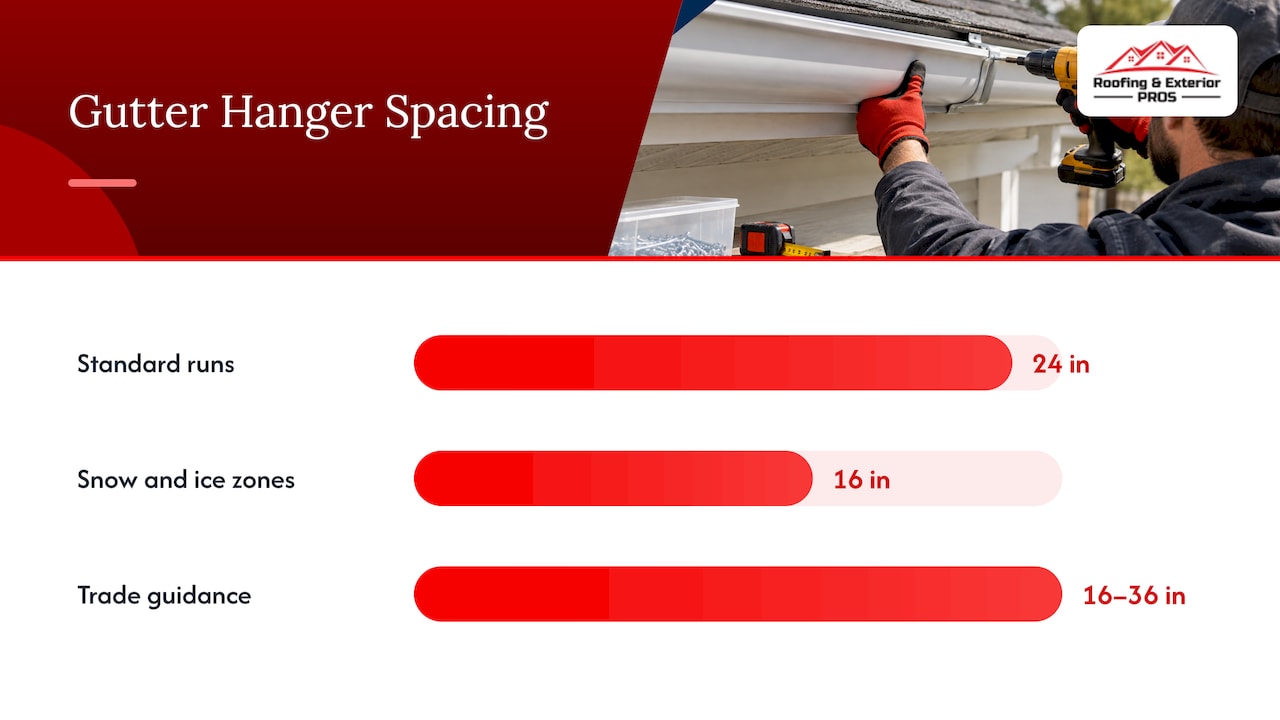
Published spacing guidance centers on 24 inches on center for standard runs and tightens to 16 inches in snow and ice zones. That tighter spacing in harsh climates is what keeps a loaded gutter from pulling away mid-winter, according to The Gutter Report.
For fasteners, hidden hangers need a screw long enough to reach structural backing, not just the fascia skin. A 3-inch #10 hex-head screw is a common choice because it penetrates deep enough into solid framing behind the fascia.
- Use closer spacing (16 inches) anywhere heavy snow load is typical.
- Use standard spacing (24 inches) on moderate climates with sound fascia.
- Check gutter pitch and even hanger alignment so water and load transfer correctly along the run; our gutter slope guidance covers the exact pitch target.
When fascia is missing or compromised, rafter-mounted straps step in, following the installation steps we outline for lasting drainage.
4. Spotting failure before it becomes a bigger repair
A gutter that’s about to fail usually gives warning signs weeks or months before it actually comes down.
- Visible sag between hangers, which often means spacing is too wide or hangers have pulled loose from soft fascia.
- Loose or protruding nails and spikes, a classic sign of an aging spike-and-ferrule system working its way out.
- Standing water or pooling after a rain, which can point to hanger failure changing the gutter’s pitch.
- Separation where the gutter pulls away from the fascia, which we cover in more depth in our piece on gutters pulling away from the house.
A seasonal check right after the spring melt and again after any major storm is advisable, since both freeze-thaw cycles and wind-driven debris stress hangers in ways that aren’t obvious from the ground. Storm-related stress on gutters and flashing is also worth a look through a property owner’s guide to hail effects if a recent storm is the likely culprit.
Re-fastening loose hangers works when the fascia underneath is still solid. When the wood is soft, fascia repair has to come first, or any new hanger will fail again on the same schedule. Basic hidden hangers run roughly $2 to $3 each in aluminum or vinyl, with copper hardware costing noticeably more, and labor and fascia access typically drive the total bill more than the hanger itself.
How we scope gutter hanger repairs on a home visit
When we inspect a gutter system, we start with the fascia, because no hanger upgrade holds on wood that’s already failing. We press-test the board at several points along each run, document what we find with photos, and walk homeowners through the options before recommending anything.
In many cases, that means upgrading old spike-and-ferrule hangers to hidden hangers for a cleaner look and stronger hold. When the fascia itself has rotted, fascia repair or replacement is recommended before any new hanger goes in, since skipping that step just moves the failure a season or two down the road. Our gutter repair and hanger replacement services cover both scenarios.
What homeowners get wrong about gutter hangers
The biggest mistake we see is treating hanger choice as a style decision instead of a substrate decision. Homeowners shop for hidden hangers because they look cleaner, then install them on fascia that’s already soft, which guarantees a repeat failure within a year or two.
Conventional advice leans heavily on spacing numbers and fastener length, and those matter, but they assume the board underneath is sound. That assumption is where most jobs go wrong. A correctly spaced, correctly fastened hanger on rotten wood still fails.
If we had to rank priorities, fascia condition comes first, gutter profile and material compatibility second, and spacing and fastener specs third. Get the first two right and the numbers in the spec sheet actually do their job. Skip the fascia check and no amount of precise spacing saves the installation.
— Jake Ehlinger
Let us handle the inspection and the fix
Gutter hanger problems rarely show up alone. By the time hangers are loosening, the fascia behind them or the pitch along the run is often part of the story, and we look at all three together rather than patching one piece. Gutter repair, hanger replacement, and fascia repair can be handled in a single visit when that’s what the job needs.

An inspection covers the fascia, the existing hangers, and the overall pitch and drainage of the run, with findings explained before recommending a fix. If you’re in the St. Louis area and unsure whether your gutters need a simple hanger swap or something more, schedule a free gutter inspection and we’ll give you a straight answer.
FAQ
Are gutter hangers necessary?
Yes. Hangers are what hold the gutter to the house and transfer the weight of water, debris, and snow into the fascia or roof structure. Without properly spaced hangers, gutters sag, pull away, and eventually fail.
What is considered the best gutter guard system?
Gutter guard systems vary by design, and the right choice depends on your region’s debris and weather patterns. We offer gutter guard installation as part of our gutter services and can recommend an option suited to your home during an inspection.
What are the two categories of gutter systems?
Gutters are generally grouped by profile into K-style, which has a flat back and decorative front edge, and half-round, which has a rounded trough and typically mounts with exposed brackets or straps rather than internal hangers.
Should gutters be nailed or screwed in?
Modern installations favor screws over nails because screws resist loosening from expansion and contraction better than smooth spikes. Spike-and-ferrule systems are considered a legacy method with lower holding power than screw-in hidden hangers.
Sources
- Gutter Hangers: Types, Spacing and Why Gutters Sag — The Gutter Report
- Gutter Hangers and Fasteners: Types and Specifications — National Gutter Authority
- Half-round gutter installation guidance — The Roofing Brief