Lap siding runs horizontally in overlapping boards. Board and batten runs vertically, with narrow strips covering the seams between wide boards. Lap is usually the lower-cost, more traditional choice. Board and batten costs a bit more and gives a taller, more textured look. In St. Louis weather, how well either one is installed matters more than which profile you pick.
We install and repair siding across the St. Louis area, and this question comes up on nearly every siding estimate. Below we explain how the two styles differ, what to expect on cost, how each performs in Missouri storms, and how to choose for your house.
TL;DR
- Look: Lap siding reads as horizontal and classic. Board and batten reads as vertical and taller, with deep shadow lines. Many homes look best with one style on the main walls and the other as an accent.
- Cost: Board and batten generally costs more than lap in the same material, because it takes more precise installation and more pieces. Exact numbers depend on material, wall shape and labor.
- Weather: Neither profile is waterproof. The water-resistive barrier and flashing behind the siding decide whether a wall stays dry.
- Storm repairs: Lap is simpler to patch when hail or wind damages a few pieces. A vertical board and batten wall is more likely to need a full elevation matched.
- Next step: Have a local contractor inspect the wall behind the siding before you choose a profile.
Table of Contents
- What each style actually is
- Vertical vs horizontal: how they change the look of a house
- Cost: what to expect
- How each performs in Missouri weather
- Installation and repair differences
- Storm damage, insurance and matching
- Do you need a permit?
- Our perspective
- How to choose: a short checklist
- Siding help from our team
- FAQ
- Sources
What each style actually is
Lap siding
Lap siding is a run of horizontal boards or planks, each overlapping the one below it. The overlap sheds water down and away from the wall. It comes in vinyl, wood, engineered wood and fiber cement. James Hardie describes its fiber cement lap siding as horizontal, overlapping boards, and it is the profile most people picture when they think of a house with siding.
Sub-styles include clapboard, beaded and Dutch lap. Exposure (the visible height of each board) is typically 4 to 8 inches, and a narrower exposure gives a more traditional look.
Board and batten
Board and batten is a vertical look. Wide boards or panels go up side by side, and thin strips called battens cover the joints. The strips create the shadow lines that give the style its texture. Reverse board and batten flips the proportions, with narrow boards and wider battens.
In fiber cement, the look is often built from vertical panels plus separate trim battens. James Hardie, for example, pairs its vertical panel siding with trim batten boards to create the rustic board-and-batten appearance. Vinyl versions mimic the look with a single molded profile, which is cheaper but flatter.
Lap siding vs panel siding
People also ask how lap compares with panel siding. Panel siding comes in large sheets, such as 4-by-8 or 4-by-9 feet, installed vertically. It is the base of most modern board and batten walls. So the real choice is between many overlapping horizontal planks and large vertical panels with battens over the seams. The panels cover wall area faster, but each seam needs careful sealing and flashing.
Vertical vs horizontal: how they change the look of a house
The direction of the lines changes how a house reads from the street.
- Horizontal lap makes a house look wider and more grounded. It suits ranches, colonials, split-levels and the brick-and-siding mix common in suburbs like Ballwin, Chesterfield and Wildwood.
- Vertical board and batten draws the eye up. It adds height to a low or wide facade, and it fits modern farmhouse, cottage and craftsman designs.
- Shadow depth is greater with board and batten, because the battens stand proud of the boards. That gives a bolder, more handcrafted feel, especially on a gable end or entry.
- Color behaves differently on each. Dark colors on board and batten look sharp but show every seam, while lighter tones soften the lines.
One caution from homeowners who mix styles: the two profiles reflect light differently, so the same paint color can look different on each. If you combine them, pick colors from the same manufacturer line, or have samples hung on the wall and viewed in morning and evening light before you commit. Fading over the years can also pull mismatched undertones further apart.
Mixing the two on one house
Mixing is common and often looks best. A few approaches that tend to work:
- Use lap on the main walls and board and batten on gable peaks, a porch front or a dormer.
- Keep the same color family and change only the profile, so the house looks designed rather than patched.
- Break the two styles at a natural line, such as a belly band, a window head or a change in plane, never in the middle of a flat wall.
- Use a third material only as a small accent. Some owners add a stone base, and stone veneer installation pairs well with either siding profile at the foundation line.
Cost: what to expect
Board and batten usually costs more than lap in the same material. Today’s Homeowner reports that lap is generally slightly less expensive, particularly in vinyl or fiber cement, and that board and batten, especially in wood, can carry higher upfront costs because of the more involved installation and extra material.
The reasons are practical:
- More pieces. The battens are a second component, and each one has to be cut, set and fastened.
- Layout work. Vertical boards must land on plumb lines and stay aligned with window and door openings.
- Fastening and blocking. Vertical siding often needs horizontal furring or blocking so there is something to nail into, while lap siding fastens straight to studs.
- Waste. Cutting around gables and rooflines wastes more material on a vertical wall.
Material changes the price more than profile does. Fiber cement, for example, costs roughly 24% less than wood to install according to James Hardie, though project pricing varies with labor and finish. A fiber cement board and batten wall can therefore cost less than a wood lap wall.
We do not publish a flat per-square-foot price, because the number depends on your walls, the existing siding, the sheathing underneath and the material you choose. For a local look at how the pieces add up, see our guide to siding replacement cost in St. Louis.
How each performs in Missouri weather
St. Louis puts siding through a lot. NOAA’s Storm Prediction Center data for the St. Louis forecast area shows an average of 38 hail days and 46 damaging wind days a year for 1980 to 2006. Add freeze-thaw cycles and humid summers, and the siding has to shed water and stay put.
Neither profile is waterproof
Building Science Education points out that cladding is a water-shedding surface, not a waterproof one. The housewrap or drainage plane behind it is the real barrier. That applies equally to lap and to board and batten.
NAHB guidance on wind-resistant exterior cladding for existing homes covers vinyl, fiber cement lap siding and soffits, and stresses the wall system as a whole. In our experience a well-flashed wall in either profile outlasts a badly flashed wall in the “better” profile.
Where each style is vulnerable
- Lap siding: The overlaps shed water naturally, but exposed butt joints, cut ends and loose or cracked courses let wind-driven rain in. Hail tends to crack vinyl and dent or chip other materials on the exposed lower edge.
- Board and batten: The seams between boards are covered by battens, but the batten edges and the bottom ends of the boards collect water if they are not sealed and kept off the ground and off roofs. Vertical walls shed water quickly when installed correctly, and trap it when the bottoms are left open or poorly flashed.
One reader forum comparison noted that vertical installation of a profile built to lap horizontally is a poor idea, because the overlap that diverts water works only in one direction. If you want vertical siding, use a product made for vertical installation.
Material matters as much as profile
Fiber cement is popular in St. Louis for both styles because it resists rot and fire and holds its shape. NAHB notes that fiber cement offers the look of traditional wood siding without the worry about rot or the caulking and painting wood needs every few years. Our guides on vinyl siding versus fiber cement and the best siding for moisture in Missouri homes go deeper on materials.
Installation and repair differences
Fiber cement board and batten is not a weekend project. It takes specialized cutting tools and careful flashing, and mistakes show up later as rot and leaks. NAHB makes the same point about professional installation.
Here is how the two compare in practice:
| Factor | Lap siding | Board and batten |
|---|---|---|
| Direction | Horizontal, overlapping | Vertical, seams covered by battens |
| Typical cost in the same material | Lower | Higher |
| Installation | Fastens to studs, familiar to most crews | More layout, often needs furring or blocking |
| Look | Classic, wide and grounded | Tall, textured, modern farmhouse or rustic |
| Patching a damaged area | Individual courses can often be replaced | Boards and battens need to be matched and lined up |
| Best for | Most home styles, tight budgets | Gables, accents, cottage and farmhouse designs |
| Maintenance focus | Joints, cut ends, caulk lines | Batten edges, board bottoms, flashing |
For a step-by-step view of what a professional job involves, read our siding installation process.
Storm damage, insurance and matching
If hail or wind has damaged your siding, the profile you already have affects the repair. Replacing a few lap courses is usually manageable. A vertical wall with panels and battens can be harder to patch without a visible break.
Matching is also an insurance question. A property insurance law blog discussing Missouri bulletins notes that when original siding is no longer made, the replacement should be a reasonable match in color and quality. If an insurer offers to replace only one elevation, ask how the new material will blend with the rest.
Two cautions that matter in Missouri:
- Missouri’s Senate Bill 101 prohibits exterior repair contractors from offering to pay a homeowner’s insurance deductible, and it also restricts them from negotiating with your insurer on your behalf. Any contractor who promises to cover your deductible is breaking the law.
- The Missouri Department of Commerce and Insurance advises storm victims to deal directly with their licensed insurance carrier and to choose contractors who document the damage and repair transparently.
What we can do is inspect, photograph and document the damage, give you a clear written scope, and answer your adjuster’s questions about the work. You stay in charge of the claim with your carrier. More detail is in our hail damage repair guide and our advice on avoiding storm chasers.
Do you need a permit?
Often not, if you are replacing siding with like materials and not changing the structure. The City of St. Louis permit criteria page lists the situations that do need a permit, and rules differ by municipality and county. If you live in a historic district, or the project touches structure or living space, call your local building department before work begins. The same goes for suburbs such as Chesterfield, Ladue or Wentzville, where requirements and design rules vary. A reputable contractor will tell you what your city requires.
Our perspective
We are a family-owned company, and we have sat at a lot of kitchen tables with homeowners who are torn between these two looks. Our honest view is that the profile is the easy decision. The hard part, and the part that decides whether the siding lasts, is what is behind it.
We start with the wall. Before we talk about boards and battens, we look for soft sheathing, damaged housewrap, failed flashing around windows and rooflines, and gutters or fascia that are sending water down the wall. If the drainage plane is compromised, we say so and price the repair, because new siding over a bad wall only hides the problem.
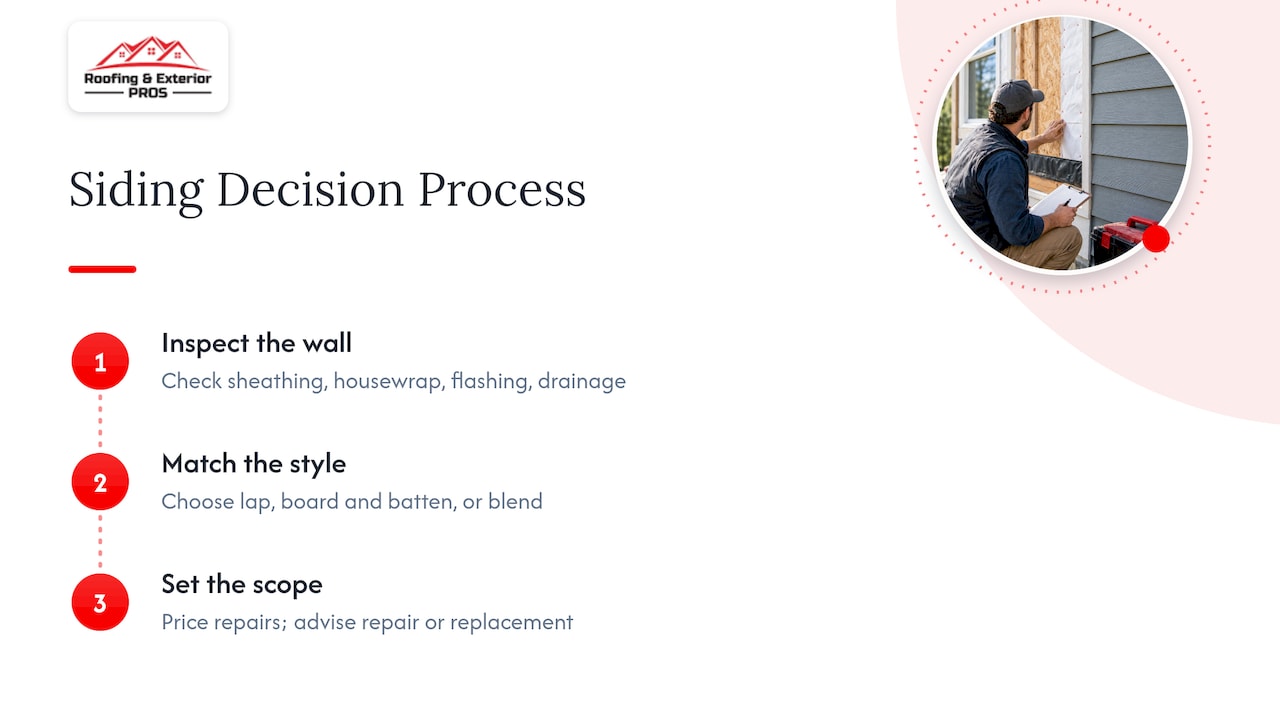
Then we match the style to the house. For most traditional homes in our service area, lap siding is the sensible, cost-conscious choice. For a gable, a porch or a farmhouse-style design, board and batten adds character that is worth the extra cost. We often suggest a blend of the two, with colors chosen from samples seen in real light.
We will give you a clear written scope and an honest answer on whether repair or replacement makes sense. Our guide on repairing or replacing siding explains the signs we look for.
— Jake Ehlinger
How to choose: a short checklist
- Check your walls first. Have a contractor inspect for moisture damage, flashing problems and sheathing condition.
- Decide where the style belongs. Whole house, gable only, or an accent area.
- Choose the material. Vinyl, fiber cement, engineered wood or wood. Material usually drives cost and upkeep more than profile.
- Get samples. Look at them on your own wall, in morning and evening light, next to your brick, roof and trim.
- Ask what is included. Housewrap, flashing, trim, removal of old siding and disposal should be itemized.
- Plan the upkeep. Our siding maintenance guide for Missouri homes lays out a seasonal routine.
- Think about curb appeal and resale. Our piece on the best siding for curb appeal helps weigh the options.
Siding help from our team
If you are comparing lap, board and batten, or a mix of both, we offer free inspections and quotes for homeowners and business owners across the St. Louis area, from St. Charles and Wentzville to Creve Coeur, Ballwin and Wildwood. We handle siding installation and repair, and we can also look at the gutters, fascia and soffit that protect your new walls. Contact us through Roofing & Exterior PROS to schedule an inspection.
FAQ
Which is cheaper, board and batten or lap siding?
Lap siding is usually cheaper in the same material. Board and batten takes more layout work, more pieces and often added framing for fastening. Switching materials can change the picture, since fiber cement can cost less to install than wood.
Is vertical siding better than horizontal?
Neither is better in every case. Horizontal lap is the traditional choice and suits most house styles. Vertical board and batten adds height and texture and works well on gables and farmhouse designs. Both perform well when the barrier and flashing behind them are done right.
Can I mix lap and board and batten on the same house?
Yes, and it often looks good. Keep colors in the same family, break the two styles at a natural line such as a gable or a change in plane, and test samples on the wall. Using lap on the main walls and board and batten as an accent is the most common approach.
Does board and batten hold up in Missouri weather?
Yes, when it is made for vertical use and installed correctly, with sealed board ends, proper flashing and a sound drainage plane. Fiber cement and quality vinyl both work in our climate. Poor flashing causes more failures than the style itself.
Do I need a permit to replace siding in St. Louis?
Replacing siding with like materials without structural change usually does not need one, but rules vary by city and county, and historic districts have their own. Check with your local building department before you start.
Sources
- James Hardie: Hardie Plank lap siding
- James Hardie: Hardie panel siding with trim batten
- Today’s Homeowner: Lap siding vs board and batten
- NOAA Storm Prediction Center: St. Louis climatology
- Building Science Education: Water-managed walls
- NAHB: Wind resistant exterior cladding
- NAHB: Concrete homes technology brief No. 15
- NAHB
- Property Insurance Coverage Law Blog: Insurance bulletins
- Missouri DCI: Severe weather resources
- City of St. Louis: Residential permit criteria