TL;DR:
- Choosing the appropriate roofing material is crucial for long-term performance and cost-efficiency in commercial buildings.
- Proper installation and system integration outweigh the importance of membrane choice alone, with maintenance playing a significant role in lifespan.
Choosing the wrong roofing material for a commercial building is an expensive mistake that plays out slowly over years of leaks, repairs, and premature replacement. A thorough commercial roofing materials comparison is not just about price per square foot. It requires weighing lifespan, energy performance, installation method, and how well a material suits your specific building. This guide breaks down the four most widely used commercial roofing systems, TPO, EPDM, PVC, and Modified Bitumen, with honest pros, cons, and a side-by-side comparison to help you make a confident, informed decision.
Table of Contents
- Key takeaways
- 1. Key criteria for evaluating commercial roofing materials
- 2. TPO roofing: features, pros, and cons
- 3. EPDM roofing: features, pros, and cons
- 4. PVC roofing: features, pros, and cons
- 5. Modified bitumen roofing: characteristics, advantages, and limitations
- 6. Side-by-side comparison of major commercial roofing materials
- My take on what actually drives commercial roofing outcomes
- Ready to get the right roof for your building?
- FAQ
Key takeaways
| Point | Details |
|---|---|
| System matters more than membrane | Durability depends on all roof layers working together, not just the membrane you choose. |
| Upfront cost vs. lifecycle cost | Cheaper materials often cost more over time through shorter lifespans and higher maintenance. |
| Energy efficiency varies widely | Reflective membranes like TPO can reduce roof surface temperatures significantly compared to black EPDM. |
| Installation quality is decisive | Improper installation causes more premature failures than any material deficiency. |
| Match material to building use | Chemical exposure, foot traffic, and climate should drive material selection as much as budget. |
1. Key criteria for evaluating commercial roofing materials
Before comparing specific materials, you need a clear framework for what actually matters. Too many property owners focus on the membrane price alone and overlook factors that determine real-world performance.
Here are the criteria that should guide every commercial roofing materials comparison:
- Durability and lifespan: How long will the material realistically last with proper maintenance?
- Seam technology: Heat-welded seams outperform glued or taped seams in long-term leak resistance. This is a bigger differentiator than most buyers realize.
- Initial vs. lifecycle cost: A lower installed cost can be misleading if the material requires replacement in 15 years instead of 25.
- Energy efficiency: Reflective membranes reduce HVAC loads. In warm climates, this savings compounds over time.
- Maintenance requirements: Some materials need biannual inspections and coating; others are largely set-and-forget.
- Rooftop equipment compatibility: HVAC units, drains, and penetrations affect which materials install cleanly and seal reliably.
- Climate suitability: Cold climates stress seams and affect flexibility; hot climates accelerate UV degradation in some materials.
One factor that gets overlooked in most comparison guides: roof systems include multiple layers, including the structural deck, vapor barrier, insulation, cover board, membrane, flashing, and drainage. How those layers interact determines long-term performance. Choosing a premium membrane and pairing it with inadequate insulation or poor drainage is a recipe for early failure.
Pro Tip: Ask any contractor bidding your project to specify every system component, not just the membrane. If they can’t explain the full assembly, that’s a red flag.
2. TPO roofing: features, pros, and cons
Thermoplastic Polyolefin, commonly called TPO, is currently the most widely installed commercial roofing membrane in the United States. Its combination of affordability and energy performance makes it a strong choice for many building types.
TPO installed costs run $5.50 to $8.50 per square foot with a typical lifespan of 15 to 25 years, depending on membrane thickness and installation quality. One of TPO’s most significant advantages is its heat-welded seams. Unlike EPDM, which uses adhesives or tape, heat-welded seams in TPO create bonds that are often stronger than the membrane itself, which dramatically reduces seam-related leaks over time.
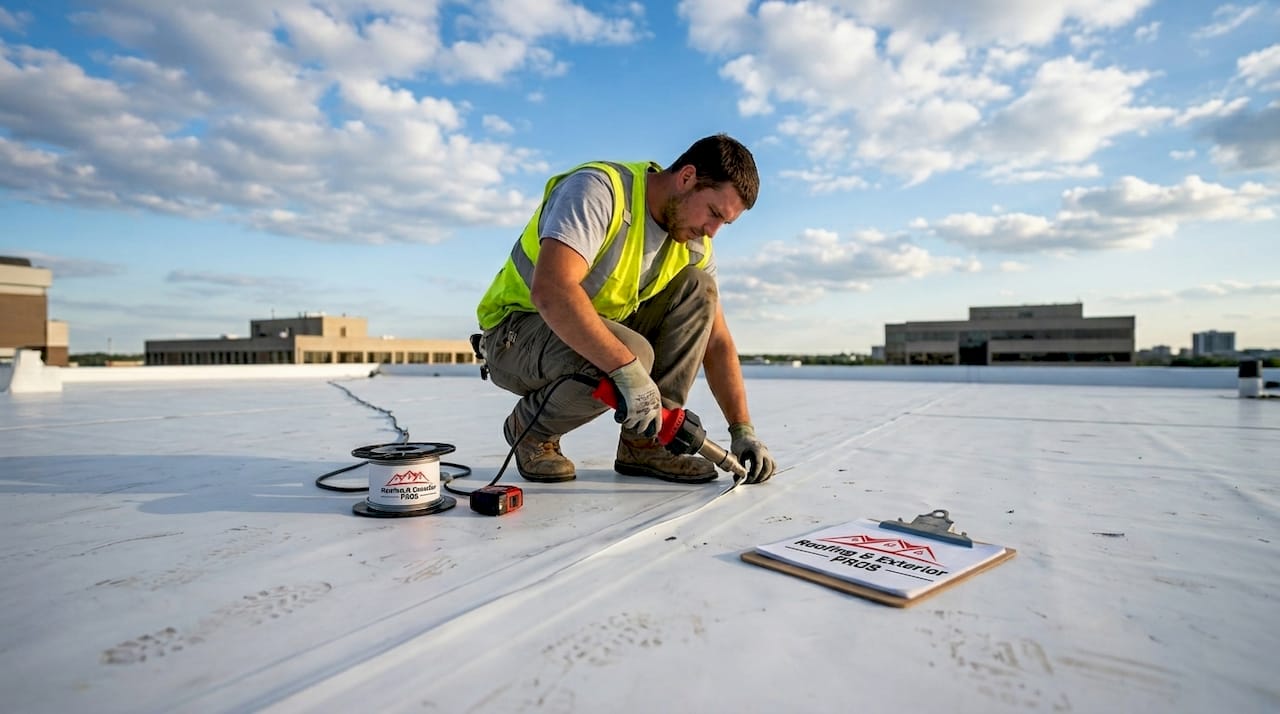
TPO’s white or light-colored surface reflects solar radiation effectively. White TPO reduces roof surface temperatures by 50 to 70°F compared to black EPDM, which translates to real reductions in cooling costs for buildings in warm climates.
Pros:
- Affordable installed cost relative to PVC
- Heat-welded seams for superior leak resistance
- Excellent reflectivity and energy savings in warm climates
- Widely available with many qualified installers
Cons:
- Quality varies significantly by manufacturer and membrane thickness
- Less chemical resistance than PVC
- Thinner membranes (45 mil) are more vulnerable to puncture under foot traffic
Pro Tip: Specify a minimum 60 mil membrane when getting bids. Thicker TPO membranes offer meaningfully better durability, especially on roofs with regular foot traffic from HVAC technicians.
For a deeper look at TPO specifications and installation considerations, the TPO roofing overview from Roofing & Exterior PROS covers what property owners in the St. Louis area need to know.
3. EPDM roofing: features, pros, and cons
Ethylene Propylene Diene Monomer, known as EPDM, is the rubber membrane that has been a commercial roofing staple for decades. Its longevity record and flexibility in cold climates give it a loyal following among facility managers in northern climates.
EPDM installed costs range from $5.00 to $8.00 per square foot with a lifespan of 20 to 30 years, which puts it on par with PVC in longevity but at a lower price point. EPDM can be installed three ways: fully adhered, mechanically fastened, or ballasted with gravel. Each method has different implications for wind uplift resistance and future repairability.
The rubber composition gives EPDM excellent flexibility in cold temperatures, making it a practical choice for buildings in regions with harsh winters. It also handles UV exposure well over time.
Pros:
- Proven track record spanning 40+ years of commercial use
- Excellent cold weather flexibility and UV resistance
- Multiple installation methods offer flexibility for different roof decks
- Cost-effective for large, simple roof areas
Cons:
- Black color absorbs heat, increasing cooling loads in warm climates
- Seams rely on adhesives or tape rather than heat welding, creating a potential vulnerability
- Ballasted installations add significant weight load to the structure
EPDM’s seam method is worth understanding carefully. While modern adhesives have improved, glued seams in EPDM remain more susceptible to failure over time compared to the heat-welded seams used in TPO and PVC. If your building has complex geometry with many penetrations and seams, that vulnerability compounds. The EPDM pros and cons breakdown from Roofing & Exterior PROS goes deeper on when EPDM makes sense and when it doesn’t.
4. PVC roofing: features, pros, and cons
Polyvinyl Chloride roofing, or PVC, sits at the premium end of the single-ply membrane market. It costs more upfront, but it earns that premium through superior chemical resistance and heat-welded seam performance that rivals TPO.
PVC installed costs run $7.00 to $12.00 per square foot with a lifespan of 20 to 30 years. The higher cost reflects both material quality and the specialized installation it requires. Like TPO, PVC uses heat-welded seams, which deliver strong, watertight bonds at every joint.
Where PVC genuinely separates itself is chemical resistance. PVC withstands grease, oils, and industrial chemicals without degrading, making it the go-to choice for restaurants, commercial kitchens, and manufacturing facilities where rooftop grease exhaust is a real concern. TPO and EPDM will break down under prolonged chemical exposure.
Pros:
- Superior chemical and grease resistance
- Heat-welded seams for excellent leak protection
- Long lifespan with proper maintenance
- Well-suited for rooftop decks and high-traffic areas
Cons:
- Highest installed cost among single-ply membranes
- PVC loses flexibility in cold climates over time as plasticizers migrate out of the membrane, which can lead to brittleness and seam cracking in northern regions
- Fewer contractors are experienced with PVC installation compared to TPO
Pro Tip: If your building has rooftop kitchen exhaust vents or grease traps, PVC is not just a preference. It’s the right call. TPO and EPDM will fail prematurely in that environment.
5. Modified bitumen roofing: characteristics, advantages, and limitations
Modified Bitumen, often called Mod Bit, is an asphalt-based system that predates single-ply membranes and still holds a meaningful share of the low-slope commercial market. It works differently from TPO, EPDM, and PVC because it is applied in multiple layers rather than as a single sheet.
Modified bitumen costs $4.50 to $8.00 per square foot with a lifespan of 15 to 20 years. The multi-layer application creates built-in redundancy. If one layer is compromised, the layers beneath it continue to provide protection, which makes repairs more forgiving and easier to localize.
Application methods include torch-applied, cold adhesive, and self-adhered. Torch-applied is the most common and creates strong bonds, but it introduces open-flame fire risk during installation, which some building owners and insurers view as a liability.
Pros:
- Multi-layer redundancy makes it forgiving on complex roof geometries
- Good performance in buildings with significant temperature swings
- Repairs are relatively straightforward and localized
- Lower entry cost compared to PVC
Cons:
- Shorter lifespan than TPO, EPDM, or PVC
- Torch-applied method carries fire risk during installation
- Heavier system adds structural load
- Less energy-efficient than reflective single-ply membranes
Mod Bit tends to work best on smaller commercial buildings, mixed-use properties, and buildings with complex roof geometry where single-ply membranes are harder to detail correctly.
6. Side-by-side comparison of major commercial roofing materials
Here is a direct comparison of the four major options to support your decision-making:
| Feature | TPO | EPDM | PVC | Modified Bitumen |
|---|---|---|---|---|
| Installed cost (per sq ft) | $5.50–$8.50 | $5.00–$8.00 | $7.00–$12.00 | $4.50–$8.00 |
| Typical lifespan | 15–25 years | 20–30 years | 20–30 years | 15–20 years |
| Seam type | Heat-welded | Adhesive/tape | Heat-welded | Torch/adhesive |
| Chemical resistance | Moderate | Low | High | Moderate |
| Energy efficiency | High (reflective) | Low (dark) | High (reflective) | Low to moderate |
| Cold climate performance | Good | Excellent | Moderate | Good |
| Best use case | General commercial, budget-conscious | Large roofs, cold climates | Restaurants, chemical exposure | Complex geometry, small commercial |
The table makes the tradeoffs clear, but it does not capture everything. Attachment method, flashing details, and contractor expertise all significantly affect which failure modes you will encounter over the life of the roof. A well-installed EPDM roof will outperform a poorly installed PVC roof every time.
For property owners weighing longer-term investments, metal roofing can last 40 or more years with low maintenance, though the upfront cost is substantially higher. The metal roof vs. shingles comparison from Roofing & Exterior PROS covers that decision in detail for property owners considering the full range of options.
My take on what actually drives commercial roofing outcomes
I’ve reviewed enough commercial roofing projects to say this with confidence: the material choice matters less than most property owners think. What matters more is whether the contractor understands the full roofing system and installs it correctly.
Deferred maintenance and improper installation cause premature failures more often than any base material deficiency. I’ve seen 10-year-old TPO roofs in excellent shape and 5-year-old PVC roofs already leaking at the seams because the contractor cut corners on flashing details. The membrane brand on the spec sheet means very little if the installation is sloppy.
The other thing I’d push back on is the instinct to minimize upfront cost. A $2.00 per square foot savings on a 20,000-square-foot roof sounds significant, but if that choice shaves five years off the lifespan, you are paying for a full replacement cycle sooner than you should. Maintenance delays cause up to 75% of premature commercial roof failures, which means a consistent inspection and maintenance schedule is one of the highest-return investments you can make after installation.
My honest recommendation: use this comparison to narrow your options to two or three materials that fit your building’s use, climate, and budget. Then spend your energy finding a contractor with documented experience installing that specific system. That combination will serve you better than any single material decision made in isolation.
— Jake
Ready to get the right roof for your building?
Understanding the differences between roofing materials is a strong start, but translating that knowledge into the right decision for your specific building takes hands-on expertise. At Roofing & Exterior PROS, we work closely with property owners and facility managers across the St. Louis area to assess building conditions, recommend the right system, and install it with the quality that makes those lifespan numbers realistic rather than theoretical.
Whether you are planning a new installation, facing a repair decision, or simply want a professional assessment of your current roof’s condition, our team is ready to help. We offer free inspections with no pressure and no guesswork. Reach out to Roofing & Exterior PROS to schedule your consultation, or explore our commercial roofing services to see the full range of what we offer. You can also review our completed projects to see the quality of work we deliver for businesses like yours.
FAQ
What is the most cost-effective commercial roofing material?
TPO offers the best balance of upfront cost and performance for most commercial buildings, with installed costs of $5.50 to $8.50 per square foot and a lifespan of 15 to 25 years. EPDM is comparable in cost and offers a longer lifespan in cold climates.
How long does a commercial flat roof typically last?
Lifespan depends on material and maintenance. EPDM and PVC can last 20 to 30 years, TPO typically lasts 15 to 25 years, and Modified Bitumen runs 15 to 20 years. Consistent maintenance and proper installation are the biggest factors in reaching those upper ranges.
Which roofing material is best for restaurants or buildings with grease exhaust?
PVC is the clear choice for buildings with rooftop grease exposure. It resists chemical degradation from oils and grease where TPO and EPDM will break down prematurely.
Does roofing material affect energy costs?
Yes, significantly. Reflective membranes like TPO and PVC reduce roof surface temperatures by 50 to 70°F compared to black EPDM, which directly lowers cooling costs in warm climates and reduces HVAC system strain year-round.
How often should a commercial roof be inspected?
Most commercial roofing manufacturers and contractors recommend biannual inspections, typically in spring and fall, plus an inspection after any major storm. Staying on that schedule is one of the most effective ways to catch small issues before they become costly failures.